

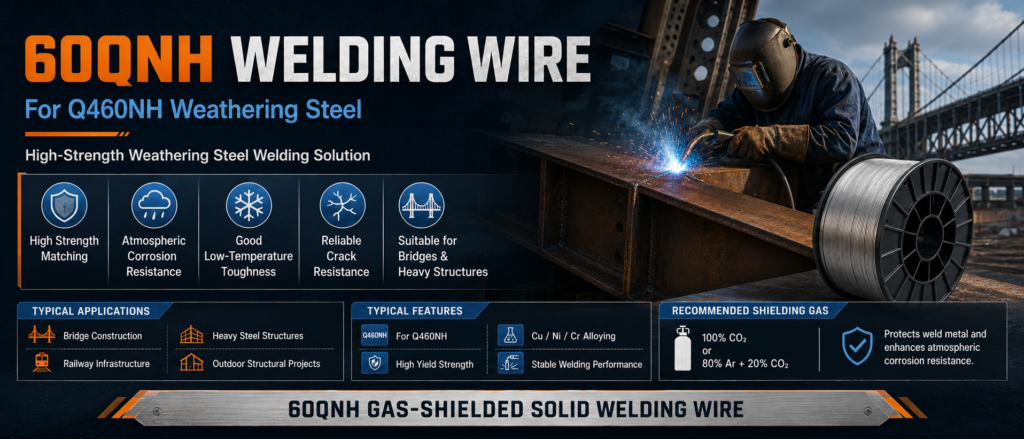
60QNH Welding Wire for Q460NH Weathering Steel: Properties, Applications and Welding Guide
Weathering steel has become an important material choice for bridges, heavy structures, railway equipment, and outdoor infrastructure because of its combination of strength, durability, and atmospheric corrosion resistance.60QNH
As structural requirements continue to increase, higher-strength weathering steels such as Q460NH are increasingly used in demanding applications where conventional structural steels may not provide sufficient load-bearing capability.
However, the performance of a weathering steel structure depends not only on the base metal. The welded joints must also provide suitable strength, toughness, corrosion resistance, and long-term reliability.
This is why selecting the correct welding wire is essential.
60QNH welding wire is designed for welding high-strength weathering steels and is commonly associated with applications involving Q460NH weathering steel. With a carefully controlled alloy system containing elements such as copper, nickel, and chromium, 60QNH provides a balance of mechanical performance, atmospheric corrosion resistance, and welding reliability.
This article explains why 60QNH welding wire is used for Q460NH weathering steel, its advantages, applications, properties, and important welding considerations.
What Is 60QNH Welding Wire?
60QNH is a low-alloy gas-shielded solid welding wire developed for weathering-resistant structural steels.
It belongs to the high-strength weathering steel welding wire category and is commonly classified as:
GB/T 8110 ER60-G
The deposited weld metal is designed to provide:
High tensile strength
High yield strength
Good impact toughness
Atmospheric corrosion resistance
Good crack resistance
Stable welding performance
Compared with general carbon steel welding wires, 60QNH contains additional alloying elements that help improve the durability of exposed welded structures.
Typical alloying elements include:
Copper (Cu)
Nickel (Ni)
Chromium (Cr)
Manganese (Mn)
Silicon (Si)
These elements work together to improve the corrosion behavior and mechanical performance of the weld metal.
What Is Q460NH Weathering Steel?
Q460NH is a high-strength weathering structural steel designed for applications requiring both high load capacity and atmospheric corrosion resistance.
The designation generally indicates:
Q: Yield strength classification
460: Approximately 460 MPa yield strength level
NH: Weathering-resistant steel
Compared with lower-strength weathering steels such as Q355NH, Q460NH provides higher structural strength.
It is commonly used in:
Large bridges
Heavy steel structures
Railway infrastructure
High-load outdoor components
Transportation structures
Industrial frameworks
Because Q460NH is a higher-strength steel, the welding consumable must provide sufficient mechanical properties to avoid creating a weak point in the welded joint.
Why Use 60QNH Welding Wire for Q460NH Steel?
The primary reason for selecting 60QNH welding wire for Q460NH steel is strength matching and durability compatibility.
A welded structure is only as reliable as its weakest component.
If the base metal has high strength but the weld metal has insufficient performance, the joint may become the limiting factor.
60QNH helps address this challenge through several advantages.
1. High Strength Matching for Q460NH Weathering Steel
The most important advantage of 60QNH is its higher strength level.
Typical mechanical performance includes:
| Property | Typical Requirement |
|---|---|
| Tensile Strength | ≥600 MPa |
| Yield Strength | ≥500 MPa |
| Elongation | ≥18% |
| Impact Toughness | High low-temperature toughness |
Compared with 50QNH and 55QNH, 60QNH is designed for higher-strength weathering steel applications.
A simplified comparison:
| Welding Wire | Typical Matching Steel | Strength Level |
|---|---|---|
| 50QNH | Q355NH | Medium strength |
| 55QNH | Q420NH | Higher strength |
| 60QNH | Q460NH | High strength |
This makes 60QNH particularly suitable when structural design requires higher load-bearing capability.
2. Excellent Atmospheric Corrosion Resistance
Weathering steel is designed to resist atmospheric corrosion through the formation of a stable protective oxide layer.
However, welded areas must also maintain appropriate corrosion performance.
60QNH contains weather-resistant alloying elements including:
Copper (Cu)
Copper contributes to atmospheric corrosion resistance and helps improve the stability of corrosion products formed during outdoor exposure.
Chromium (Cr)
Chromium improves corrosion resistance and contributes to protective oxide formation.
Nickel (Ni)
Nickel helps improve toughness and corrosion performance, especially under demanding environmental conditions.
The combination of these elements helps 60QNH weld metal better match the characteristics of weathering steel structures.
3. Designed for High-Strength Bridge Applications
One of the most important applications of Q460NH weathering steel is bridge construction.
Modern bridges require:
High load capacity
Long service life
Reduced maintenance
Resistance to outdoor exposure
Reliable welded connections
60QNH welding wire can be used for suitable Q460NH bridge components, including:
Main girders
Steel beams
Structural joints
Reinforcement sections
Bridge frameworks
Heavy connection components
For exposed bridges, selecting a compatible welding wire is important because weld areas must maintain both structural and corrosion performance.
4. Improved Low-Temperature Toughness
Many bridges and outdoor structures operate in cold regions.
Low temperatures can reduce the toughness of steel materials and increase the risk of brittle fracture.
Therefore, welding wire for high-strength weathering steel must provide good impact performance.
60QNH is designed to maintain reliable toughness under low-temperature conditions.
This makes it suitable for applications involving:
Northern climates
Railway structures
Outdoor industrial facilities
Heavy infrastructure projects
5. Good Crack Resistance
High-strength steel welding requires careful control of cracking risks.
Potential cracking problems include:
Hydrogen-induced cracking
Cold cracking
Weld metal cracking
Heat-affected zone cracking
60QNH helps reduce cracking risks through:
Controlled chemical composition
Suitable alloy design
Good weld metal toughness
Stable welding performance
However, welding quality still depends on:
Preheating
Hydrogen control
Heat input
Welding parameters
Joint preparation
Interpass temperature
The welding wire alone cannot magically defeat bad welding practices. Metallurgy remains stubbornly uninterested in shortcuts.
6. Suitable for Outdoor Steel Structures
Q460NH weathering steel is used in many outdoor applications where strength and corrosion resistance are required.
Typical 60QNH applications include:
Bridge Construction
Highway bridges
Railway bridges
Large-span structures
Heavy Steel Structures
Industrial frameworks
Support structures
Outdoor platforms
Transportation Equipment
Railway vehicles
Heavy transport structures
Infrastructure Projects
Towers
Large steel components
Long-life outdoor installations
60QNH vs 55QNH Welding Wire
The main difference between 60QNH and 55QNH is strength level.
| Feature | 55QNH | 60QNH |
|---|---|---|
| Typical Steel Match | Q420NH | Q460NH |
| Strength Level | Higher strength | High strength |
| Yield Strength | ≥450 MPa | ≥500 MPa |
| Application | Heavy weathering structures | Higher-load structures |
| Bridge Use | Yes | Yes |
| Corrosion Resistance | Excellent | Excellent |
55QNH is suitable for many high-strength weathering steels, while 60QNH is selected when even higher mechanical performance is required.
60QNH vs 50QNH Welding Wire
The difference is more significant.
| Feature | 50QNH | 60QNH |
|---|---|---|
| Typical Steel Match | Q355NH | Q460NH |
| Yield Strength Level | Medium | High |
| Structural Application | General weathering steel | High-load weathering steel |
| Strength Requirement | Lower | Higher |
| Typical Use | Standard bridges | Heavy-duty structures |
Choosing between them depends mainly on the base steel grade and engineering requirements.
Chemical Composition of 60QNH Welding Wire
The alloy design of 60QNH focuses on achieving both strength and weather resistance.
Typical elements include:
| Element | Function |
|---|---|
| Carbon | Controls strength and hardness |
| Manganese | Improves strength and deoxidation |
| Silicon | Improves weld quality |
| Copper | Atmospheric corrosion resistance |
| Nickel | Toughness improvement |
| Chromium | Corrosion resistance |
The balance of these elements allows 60QNH to provide reliable weld performance for weathering steel structures.
Welding Applications of 60QNH
60QNH Bridge Fabrication
Large bridges require welding consumables capable of handling:
High structural loads
Fatigue conditions
Temperature changes
Outdoor exposure
60QNH provides a suitable option for high-strength weathering steel bridge fabrication.
Railway Infrastructure
Railway structures experience:
Repeated loading
Vibration
Weather exposure
Temperature variation
High-strength weathering steel combined with suitable welding wire can improve long-term durability.
60QNH Heavy Industrial Structures
Applications include:
Large support frames
Outdoor steel equipment
Heavy structural assemblies
The combination of strength and corrosion resistance makes 60QNH useful for demanding environments.
60QNH Welding Parameters
Typical welding parameters depend on:
Wire diameter
Base material thickness
Joint design
Welding position
Shielding gas
Heat input requirements
Common wire diameters include:
0.8 mm
1.0 mm
1.2 mm
1.6 mm
Typical considerations:
Welding Current
Higher current may be required for thicker materials.
Voltage
Voltage affects:
Arc stability
Weld shape
Penetration
60QNH Travel Speed
Incorrect travel speed may cause:
Lack of fusion
Excessive reinforcement
Poor bead appearance
60QNH Heat Input Control
High-strength weathering steel requires careful heat input management to maintain weld performance.
60QNH Important Welding Considerations for Q460NH
1. Control Hydrogen
Hydrogen control is critical for high-strength steel.
Recommended practices include:
Dry welding consumables
Clean joint surfaces
Proper shielding
Controlled storage conditions
2. Control Preheat and Interpass Temperature
High-strength steels may require controlled thermal conditions.
Incorrect temperature control may affect:
Weld toughness
Microstructure
Crack resistance
3. Proper Joint Preparation
Before welding:
Remove oil
Remove moisture
Clean rust and contamination
Ensure correct joint geometry
4. Follow Qualified Welding Procedures
Important variables include:
Welding wire classification
Shielding gas
Current
Voltage
Heat input
Welding sequence
A qualified welding procedure should always guide production welding.
Common Problems When Welding Q460NH with 60QNH
Porosity
Possible causes:
Poor shielding gas protection
Contamination
Moisture
Incorrect welding technique
Cracking
Possible causes:
Excessive restraint
Hydrogen
Improper heat control
Incorrect welding parameters
Insufficient Strength
Possible causes:
Wrong filler selection
Incorrect heat input
Poor welding procedure
How to Select 60QNH Welding Wire?
Choose 60QNH when:
The base steel is Q460NH or similar high-strength weathering steel
High yield strength is required
The structure carries heavy loads
Outdoor corrosion resistance is important
Long service life is required
Do not select welding wire only by strength value.
The correct choice depends on:
Base material
Structural requirements
Environmental conditions
Welding procedure
Inspection standards
60QNH Conclusion
60QNH welding wire is designed for high-strength weathering steel applications where both mechanical performance and atmospheric corrosion resistance are required.
For Q460NH weathering steel, selecting an appropriate welding wire is essential because the welded joint must maintain the strength, toughness, and durability of the base material.
The main advantages of 60QNH include:
High strength matching
Excellent weather resistance
Good low-temperature toughness
Strong crack resistance
Reliable welding performance
Suitability for bridges and heavy structures
Compared with 50QNH and 55QNH, 60QNH is positioned for higher-strength weathering steel applications.
When welding Q460NH structures, the combination of correct filler metal selection, controlled welding parameters, and qualified procedures helps achieve long-lasting and reliable welded structures.