
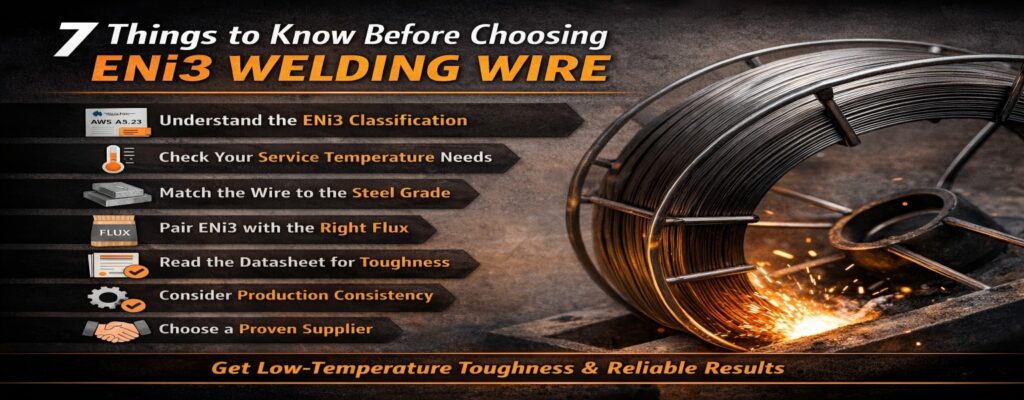
7 Things to Know Before Choosing ENi3 Welding Wire
Choosing welding consumables for low-temperature service is never just a purchasing decision. It is a performance decision, a quality decision, and in many projects, a safety decision. That is especially true when the filler metal under consideration is ENi3 welding wire.
On paper, ENi3 may look like just another low-alloy submerged arc wire. In practice, it is often selected for applications where weld metal toughness matters far more than a simple strength number on a datasheet. Tanks, pressure vessels, low-temperature piping, and process equipment do not forgive the wrong filler choice. If the weld metal cannot maintain adequate impact performance in service, the cost of rework can be much higher than the price difference between consumables.
That is why buyers, welding engineers, and fabricators need to look beyond the catalog line item. The right ENi3 wire is not simply the one that matches a standard. It is the one that fits the steel grade, the flux system, the service temperature, the code requirements, and the realities of production.
Here are seven things that matter before you choose.
1. Know what ENi3 actually is
The first mistake many buyers make is assuming ENi3 is a broad generic label that can be evaluated only by price. It is not. In current manufacturer literature, ENi3 is commonly identified under AWS A5.23 for submerged arc welding and often cross-referenced with EN ISO 14171-A S2Ni3. It is generally described as a copper-coated SAW solid wire with around 3% nickel, designed to achieve strong low-temperature impact properties, especially when used with a highly basic flux. (林肯电气)
That classification matters because it tells you the wire is intended for a specific job profile. ENi3 is not a universal solution for every low-alloy steel project, and it is not chosen just because “nickel sounds tougher.” It exists because certain structures require weld metal toughness at low service temperatures, and nickel-alloyed SAW wires are one of the proven ways to get there. If you start with a correct understanding of what ENi3 is designed to do, your selection process immediately becomes more accurate.
2. Start with the service temperature, not the product brochure
A filler metal should always be selected from the service requirement backward, not from the warehouse shelf forward. ENi3 is widely marketed for low-temperature steel welding and is commonly associated with applications requiring impact toughness at very low temperatures. Official product pages and datasheets describe ENi3- or S2Ni3-type wires as suitable for low-temperature steels and, in some cases, for service down to around -100 °C to -105 °C, depending on the wire-flux combination, procedure, and project specification. (SOUTH AMERICA PORTUGUESE)
This is where many purchasing decisions go wrong. A project may say “low-temperature steel,” but that phrase alone is not specific enough. Is the required impact test temperature -20 °C, -46 °C, -60 °C, or much lower? Is the required value based on weld metal, HAZ, or both? Is the job for general cold service, or is it for cryogenic storage, LNG-related fabrication, or low-temperature process vessels? Those are not minor details. They define whether ENi3 is merely acceptable or actually the right choice.
A good selection process begins with three questions:
What is the minimum design temperature?
What impact properties must the weld metal achieve?
What test values are required by code or project specification?
If those answers are unclear, no consumable choice is truly safe.
3. Match ENi3 to the steel grade and the application
ENi3 is frequently used in fabrication sectors where low-temperature toughness is critical, including pressure vessels, storage equipment, tank construction, apparatus fabrication, and pipe manufacture. Some manufacturers also identify it for fine-grain steels and nickel-bearing steels up to around 3.5% Ni, while others reference typical low-temperature steel families used in vessel and piping work. (Subarcflux)
This gives you an important clue: ENi3 is not selected in isolation. It is selected in relation to the base material. A wire can have the right classification and still be the wrong practical choice if the steel chemistry, plate thickness, restraint condition, or code qualification path pushes the weld into a different performance window.
For example, a fabricator working on low-temperature pressure vessels may care about much more than basic tensile values. They may need confidence in notch toughness, weld metal cleanliness, crack resistance, and procedure qualification results under a specific flux combination. In that situation, the smartest question is not “Is this ENi3?” but “Has this ENi3 been proven on this type of steel, under this type of qualification requirement?”
That is a much more useful engineering question, and it often prevents expensive procurement mistakes.
4. Never evaluate the wire without the flux
One of the most overlooked truths in submerged arc welding is that wire selection alone does not determine weld performance. The wire-flux combination does. Multiple manufacturer sources explicitly state that ENi3 or S2Ni3 wires are intended to deliver their low-temperature performance in combination with a basic or highly basic flux. (林肯电气)
That means the buyer who compares only wire prices is not really comparing welding systems. Flux basicity, hydrogen behavior, slag detachability, alloy pickup or burn-off behavior, and weld metal cleanliness can all influence the final result. A wire that looks excellent on paper can disappoint in production if it is paired with the wrong flux or used under conditions that were never validated.
This is why serious ENi3 selection should always include questions such as:
Which flux was used to achieve the published impact values?
Were the test results generated with single-wire SAW, tandem SAW, or another setup?
What heat input window was used?
Was post-weld heat treatment part of the test condition?
If a supplier cannot clearly explain the recommended wire-flux pairing, you do not yet have enough information to make a confident selection.
5. Read the datasheet for toughness, not just tensile strength
A surprising number of buyers scan only the top half of a datasheet. They look at classification, packaging, and maybe tensile strength, then move on. For ENi3, that is not enough.
The real value of this type of wire is usually tied to low-temperature impact performance, chemical consistency, and suitability for a specific application window. Official descriptions repeatedly emphasize the nickel content and low-temperature toughness objective rather than promoting ENi3 as a general-purpose high-strength wire. (林肯电气送货)
When reviewing a datasheet or technical offer, pay close attention to:
typical nickel content and chemistry tolerance
impact test temperature and absorbed energy values
recommended flux pairing
base metal application range
approval status, if relevant to your market
packaging integrity and storage guidance
whether published values are “as welded” or tied to specific conditions
A professional buyer does not just ask, “Does it meet the standard?” A professional buyer asks, “Under what conditions did it meet the standard, and are those conditions close to my production reality?”
That is where good welding decisions are made.
6. Think about production consistency, not just lab performance
A wire can pass qualification and still create trouble on the shop floor. That is because real production depends on consistency: arc stability, copper coating quality, feed reliability, cast and helix control, surface cleanliness, and lot-to-lot chemistry stability.
Manufacturers frequently promote ENi3-type SAW wires as copper-coated products intended for stable welding performance, and that is not a minor sales point. In submerged arc welding, production efficiency and repeatability matter. If wire feeding is erratic, if surface condition varies, or if chemistry control drifts, the result may be unstable penetration, excess rework, or unexpected qualification risk. (林肯电气送货)
This is why the best buying decisions often come from combining engineering review with practical shop-floor feedback. Ask your welding team what they actually need from the wire in daily operation. Easy feeding, predictable slag behavior, repeatable bead shape, and stable mechanical results are not “secondary benefits.” They are part of total cost.
Cheap consumables often become expensive only after they enter production.
7. Choose a supplier that can prove suitability, not just quote a standard
The last and most important point is this: buying ENi3 should not be treated as a commodity-only transaction.
A serious supplier should be able to provide more than a classification line. They should be able to explain the intended application range, recommend suitable flux combinations, provide technical documentation, and discuss how the wire performs under realistic fabrication conditions. Product literature across major manufacturers consistently presents ENi3-type wires in the context of low-temperature service, specific flux pairings, and application guidance rather than as anonymous bulk wire. (林肯电气)
That matters because your real risk is not buying the wrong name. It is buying the right name with the wrong support behind it.
If your project involves pressure vessels, cryogenic storage, low-temperature piping, or code-sensitive fabrication, ask the supplier to help answer practical questions:
What flux do you recommend with this wire?
What impact data can you share?
Which projects or steel grades is this wire commonly used on?
What certificates and traceability documents are available?
How stable is performance across batches?
The more confidently a supplier can answer those questions, the lower your project risk usually becomes.
Final thoughts
ENi3 welding wire is not difficult to buy. Buying the right ENi3 welding wire is a different matter.
When low-temperature toughness is part of the design requirement, wire selection needs to be treated as part of the welding engineering process, not just procurement. Classification matters. Nickel content matters. Flux pairing matters. Base metal matching matters. Procedure context matters. And supplier capability matters.
The smartest buyers understand that weld quality starts long before the arc is struck. It begins with what the welder is given to work with.
If you choose ENi3 with that mindset, you are far more likely to get stable welding performance, smoother qualification, and fewer surprises in production.