
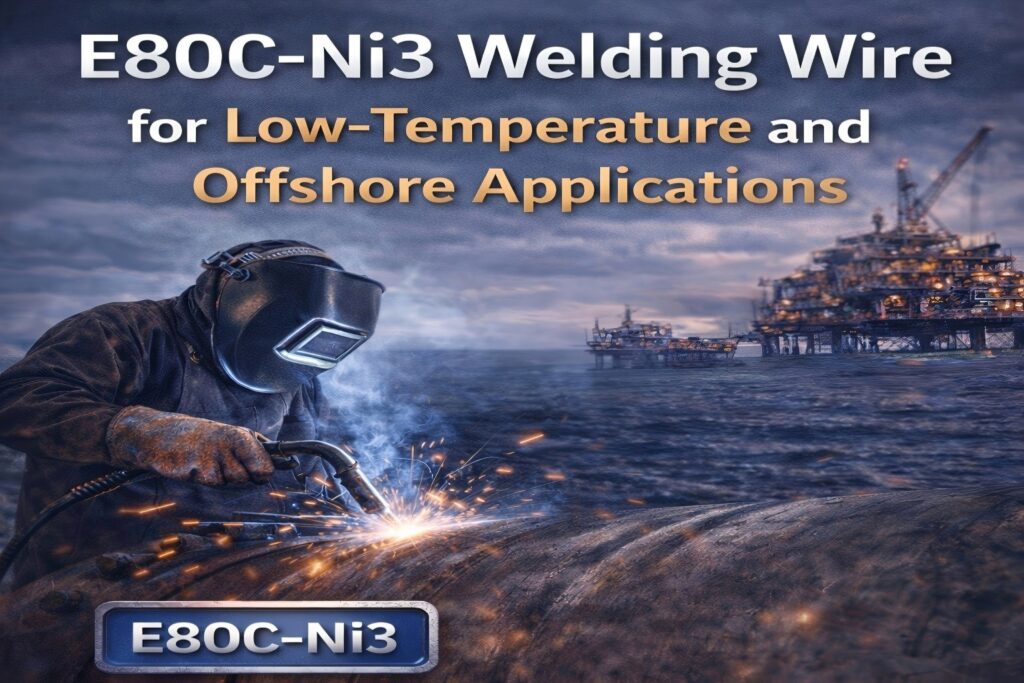
E80C-Ni3 Welding Wire for Low-Temperature and Offshore Applications
In offshore platforms, arctic structures, and heavy-duty fabrication, welding materials must withstand extreme environments. Strength alone is not enough — impact toughness at subzero temperatures is critical.E80C-Ni3.
E80C-Ni3 metal-cored welding wire is specifically designed for high-strength structural applications requiring superior low-temperature performance. For projects operating in harsh climates, selecting the right consumable can directly impact safety, durability, and compliance success.
Click to view product data information:https://www.akweld.com/wp-content/uploads/2026/02/E80C-Ni3.pdf
E80C-Ni3 Why Low-Temperature Toughness Matters
At low temperatures, steel becomes more susceptible to brittle fracture. Without sufficient impact resistance, welded joints may fail under dynamic loads or stress concentration.
E80C-Ni3 contains approximately 3% Nickel, significantly improving:
Charpy V-notch impact toughness
Crack resistance under dynamic loading
Microstructural stability in cold service
Resistance to brittle fracture
Compared with lower nickel grades, Ni3 classification provides enhanced toughness at temperatures as low as -40°C or below, depending on project specifications.
For offshore and northern climate projects, this added margin of safety is essential.
E80C-Ni3 Classification and Mechanical Performance
E80C-Ni3 is classified under AWS A5.28 for low-alloy steel electrodes for gas-shielded arc welding.
Typical mechanical characteristics include:
Minimum tensile strength: 80 ksi (550 MPa)
High yield strength
Excellent elongation
Strong impact performance at subzero temperatures
The metal-cored design also provides improved deposition efficiency and smooth arc characteristics compared to solid wire.
E80C-Ni3 Key Advantages in Harsh Environments
1️⃣ Superior Impact Toughness
Nickel-enhanced weld metal maintains ductility and absorbs energy under impact loading, reducing fracture risk.
2️⃣ Reliable Performance in Offshore Structures
Marine structures experience cyclic loading, wind forces, and temperature fluctuations. E80C-Ni3 helps maintain long-term weld integrity.
3️⃣ Higher Productivity for Heavy Fabrication
Metal-cored wire allows:
Higher deposition rates
Reduced spatter
Stable arc performance
Cleaner weld profiles
For large offshore modules or heavy machinery, improved efficiency reduces overall fabrication cost.
4️⃣ Compliance Support for International Projects
Projects referencing AWS or international engineering standards require certified welding consumables. Properly documented E80C-Ni3 supports:
WPS alignment
Third-party inspection approval
Full batch traceability
Reduced audit risk
Typical Applications
E80C-Ni3 is widely used in:
Offshore oil & gas platforms
Arctic structural fabrication
Shipbuilding and marine structures
Heavy construction equipment
Bridges and high-strength steel frameworks
Low-temperature service vessels
Where environmental conditions are severe, Ni3 alloy content provides added reliability.
Choosing the Right Supplier
For critical projects, performance data must be backed by documentation.
A qualified supplier should provide:
Mill Test Certificates (MTC)
Chemical composition reports
Mechanical and impact test data
Traceability documentation
Technical support for WPS qualification
In global engineering markets, compliance transparency builds trust and reduces project risk.
Conclusion
E80C-Ni3 is more than a high-strength welding wire — it is a strategic solution for low-temperature and offshore fabrication.
Its 3% nickel content enhances impact toughness, reduces brittle fracture risk, and supports compliance with demanding engineering standards.
For projects where safety, durability, and certification matter, selecting E80C-Ni3 provides measurable advantages.
If your offshore or cold-climate projects require certified high-toughness welding consumables, feel free to connect and discuss your technical requirements.