
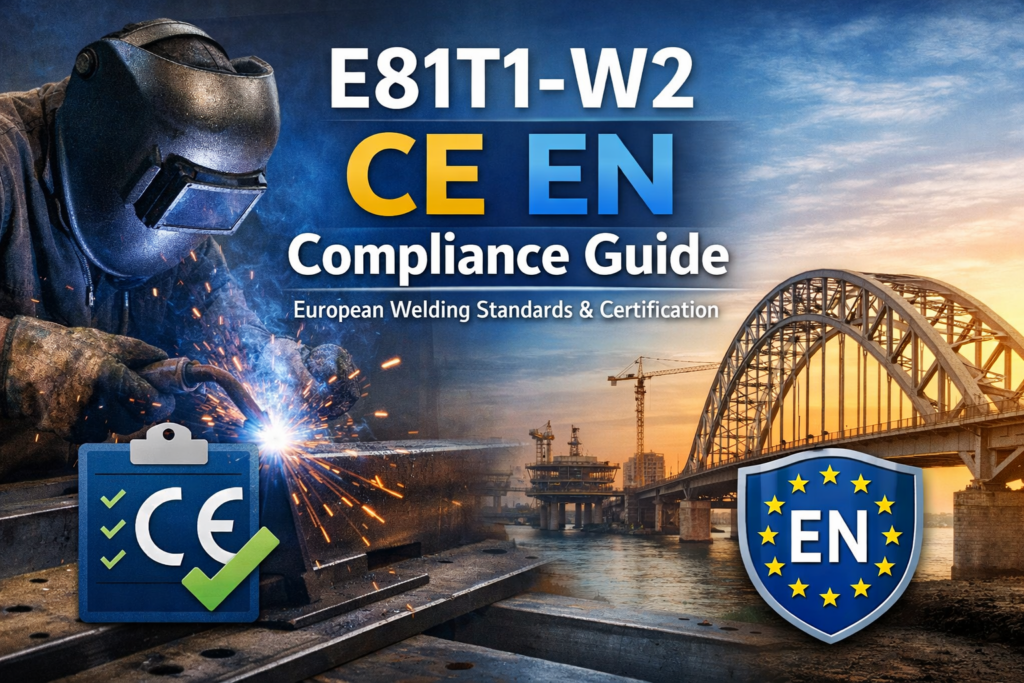
CE and EN Compliance Guide for E81T1-W2 Welding Consumables
Your Complete Resource for European Structural and Weathering Steel Projects.E81T1-W2
Introduction — Why Compliance Matters in Europe
In the European fabrication and construction industry, welding consumable compliance is no longer optional — it’s a legal and contractual requirement.
Whether you are sourcing welding wire for bridges, infrastructure, or offshore weathering steel projects, E81T1-W2 flux cored wire must meet stringent European standards and certification expectations.
European end-users and contractors demand CE compliance, adherence to EN ISO standards, and documentation that proves consistency, traceability, and performance. Ignoring compliance risks project delays, failed inspections, and lost business opportunities.
This guide covers everything you need to know about CE and EN compliance for E81T1-W2 — from classification to certificates — in a straightforward, practical format.
1. Understanding E81T1-W2 and Its Typical Uses
E81T1-W2 is a flux cored welding wire designed for welding weathering steels and high-strength structural steels. It is widely used in:
Bridge fabrication
Structural steel construction
Weathering steel components
Coastal and offshore installations
Although originally defined under AWS classification (A5.29), European buyers require documentation and compliance under EN ISO standards.
2. E81T1-W2 EN ISO Standards Applicable to E81T1-W2
In Europe, welding consumables must conform to standards published or endorsed by the CEN.
The most relevant standards for flux cored wires include:
EN ISO 17632 — Flux Cored Wires for Non-Alloy and Fine Grain Steels
This standard defines:
Classification symbols and chemical limits
Mechanical property requirements
Impact toughness values
Hydrogen control requirements
For E81T1-W2 to be accepted in European projects, it must be validated to at least the minimum requirements under EN ISO 17632.
3. E81T1-W2 CE Compliance and the Role of the European Union
The European Commission regulates several directives that apply to welding consumables when used in structural and pressure applications.
Key Compliance Drivers:
CE Marking (Construction Products Regulation)
PED 2014/68/EU (Pressure Equipment Directive)
Machinery Directive 2006/42/EC (when applicable)
Although welding consumables themselves are not always CE-marked products, CE-related compliance documentation is often required by end-users and EPC contractors.
4. E81T-W2 Essential Compliance Documents and Certificates
European buyers expect the following documentation for E81T1-W2:
✔ EN 10204 – 3.1 Material Test Certificate
A 3.1 certificate must be issued by the manufacturer’s authorized inspection body and:
Validate chemical composition
Validate mechanical properties
Include heat/lot traceability numbers
Without a 3.1 certificate, European procurement teams frequently reject material at customs or pre-bid qualification stages.
✔ Declaration of Conformity (if applicable)
For projects that require CE-related conformity assessments.
✔ Impact Test Reports
For structural and weathering steels, toughness at specified temperatures (e.g., -20°C, -40°C) is commonly required.
✔ Hydrogen Control Records
To prove low diffusible hydrogen levels comply with EN limits.
5. E81T1-W2 Why Traceability and Batch Control Are Vital
Europe holds traceability to high standards. Welding consumables must be:
Identified by heat/batch number
Linked to test reports
Traceable back to manufacturing records
This is a non-negotiable requirement for most European fabrication standards, including bridge fabrication and offshore structural projects.
6. E81T1-W2 Common Compliance Challenges and Solutions
Here are challenges exporters often face — and how to overcome them:
🚫 Missing or Incomplete Certificates
Solution: Prepare 3.1 certificates before shipment.
🚫 Unverified Chemical or Mechanical Results
Solution: Third-party testing or inspection before export.
🚫 Non-EN ISO Classification Claims
Solution: Provide equivalence documentation to EN ISO 17632.
7. How to Verify a Supplier’s Compliance Credentials
Before working with a manufacturer, European buyers should request:
✔ Official EN ISO 17632 certification (or equivalence)
✔ 3.1 Test certificates (EN 10204)
✔ Impact test results for specified temperatures
✔ Documentation traceable to batch numbers
This protects procurement teams from risk and ensures project acceptance.
8. Case Example: E81T1-W2 in European Bridge Fabrication
In recent projects across Germany and the Netherlands, E81T1-W2 supplied with full EN compliance documentation enabled:
Faster pre-qualification
Seamless customs clearance
Easier acceptance by structural engineers
Contractors reported significant time savings when documentation was complete and standardized.
Conclusion — Compliance Is Competitive Advantage
In the European welding consumable market, price alone is not enough.
CE and EN compliance — particularly for products like E81T1-W2 — is a strategic differentiator.
Procuring the right certificates and demonstrating compliance can:
✅ Shorten tender cycles
✅ Increase trust with European EPC contractors
✅ Avoid customs delays
✅ Enable repeat business
For European structural and weathering steel projects, compliance precedes purchase decisions.