

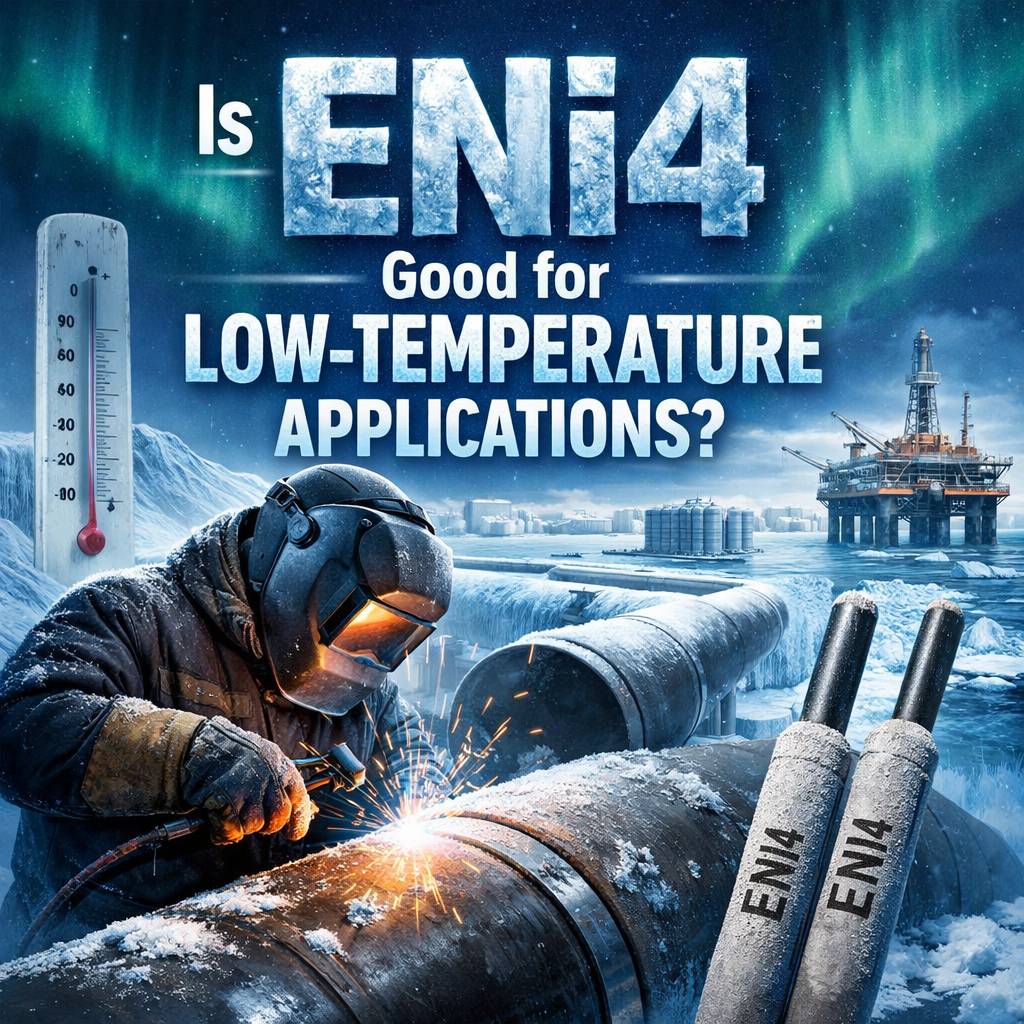
Is ENi4 Good for Low-Temperature Applications?
Low-temperature environments place extreme demands on welded structures.
Reduced impact toughness, brittle fracture risks, and high internal stresses can quickly turn an ordinary weld into a structural failure.ENi4
So the key question is:
Is ENi4 welding wire suitable for low-temperature applications?
The answer depends on mechanical properties, chemical composition, impact test requirements, and project specifications.
1️⃣ What Is ENi4?
ENi4 is a submerged arc welding (SAW) wire classified under American Welding Society AWS A5.23.
It is a nickel-containing alloy steel welding wire designed for:
Medium to high strength structural steels
Pressure vessels
Offshore structures
Heavy fabrication
The presence of nickel (Ni) improves weld metal toughness—especially important in low-temperature service.
2️⃣ Why Low Temperature Welding Is Challenging
At low temperatures:
Steel becomes less ductile
Impact toughness decreases
Risk of brittle fracture increases
Heat-affected zone (HAZ) becomes critical
For projects such as:
Offshore platforms
LNG storage tanks
Arctic structural steel
Pressure vessels
Impact toughness performance is a mandatory requirement.
3️⃣ Chemical Composition Advantage
Typical ENi4 weld metal contains:
~1.5–2.0% Nickel
Controlled carbon
Moderate manganese
Small molybdenum addition
Nickel is the key element here.
✔ Improves low-temperature toughness
✔ Reduces transition temperature
✔ Enhances crack resistance
Compared to plain carbon SAW wires, It performs significantly better in colder environments.
4️⃣ ENi4 Impact Toughness Performance
When properly paired with compatible flux and qualified welding procedures, ENi4 can achieve:
27J @ -20°C
Often acceptable values at -30°C
Depending on flux system and parameters
However, for extremely low temperatures (e.g., -50°C or below), higher nickel systems may be required.
Impact performance always depends on:
Flux selection
Welding parameters
Heat input control
Post-weld heat treatment
5️⃣ Where ENi4 Is Commonly Used in Cold Conditions
It is widely selected for:
🌊 Offshore Oil & Gas
Structural components exposed to marine climates.
🏗 Heavy Structural Fabrication
Bridges and platforms in cold regions.
🛢 Pressure Vessels
Moderate low-temperature service applications.
⚡ Power Plant Equipment
Steam and industrial structures requiring reliable toughness.
6️⃣ When ENi4 May Not Be Enough
It may not be suitable if:
Service temperature is extremely low (< -50°C)
Project requires very high CVN values
Material is high-alloy cryogenic steel
LNG cryogenic tank fabrication
In those cases, higher nickel classifications (such as 2.5% or 3.5% Ni systems) may be specified.
7️⃣ Key Factors Before Selecting ENi4
Before deciding, engineers should verify:
✔ Required impact test temperature
✔ Minimum CVN value
✔ Base material grade
✔ Project standard (ASME, EN, offshore codes)
✔ Flux-wire combination qualification
Proper PQR (Procedure Qualification Record) testing is essential.
8️⃣ Final Verdict: Is ENi4 Good for Low-Temperature Applications?
Yes — ENi4 is suitable for moderate low-temperature applications, especially when toughness requirements are around -20°C to -30°C.
Its nickel content provides:
Improved impact resistance
Reduced brittleness
Better structural reliability compared to standard carbon SAW wires
However, for extreme cryogenic conditions, higher alloy systems should be considered.
🔥 Why Fabricators Choose ENi4
✔ Balanced strength and toughness
✔ Cost-effective vs higher nickel wires
✔ Reliable for offshore and structural steel
✔ Suitable for pressure vessel projects
✔ Stable SAW performance
For heavy fabrication projects operating in cold environments, ENi4 remains a practical and proven solution.