
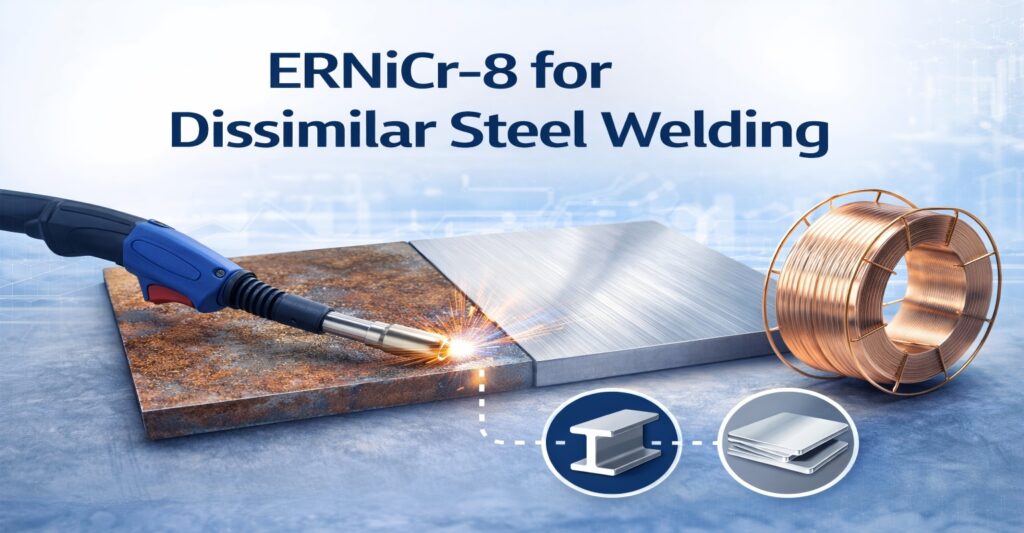
ERNiCr-8 for Dissimilar Steel Welding
Dissimilar steel welding is widely used in industries where different metals must be joined to meet performance, corrosion, or temperature requirements. In these applications, selecting the right filler metal is critical. ERNiCr-8 welding wire is a reliable choice for joining dissimilar steels because it offers excellent crack resistance, good metallurgical compatibility, and stable mechanical performance in demanding service conditions.ERNiCr-8
What Is ERNiCr-8 Welding Wire?
ERNiCr-8 is a nickel-chromium based welding wire designed for high-performance welding applications. It is commonly used when welding dissimilar metals that require strong, stable joints under thermal stress, pressure, or corrosive environments. Thanks to its nickel-rich composition, It helps reduce the risks associated with dilution, thermal expansion differences, and brittle weld structures.
This makes ERNiCr-8 especially valuable in dissimilar steel welding, where conventional filler metals may not provide enough flexibility or structural reliability.
Why Dissimilar Steel Welding Is Challenging
Welding two different steels together is never simple. Each base metal may have a different chemical composition, melting behavior, thermal conductivity, and expansion rate. These differences can lead to several problems during and after welding, including:
hot cracking and solidification cracking
residual stress caused by thermal mismatch
brittle microstructures in the weld zone
reduced corrosion resistance
lower joint durability in high-temperature service
Because of these risks, choosing a filler wire with strong metallurgical adaptability is essential. This is where ERNiCr-8 welding wire shows clear advantages.
ERNiCr-8 Advantages in Dissimilar Steel Welding
1. Excellent Crack Resistance
One of the main reasons fabricators choose ERNiCr-8 is its ability to minimize cracking in complex weld joints. Dissimilar steels often create stress concentrations during cooling, but the nickel-chromium composition of It helps maintain a more ductile and tolerant weld deposit.
2. Good Compatibility with Different Base Metals
ERNiCr-8 performs well when joining steels with different alloy contents and physical properties. It can help create a transition zone that is more stable than what might be achieved with standard stainless or carbon steel fillers.
3. Strong High-Temperature Performance
In applications involving heat, pressure, or thermal cycling, weld joints must remain stable over time. It offers good strength and oxidation resistance, making it suitable for service in elevated temperature environments.
4. Reliable Mechanical Properties
A well-made weld with ERNiCr-8 can provide dependable strength, toughness, and structural integrity. This is important in industries where failure in a dissimilar joint could lead to downtime, safety issues, or costly repairs.
5. Better Long-Term Service Reliability
When used correctly, ERNiCr-8 helps improve the service life of welded components exposed to corrosion, vibration, and temperature fluctuation. For many manufacturers, this means lower maintenance costs and better overall system performance.
Typical Applications of ERNiCr-8 Welding Wire
The application of ERNiCr-8 welding wire in dissimilar steel welding can be found in many industrial sectors. Common examples include:
Power Generation
It is used in components exposed to heat and pressure, where different steels must be joined with strong and stable welds.
Petrochemical Industry
Dissimilar joints are common in piping systems, pressure vessels, and processing equipment. ERNiCr-8 helps improve joint reliability in corrosive and high-temperature environments.
Boiler and Furnace Fabrication
Equipment used in thermal systems often requires the welding of heat-resistant steels to other alloys. ERNiCr-8 is valued for its thermal stability and crack resistance.
Repair and Maintenance
In repair welding, base metals may be mixed, aged, or difficult to identify precisely. ERNiCr-8 offers flexibility and reliability for maintenance teams handling complex joint conditions.
Heavy Industrial Equipment
Dissimilar steel welding is often needed in machinery, structural components, and process equipment that operate under mechanical and thermal stress.
Best Practices for Using ERNiCr-8
To achieve the best results, welders should combine the right filler wire with proper welding procedure control. Recommended practices include:
clean the joint thoroughly before welding
select suitable heat input and travel speed
control interpass temperature carefully
use proper joint design to reduce restraint
follow qualified welding procedures for the base materials involved
Good preparation and parameter control are just as important as filler metal selection in achieving a sound dissimilar steel weld.
Why ERNiCr-8 Is a Smart Choice
For manufacturers and distributors looking for a dependable filler metal, It provides a practical solution to one of welding’s most difficult challenges. Its balanced performance in terms of crack resistance, compatibility, and high-temperature stability makes it an excellent option for demanding dissimilar steel applications.
As more industries require complex material combinations, the role of ERNiCr-8 welding wire in dissimilar steel welding continues to grow. It is not only a technical solution, but also a way to improve reliability, reduce failure risk, and support long-term operating performance.
ERNiCr-8 Conclusion
The application of ERNiCr-8 welding wire in dissimilar steel welding is increasingly important in modern industry. When two different steels must be joined safely and effectively, It offers the metallurgical strength and flexibility needed for high-quality results. With proper welding procedures, it can help deliver durable, crack-resistant, and service-ready joints across a wide range of industries.