
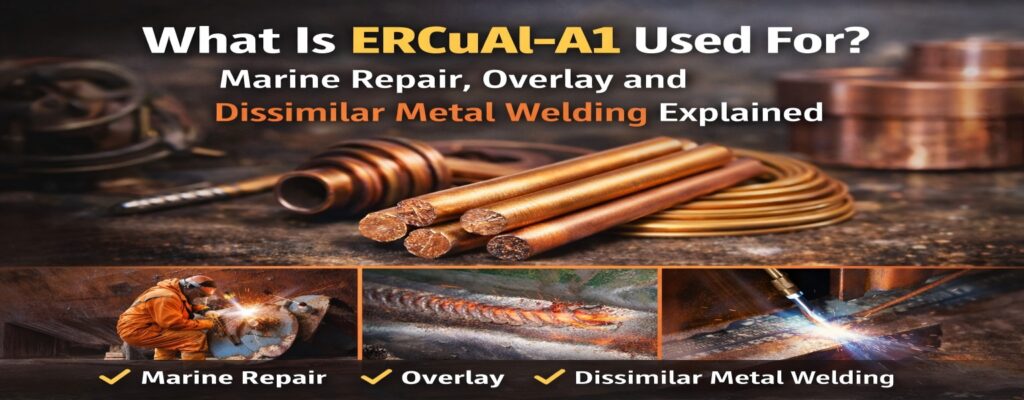
What Is ERCuAl-A1 Used For? Marine Repair, Overlay and Dissimilar Metal Welding Explained
When engineers, purchasing teams, and business leaders look at ERCuAl-A1, they are usually asking the same practical question in different ways: Where does this filler metal actually create value? The short answer is that ERCuAl-A1 is most often chosen for marine repair, corrosion-resistant overlay, wear-surface build-up, and some dissimilar-metal applications, especially where seawater resistance, anti-galling behavior, and reliable surface performance matter more than maximum joint strength. ERCuAl-A1
It is classified under AWS A5.7 / ASME SFA-5.7, and equivalent designations in current product literature include EN ISO 24373 S Cu 6100 (CuAl7).
ERCuAl-A1 is an iron-free aluminum-bronze filler metal supplied in both spooled wire and bare rod for GMAW/MIG and GTAW/TIG processes. Typical published chemistry is roughly 6.0–8.5% aluminum with copper as balance, and common deposited properties listed by suppliers include about 125 HB/BHN hardness, tensile strength around 400–469 MPa, and high elongation in the as-welded condition. Those numbers help explain why it is popular for surfacing and restoration work rather than only for simple bead deposition.
What ERCuAl-A1 Is Mainly Used For
The clearest and most consistent use case across current datasheets is overlay and cladding. North American and European product literature repeatedly positions ERCuAl-A1 as a filler for bearing surfaces, wear-resistant surfaces, build-up, and corrosion-resistant overlays. Suppliers also describe it for metalizing, surfacing on steel and cast iron, and repair of parts that need a bronze working surface without manufacturing the entire component from bronze.
A second major use case is marine repair. Aluminum bronzes are widely valued in seawater service because they combine corrosion resistance, wear resistance, and good mechanical performance. The Copper Development Association notes that aluminum bronzes often show excellent seawater corrosion resistance, can outperform many stainless steels in those environments, and are broadly used in marine components such as propellers, pumps, valves, tubesheets, and other seawater-exposed hardware. That fits closely with ERCuAl-A1 filler-metal datasheets that name parts such as impellers, valve seats, tube sheets, pickling hooks, and chemical-plant or pulp-mill equipment.
A third application area is selected dissimilar-metal welding. This is where buyers and engineers need to read the fine print. Some current supplier literature, especially in Asia, states that ERCuAl-A1 is suitable for welding carbon steel and stainless steel, butt welding steel to copper, and related machinery or shipbuilding uses. At the same time, other widely referenced datasheets explicitly say ERCuAl-A1 is not recommended for joining and is better suited to overlay because of the deposit characteristics. In real-world terms, that means ERCuAl-A1 can appear in dissimilar-metal procedures, but it should not be treated as a universal structural joining answer without application-specific procedure qualification.
Why ERCuAl-A1 Works So Well in Marine Repair
Marine service is hard on metals. Salt water, splash zones, erosion, cavitation, and intermittent contact make many standard materials fail faster than expected. Aluminum bronzes are attractive in this environment because they form a thin, adherent aluminum-oxide film that is self-healing and helps protect the surface from further attack. Industry references also describe aluminum bronze as resistant in seawater, brine, and many aggressive chemical environments, which is why the alloy family shows up again and again in pumps, valves, condensers, tubesheets, and offshore or shipboard hardware.
For ship repair yards, pump rebuilders, offshore maintenance contractors, and industrial MRO teams, that translates into a very practical benefit: repair instead of replace. If the damaged zone is localized, overlaying or rebuilding a corrosion- and wear-exposed surface with ERCuAl-A1 can preserve function, extend service life, and reduce downtime versus replacing an entire bronze or mixed-metal assembly. That is especially attractive where long lead times or expensive castings are involved. This value logic is consistent with supplier positioning of ERCuAl-A1 for impellers, valve seats, bearing surfaces, hydraulic ball bowls, chemical plants, and pulp mills.
Why ERCuAl-A1 Is Often Chosen for Overlay and Surfacing
From an engineering perspective, ERCuAl-A1 makes sense when the goal is to create a functional surface rather than to build a fully structural weldment. Current product data describes good corrosion resistance, good metal-to-metal gliding behavior, and surface hardness around 120–125 HB, all of which support its use in bearing surfaces, anti-galling surfaces, and sliding wear zones. The Copper Development Association also notes that aluminum bronzes are extensively used as metal-sprayed or weld-deposited surfacing materials, generally over steel substrates, to provide wear, corrosion, and sparking resistance.
That makes ERCuAl-A1 particularly relevant for components such as bearing seats, sleeves, valve seating areas, pump components, wear rings, hydraulic contact surfaces, and rebuilt machine parts. Instead of designing the whole part from a more expensive copper alloy, manufacturers can use a steel body and apply bronze only where its properties matter most. For CEOs and operations leaders, that can mean lower material cost, shorter sourcing cycles, and better lifecycle economics. For engineers, it means a more targeted materials strategy.
The Truth About ERCuAl-A1 in Dissimilar Metal Welding
The phrase “dissimilar metal welding” brings traffic, but it also creates confusion. With ERCuAl-A1, the safest and most accurate explanation is this: it is sometimes used in dissimilar-metal situations, but its best-supported mainstream role remains overlay and repair. Bedra’s current literature lists use on carbon steel, stainless steel, and steel-to-copper butt welding, while Pinnacle and Welding Material Sales describe the alloy as not recommended for joining and primarily intended for overlaying or metalizing.
So how should an engineer interpret that? As a selection rule, ERCuAl-A1 is strongest when the design objective is surface property enhancement or localized restoration. If the design objective is a primary load-bearing joint between difficult combinations of metals, engineers should verify the joint design, dilution, service temperature, corrosion environment, and qualification route before standardizing on A1. Current A2 product literature is informative here: ERCuAl-A2 is described by suppliers as an iron-containing aluminum-bronze wire with higher welding strength and more explicit positioning for welding aluminum bronze, other copper-based alloys, iron-based alloys, and dissimilar metals such as aluminum bronze to steel and copper to steel.
In other words, when procurement teams see both A1 and A2 in supplier catalogs, they should not treat them as interchangeable. A1 is often the better conversation for overlay, surfacing, and corrosion/wear restoration. A2 is more often marketed where joining performance and broader dissimilar-metal coverage are central requirements. That distinction matters because choosing the wrong consumable can raise rework risk, qualification cost, and field-failure exposure.
What Engineers Should Check Before Specifying ERCuAl-A1
First, confirm the service function. If the deposited metal must resist seawater, corrosion, galling, or sliding wear, ERCuAl-A1 deserves consideration. If the weld must carry high structural loads in a dissimilar-metal joint, the engineer should not assume A1 is the default answer simply because it appears in a supplier list. The mixed guidance across current product sheets is a signal to validate the application through WPS/PQR logic, not to generalize.
Second, control surface preparation and welding conditions. Voestalpine’s current technical sheet states that the weld-seam area should be cleaned to metallic bright condition by grinding, sand blasting, or pickling to avoid cracking or porosity. Published operating data also points to argon shielding, with Pinnacle listing typical GMAW spray-transfer settings and GTAW parameters for the alloy. For many shops, that means ERCuAl-A1 is operationally manageable, but it still rewards clean prep and disciplined procedure control.
Third, align the filler with the standard required by the customer or class society. Current references identify ERCuAl-A1 under AWS A5.7 / SFA-5.7 and EN ISO 24373 S Cu 6100 (CuAl7). Voestalpine’s current sheet also lists DNV-GL approval, which can be meaningful in marine procurement and quality documentation.
What Overseas Buyers and Procurement Teams Should Ask Suppliers
For procurement teams, the first question is not price; it is application fit. Ask the supplier whether the wire is being recommended for overlay/cladding, repair build-up, or joint welding, and request the exact technical basis for that recommendation. Because supplier positioning differs, the answer should be tied to a datasheet, a qualified procedure, or prior service experience rather than a generic sales statement.
Next, confirm the standard, form, and size range. Published information shows ERCuAl-A1 available as spooled wire and straight rod, with common diameters ranging from small MIG wire sizes up to larger rod diameters; Bedra also lists multiple delivery forms including spools, barrels, straight bars, and coil wire. For global sourcing, that affects freight, automation compatibility, inventory planning, and line-change frequency.
Finally, ask for evidence of consistency and compliance: mill test certificates, chemistry confirmation, packaging options, and any marine or customer-specific approvals. In sectors such as shipbuilding, offshore repair, machinery manufacturing, and industrial maintenance, documentation quality can be just as important as nominal alloy designation. A filler classified correctly on paper but poorly controlled in supply can still create expensive quality escapes.
Why This Matters to CEOs and Business Leaders
From a leadership standpoint, ERCuAl-A1 is not just a consumable choice; it is a risk-and-reliability decision. In the right application, it supports longer service life in corrosive environments, lower replacement cost through repair and overlay, and more efficient use of expensive copper-alloy properties only where they are needed. That is why the alloy family is repeatedly associated with marine hardware, pumps, valves, tubesheets, bearings, and other components where downtime can cost far more than the welding wire itself.
For companies selling fabricated parts or repair services internationally, that also creates a strong commercial message: ERCuAl-A1 helps solve corrosion, wear, and maintenance-life problems, not just welding problems. Buyers do not search for filler metals because they want chemistry; they search because they need a longer-lasting pump, a rebuilt bearing surface, a marine repair that holds up, or a qualified alternative to a full part replacement. Positioning the product around those business outcomes is what turns technical content into conversion content.
Conclusion
So, what is ERCuAl-A1 used for? Most reliably, it is used for marine repair, corrosion-resistant and wear-resistant overlay, bearing-surface build-up, and selected dissimilar-metal applications where bronze surface properties are the main goal. Its strength comes from the same traits that make aluminum bronzes valuable in harsh service: excellent seawater resistance, good wear behavior, anti-galling performance, and strong suitability for deposited functional surfaces. But for joining applications, especially structurally significant dissimilar-metal joints, the smart move is to qualify carefully and distinguish A1 from more join-focused alternatives such as A2.