

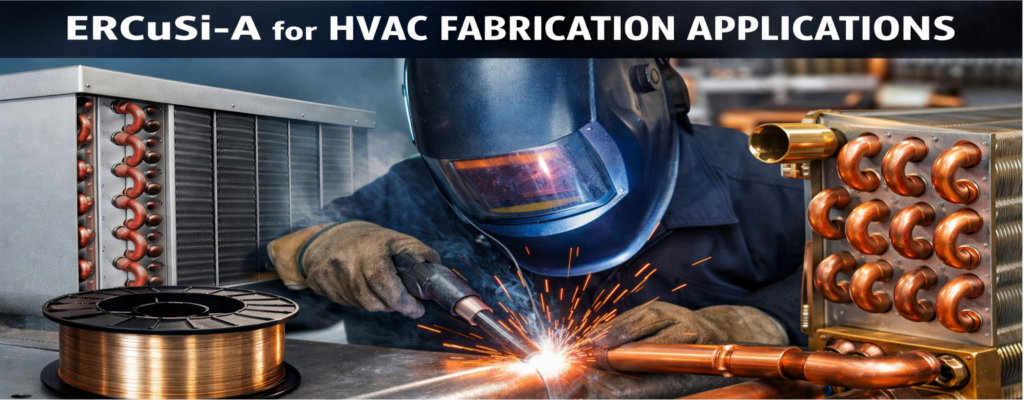
ERCuSi-A in HVAC, Heat Exchangers and Copper Fabrication
Copper and copper alloys are widely used in HVAC and heat-exchanger systems because they offer high thermal conductivity, good corrosion resistance, and practical manufacturability in heating and cooling equipment. At the same time, ERCuSi-A is classified under AWS A5.7 as a silicon-bronze filler metal used for welding and brazing applications involving copper alloys, light-gauge steel, galvanized steel, and some corrosion-resistant surfacing work. Taken together, that makes ERCuSi-A relevant anywhere HVAC and copper fabrication overlap with joining, repair, or light fabrication needs. ERCuSi-A.
1. What ERCuSi-A Is and Why It Matters
ERCuSi-A is a silicon-bronze filler metal with copper as the balance and silicon typically in the 2.8 to 4.0 percent range under AWS A5.7 requirements. Current product literature positions it for MIG and TIG use on silicon bronze, copper-zinc alloys, low-aluminum bronze, malleable iron, light-gauge steel, and galvanized steel, with shielding gas commonly listed as 100 percent argon for many GMAW applications.
In practical terms, that chemistry and application range make ERCuSi-A useful when a fabricator wants a filler that wets well, runs cleanly, and supports joining tasks involving copper-based materials or coated steels. Lincoln Electric also describes silicon-bronze wire for welding, plasma, laser, and MIG brazing, especially where a high-quality finish and corrosion resistance are valued.
2. Where ERCuSi-A Fits in HVAC and Heat Exchangers
HVAC and heat-exchanger equipment often include copper tubing, copper-alloy components, and sheet-metal assemblies because copper remains a common material for air-conditioning, refrigeration, and broader heating-and-cooling systems. Copper’s role in these systems comes from its combination of heat transfer performance and durability in service.
That does not mean ERCuSi-A should be treated as a one-size-fits-all filler for every joint in HVAC production. A more accurate view is that ERCuSi-A fits best in fabrication or repair situations involving copper-alloy parts, copper-to-brass type assemblies, coated sheet-steel sections, or corrosion-resistant surface work around HVAC and heat-exchanger equipment. That conclusion follows from the way manufacturers position ERCuSi-A for copper, copper-silicon, copper-zinc, galvanized steel, and light-gauge steel rather than as a universal filler for every copper-tube joining task.
For example, in the broader equipment build around a heat exchanger, there may be brackets, housings, transition pieces, light-gauge coated panels, or copper-alloy accessory parts where a silicon-bronze filler is a practical choice. In repair work, it can also make sense where the job involves restoring or attaching copper-alloy parts without chasing the highest possible fusion temperature or a heavy structural deposit. That is also consistent with product literature describing ERCuSi-A for brazing light-gauge steel and for corrosion-resistant layers.
3. Why Fabricators Use It for Copper and Mixed-Material Work
One reason ERCuSi-A remains popular in copper fabrication is versatility. Supplier data describes it for joining copper, copper-silicon, copper-zinc alloys, and in some cases steel to copper, brass, and bronze. That gives shops one filler option that can cover several common fabrication scenarios instead of serving only one narrow material family.
Another reason is process behavior. Lincoln states that its silicon-bronze wire is designed for applications where a high-quality finish is demanded and notes controlled chemistry to improve puddle fluidity. That matters in HVAC and heat-exchanger fabrication because appearance, fit-up, and distortion control can all affect downstream assembly quality, especially on thin material or visible joints.
ERCuSi-A is also frequently associated with galvanized and coated sheet steel. That makes it relevant for HVAC equipment makers and metal fabricators who work not only with copper components but also with coated outer structures or adjoining sheet-metal parts. Lincoln and other suppliers explicitly position silicon-bronze consumables for galvanized sheet and GMA brazing, which is one reason the alloy appears so often in automotive and light-sheet fabrication discussions.
4. Main Advantages and Practical Limits
The main advantages of ERCuSi-A in this space are clear. It is well established for copper-alloy work, supports MIG and TIG processes, is used on galvanized and light-gauge steels, and is often chosen when corrosion resistance and a good surface finish are important. Those traits align well with fabrication environments where thin sections, mixed materials, or corrosion-prone service conditions matter.
At the same time, the smart choice is to treat ERCuSi-A as an application-specific filler, not a default answer for every HVAC or heat-exchanger joint. Heat exchangers can involve demanding service conditions, including corrosion mechanisms in copper tubing and performance requirements tied directly to pressure, heat transfer, and long-term reliability. Because of that, filler selection should always be matched to the exact base metals, service conditions, and procedure requirements of the part being built or repaired.
In plain language, ERCuSi-A is often a very good fit around HVAC and copper fabrication, but “around” is the key word. It is especially relevant where the job involves copper alloys, copper-based fabrication, galvanized or coated sheet parts, or repair and attachment work. It should not be selected only because the assembly happens to belong to the HVAC sector.
5. How to Choose ERCuSi-A for the Right Job
A good starting point is to ask what the actual joint involves. If the fabrication includes silicon bronze, copper-zinc alloys, low-aluminum bronze, malleable iron, or light-gauge or galvanized steel, ERCuSi-A is already within the application range described by current manufacturers. If the job instead involves a different copper-joining requirement with specific service constraints, the filler should be checked against those exact demands rather than chosen by habit.
The next question is process choice. Current references show ERCuSi-A available for both GMAW and GTAW, with 100 percent argon commonly listed, while some product lines also support laser and plasma brazing variants in similar silicon-bronze families. That gives fabricators flexibility depending on whether they prioritize speed, appearance, heat input control, or production method.
Finally, consider the service environment. HVAC and heat-exchanger assemblies may combine copper’s thermal advantages with corrosion exposure, thin sections, and mixed-material fabrication. In that setting, ERCuSi-A is most compelling when its documented strengths match the real job: copper-alloy joining, coated-sheet brazing, corrosion-conscious fabrication, and clean-looking weld or braze seams.
Used that way, ERCuSi-A is not just a generic silicon-bronze wire. It becomes a practical filler choice for selected HVAC, heat-exchanger, and copper-fabrication work where material compatibility, finish quality, and process control all matter.