
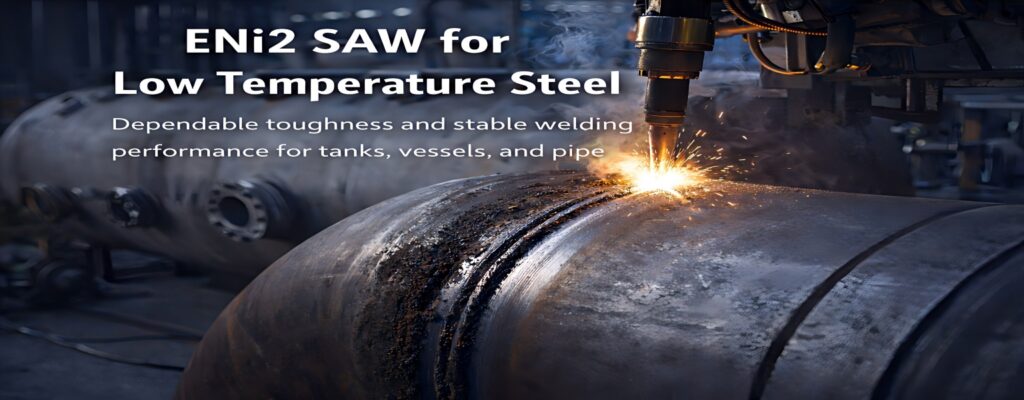
ENi2 SAW for Low Temperature Steel
Low-temperature steel fabrication demands more than basic weld strength. In many projects, the real challenge is maintaining toughness and reliability when service temperatures drop, especially in tanks, vessels, and pipe systems where weld integrity has a direct impact on safety and performance. That is why ENi2 SAW wire is a common choice for fabricators working with low-temperature steels. Public product data for ENi2 classifies it under AWS A5.23 ENi2 and EN ISO 14171-A S2Ni2, and describes it for fine-grain steels with low-temperature toughness as well as nickel-alloy steels used in vessel, tank, and pipe manufacture.
Why ENi2 SAW Is Used for Low Temperature Steel
It is valued because low-temperature service places special demands on weld metal. A steel structure that performs well at room temperature may face a very different set of conditions in cold environments, where impact toughness becomes a much more critical property. Manufacturers and engineers therefore look for a submerged arc welding wire that supports dependable weld-metal performance under these conditions. Multiple ENi2 product sheets position this classification specifically for low-temperature steels and nickel-bearing steels where toughness is an essential requirement, not a secondary benefit.
In practical terms, It SAW is often associated with fabrication work where both productivity and mechanical reliability matter. Submerged arc welding is widely selected for heavy sections and long weld runs because it supports efficient deposition and stable production. When paired with the right wire and flux, it can help fabricators achieve the repeatability required for cold-service applications. That is one reason ENi2 is commonly linked with pressure vessels, storage tanks, apparatus construction, and pipe manufacture in published technical descriptions.
What ENi2 Means in Welding Practice
From a classification standpoint, ENi2 corresponds to the S2Ni2 designation in EN ISO 14171-A and the ENi2 designation in AWS A5.23. Public technical data shows this family is nickel-alloyed, with nickel content ranges published around the 2% class, which is consistent with its use in low-temperature steel welding.
That nickel addition matters because it helps position ENi2 for applications where low-temperature toughness is required. Some manufacturers publish matched-system data showing strong impact performance at cold temperatures, including values reported at -60°C, although actual results always depend on the full welding system, including flux, plate material, welding parameters, and procedure qualification. In other words, ENi2 should be understood not as a standalone guarantee, but as a classification designed for cold-service welding when applied correctly.
Typical Applications of ENi2 SAW
One of the biggest reasons users search for ENi2 is application fit. In public product literature, ENi2 is repeatedly associated with fine-grain steels, low-temperature steels, and nickel-alloy steels used in vessel, tank, and pipe manufacturing. That makes it especially relevant for industries such as energy, industrial equipment, storage systems, and heavy fabrication, where low-temperature performance and weld consistency are both important.
For example, a pressure vessel fabricator may choose ENi2 when the design calls for reliable weld performance in a cold-service environment. A pipe manufacturer may consider it when working on material grades that need better toughness at reduced temperatures. In both cases, the welding wire is not chosen simply because it can deposit metal, but because it is part of a broader strategy to meet mechanical-property targets, pass inspection, and reduce the risk of rework later in production. This is a practical engineering inference based on the application scope published for ENi2 and the role of submerged arc welding in heavy fabrication.
The Importance of Wire and Flux Matching
Another key point for low-temperature steel welding is that ENi2 wire should never be evaluated in isolation. Technical product sheets for ENi2 repeatedly note that flux suitability depends strongly on the application and that the chosen flux should match the base material and welding conditions as closely as possible. This is especially important in submerged arc welding, where the final weld-metal properties come from the wire-flux combination, not from the wire alone.
That means buyers and welding engineers should look beyond the electrode name and ask a more complete question: which ENi2 wire-and-flux system is appropriate for the required service temperature, base metal, and mechanical-property target? A good supplier should be able to explain classification, recommended applications, compatible fluxes, and the expected performance range under qualified procedures. That kind of technical support is often what separates a usable product from a successful welding solution. This recommendation is an original synthesis grounded in the application notes published for ENi2 wires.
How to Choose ENi2 SAW for Low Temperature Steel
If you are selecting ENi2 SAW wire for a project, the most practical starting points are classification, base material, service temperature, and process compatibility. Confirm that the product is classified to AWS A5.23 ENi2 and, where relevant, EN ISO 14171-A S2Ni2. Then review whether the supplier positions the product for fine-grain steels, nickel-alloy steels, vessels, tanks, or pipe manufacture. Finally, evaluate the recommended flux and confirm that the welding procedure can deliver the toughness level your application requires.
The most successful ENi2 applications are usually the result of disciplined process control, not just a correct purchase order. In cold-service welding, procedure qualification, consumable handling, and parameter control all influence the final result. ENi2 gives fabricators a strong starting point for low-temperature submerged arc welding, but the best performance comes when the entire welding system is selected with the service requirement in mind.
Conclusion
It SAW for low temperature steel is more than a specification label. It is a practical submerged arc welding solution for fabricators who need dependable toughness, stable production, and application fit in tanks, vessels, and pipe manufacturing. Because ENi2 is classified and marketed specifically for low-temperature and nickel-bearing steel applications, it remains a relevant choice for projects where cold-service performance cannot be treated as an afterthought. The best results come from treating ENi2 as part of a complete welding system that includes the correct flux, qualified procedures, and a clear understanding of the base material and service environment. I他