

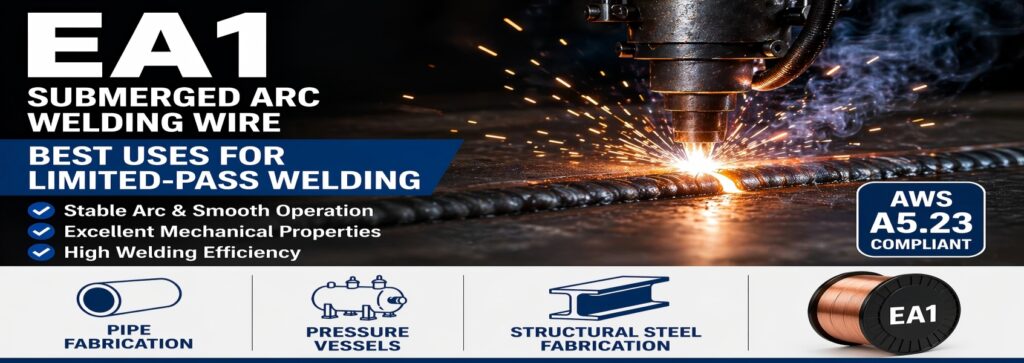
EA1 Submerged Arc Welding Wire: Best Uses for Limited-Pass Welding
In submerged arc welding, filler metal selection has a direct impact on productivity, weld quality, and mechanical performance. For fabricators working on pipe, pressure-related components, and heavy steel sections, EA1 submerged arc welding wire is often chosen for limited-pass welding because it combines stable operation with the chemistry needed for dependable weld results. Public product and standards references consistently describe EA1 as an AWS A5.23 classification for SAW, and several major product listings describe it as a common choice for pipe fabrication and other limited-pass applications.
This article explains what EA1 wire is, why it performs well in limited-pass welding, where it is commonly used, and what buyers and welding engineers should consider before selecting it.
What Is EA1 Submerged Arc Welding Wire?
EA1 is a submerged arc welding wire classification under AWS A5.23, the AWS specification covering low-alloy and high-manganese steel electrodes and fluxes for SAW. Product descriptions associated with EA1 commonly identify it as a low-carbon, medium-manganese, low-silicon wire with molybdenum addition, intended for single-pass or multiple-pass welds and especially suitable for pipe fabrication and limited-pass work.
In practical terms, that means EA1 is not just a general wire for routine SAW. It is typically selected when the weld procedure needs a balance of:
dependable arc stability,
smooth wire feeding,
sound weld metal quality,
and mechanical properties suited to carbon steel or certain low-alloy steel applications.
What Limited-Pass Welding Means
Limited-pass welding refers to applications where the joint design, productivity target, or fabrication method favors fewer weld passes rather than a large number of build-up layers. This is especially relevant in pipe mills, line pipe production, and structural fabrication where throughput matters and weld consistency must be maintained from joint to joint.
In these cases, the wire needs to perform well under higher deposition conditions and still deliver acceptable weld shape and mechanical properties. That is why EA1 is repeatedly marketed and referenced for single-pass or limited-pass welding, particularly in pipe fabrication.
Why EA1 Works Well for Limited-Pass Welding
1. It is widely associated with pipe fabrication
One of the strongest signals from current search results is the repeated connection between EA1 and pipe fabrication. Multiple supplier and manufacturer pages describe EA1 as a standard choice for this type of work, which suggests strong market alignment between the classification and limited-pass production environments.
That matters for SEO and for real-world fabrication alike: when a wire repeatedly appears in relation to a specific use case, it usually reflects a consistent industry selection pattern.
2. Its chemistry supports suitable weld performance
Public product pages describe EA1-type wire as having a composition that includes low carbon, medium manganese, low silicon, and about 0.5% molybdenum. This chemistry is commonly used to support weld metal strength and performance in applications that need more than a plain carbon steel SAW wire can provide.
For limited-pass welding, that is useful because the weld deposit often needs to reach target properties without relying on a large number of passes to refine the final result.
3. It is suited to automatic and high-efficiency welding
EA1 product literature also emphasizes stable arc performance, smooth wire feeding, and efficient deposition in automatic or semi-automatic SAW operations. Those features are highly relevant in limited-pass welding because production speed only matters when the process remains stable and repeatable.
4. It offers a practical balance for carbon and low-alloy steels
Current supplier pages position EA1 for unalloyed and low-alloy steel welding, with some describing improved impact toughness compared with more basic mild-steel filler options. That makes EA1 a practical choice when fabricators want a wire that fits mainstream industrial steel applications without moving into more specialized alloy systems.
Best Uses for EA1 Wire in Limited-Pass Welding
Pipe fabrication
This is the clearest and most repeated use case for EA1. In pipe fabrication, producers often need consistent bead shape, efficient deposition, and repeatable properties across many joints. EA1 is repeatedly identified as a standard option for that environment.
Longitudinal and circumferential seams
Where SAW is used on production seams, limited-pass procedures can help maintain throughput. EA1 is well matched to this kind of work when the procedure calls for low-alloy weld metal rather than a basic carbon-steel deposit. This is an inference based on how EA1 is currently positioned across manufacturer and distributor references for pipe and industrial SAW work.
Structural fabrication with controlled procedure windows
Some product descriptions also position EA1 for carbon steel welding applications that require stable feeding, good bead appearance, and consistent mechanical properties. In structural shops using SAW for repetitive joints, that combination can make EA1 attractive where the welding procedure has already been qualified for the job.
Industrial manufacturing focused on deposition efficiency
Limited-pass welding is often driven by productivity. Because EA1 is promoted for efficient deposition in automatic and semi-automatic SAW, it can fit manufacturing lines where output, consistency, and weld appearance all matter.
Key Advantages of EA1 SAW Wire
Choosing EA1 for limited-pass welding can offer several practical advantages:
Higher productivity potential.
Fewer passes can reduce cycle time and improve shop efficiency when the joint design and qualified procedure support it. EA1 is widely presented for exactly this kind of work.
Reliable weld bead appearance.
Supplier literature highlights smooth feeding and stable arc behavior, both of which help maintain bead consistency.
Suitable mechanical-property profile for relevant applications.
Because EA1 belongs to the AWS A5.23 low-alloy SAW family and is commonly sold for pipe and low-alloy steel work, it is positioned beyond plain general-purpose carbon-wire applications.
Good fit for qualified production welding.
In repetitive fabrication environments, wires with a strong track record in pipe and limited-pass welding are often favored because they reduce uncertainty during procedure qualification and routine production. This is an inference drawn from current product positioning, not a universal guarantee for every application.
What to Check Before Using EA1
Even when a wire is widely used for limited-pass welding, selection should never be based on classification alone.
Confirm the applicable standard
EA1 belongs to the AWS A5.23 system, so procedure and qualification work should align with the relevant code, project specification, and flux combination.
Match the wire with the right flux
In submerged arc welding, performance depends on the wire-flux combination, not just the wire itself. Buyers should review the manufacturer’s approved combinations and verify the procedure through qualification testing. The Lincoln literature explicitly cautions that published test results should not be assumed for every application and that suitability should be confirmed by qualification testing.
Review actual certification and batch data
Some manufacturers note the availability of lot-specific certificates, which is important for projects where traceability matters.
Check whether the application is truly limited-pass
EA1 is strongly associated with limited-pass and pipe applications, but that does not mean it is automatically the best option for every multi-pass heavy-section weld or every low-temperature service requirement. Final selection still depends on procedure qualification, service conditions, and code requirements.
EA1 vs General SAW Wires
Compared with more general SAW wires, EA1 is usually chosen when the job needs a more specific low-alloy weld deposit and when pipe fabrication or limited-pass welding is a priority. Search results repeatedly place EA1 in that narrower, more application-driven category rather than presenting it as a one-size-fits-all submerged arc wire.
That makes EA1 especially relevant for buyers searching terms like:
It welding wire for pipe fabrication
It submerged arc wire for limited-pass welding
AWS A5.23 EA1 uses
It wire-flux combination
It low-alloy SAW wire
These keyword directions also align with the visible search-result themes around It right now.
Conclusion
It submerged arc welding wire is best known for limited-pass welding, especially in pipe fabrication and related industrial SAW applications. Current product and standards references consistently associate EA1 with AWS A5.23 classification, low-alloy wire chemistry, stable performance, and suitability for single-pass or limited-pass production welding.
For fabricators, that makes EA1 a practical option when the goal is to combine productivity with dependable weld quality. For buyers, the key is not just to choose EA1 by name, but to confirm the right wire-flux combination, certification, and qualified procedure for the actual job.