

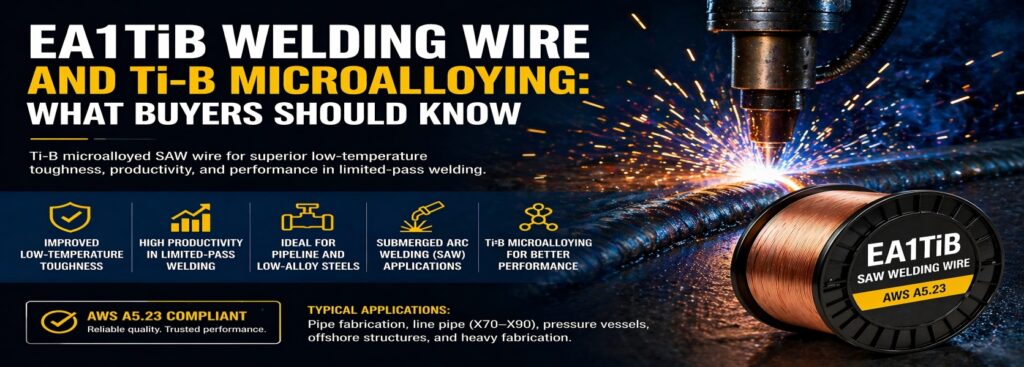
EA1TiB Welding Wire and Ti-B Microalloying: What Buyers Should Know
If you are sourcing submerged arc welding wire for pipeline steel, pressure applications, or other low-alloy steel fabrication, EA1TiB is the kind of grade that gets attention when buyers need a balance of productivity, strength, and low-temperature toughness. Public references show that Ti-B microalloyed SAW wires are commonly positioned for two-run or limited-pass welding, especially in pipe mills and line-pipe applications where weld toughness is critical.
The reason buyers search for EA1TiB is not only the classification itself. They are usually trying to answer a more commercial question: what does Ti-B microalloying actually do, and when is it worth paying for? In current product literature and technical references, Ti-B microalloyed SAW wires are repeatedly associated with improved impact toughness, two-run technique performance, and use on pipeline steels with demanding mechanical-property targets.
What Is EA1TiB Welding Wire?
Under AWS A5.23, submerged arc welding electrodes are classified within a standardized system for low-alloy and high-manganese steel electrodes and fluxes. AWS A5.23 is the governing specification family buyers should check when evaluating low-alloy SAW wire classifications and related flux systems.
In the market, however, product naming is not always identical from one supplier to another. Some manufacturers publish similar Ti-B microalloyed SAW wires under classifications such as EA2TiB or corresponding ISO designations such as S2MoTiB or S3MoTiB, while describing essentially the same commercial use case: pipe steels, high toughness requirements, and two-run or multi-arc submerged arc welding. That means buyers should never rely on the grade name alone; they should verify the exact AWS/ISO classification, flux pairing, and approval package on the supplier datasheet.
So from a buyer’s perspective, “EA1TiB welding wire” is best understood as a Ti-B microalloyed low-alloy SAW wire category used where ordinary SAW wires may not deliver enough low-temperature toughness or productivity in limited-pass or two-run production welding.
EA1TiB What Ti-B Microalloying Means in Welding Wire
Titanium and boron are added in very small amounts, but they can strongly influence weld-metal microstructure. Public metallurgy references on Ti microalloying show that small Ti additions can improve low-alloy steel performance by promoting favorable precipitation and grain-refinement effects when controlled correctly.
In submerged arc weld metal specifically, available technical literature and manufacturer data link Ti-B alloying with microstructures rich in acicular ferrite and improved low-temperature toughness when the overall alloy balance is correct. One technical summary of SAW weld metals reports that low-carbon systems with suitable amounts of Mn, Mo, Ti-B, Cu, Ni, and rare earths can produce weld metals with high low-temperature impact toughness.
That is why many Ti-B microalloyed SAW wires are sold for pipe steel and high-toughness welds. In practical terms, Ti-B microalloying is not just a chemistry feature for a datasheet. It is a deliberate design choice aimed at helping the weld deposit achieve better toughness performance, especially where the procedure uses high dilution, two-run technique, or limited-pass production welding.
EA1TiB Why Buyers Search for Ti-B Microalloyed SAW Wire
Most buyers are not purchasing welding wire because of alloy theory. They are purchasing because the project requires a specific outcome: meeting toughness requirements without losing production efficiency. Current supplier pages consistently describe Ti-B microalloyed SAW wires as suitable for pipe mills, double-sided single-arc welding, multi-arc welding, and line pipe grades where low-temperature properties matter.
This is especially important in line-pipe manufacturing and similar production environments. One manufacturer description for a Ti+B SAW wire states that the wire is designed to achieve optimum impact properties in the two-run technique with pipe-mill fluxes. Another describes Ti/B microalloyed SAW wires for pipeline steels and high toughness requirements, including low-temperature service.
For buyers, that translates into a simple sourcing logic: when the job involves pipe fabrication, limited-pass welding, or toughness-critical weld metal, Ti-B microalloyed wire becomes a serious candidate.
Best Applications for EA1TiB-Type Wire
1. Pipeline and line-pipe welding
This is one of the strongest use cases visible in current product literature. Ti-B microalloyed SAW wires are repeatedly marketed for pipeline steels, longitudinal pipe welding, and pipe-mill applications, including grades up to API X70 and X80, and in some product references even up to X90 depending on the system and procedure.
2. Two-run and limited-pass welding
Two-run technique is mentioned again and again in public references for Ti-B microalloyed SAW wires. This matters because in high-productivity production welding, the weld metal often must reach toughness targets with fewer passes and under higher dilution conditions. Ti-B wire systems are specifically promoted for that environment.
3. High-toughness low-alloy steel fabrication
Some Ti-B SAW wire references emphasize low-temperature toughness, even down to -46 °C or below for certain wire systems and procedures. That does not mean every product sold under a Ti-B concept will automatically qualify for every low-temperature job, but it does show why buyers with toughness-sensitive applications often search this category first.
EA1TiB Main Benefits Buyers Should Care About
Better low-temperature toughness
This is the primary commercial reason Ti-B microalloying matters. Product literature repeatedly connects Ti-B additions with improved impact properties, especially in pipeline and two-run SAW applications.
Improved performance in high-dilution welds
One market reference for an AWS A5.23 Ti-B wire explicitly notes its suitability for high dilution welds where low-temperature impact toughness is required. That is highly relevant to buyers comparing Ti-B microalloyed wire against more general-purpose SAW options.
Higher productivity in automated SAW
Ti-B microalloyed SAW wires are frequently tied to pipe mills, multi-arc, and automatic submerged arc welding, all of which point to production efficiency. For buyers, that means the value proposition is not just toughness, but toughness without sacrificing throughput.
EA1TiB What Buyers Must Verify Before Ordering
1. Exact classification
One of the biggest sourcing mistakes is assuming that every “Ti-B” SAW wire is interchangeable. Public references show multiple designations such as EA2TiB, S2MoTiB, and S3MoTiB, with different alloy balances and intended performance windows. Buyers should request the supplier’s exact AWS A5.23 classification, corresponding ISO classification, and approved wire-flux combinations.
2. Recommended flux combination
In submerged arc welding, the wire alone does not tell the whole story. Mechanical properties depend on the wire plus flux system. Multiple manufacturer pages emphasize specific use with pipe-mill fluxes or targeted SAW systems. Buyers should always ask for the recommended flux and supporting test data, not just the bare wire certificate.
3. Toughness test temperature and procedure condition
If your project needs Charpy performance at a specific temperature, you must confirm the actual qualification results. Some product literature cites very strong toughness capability, but those numbers depend on the welding procedure, heat input, flux, and joint design. Buyers should request impact values at the actual required temperature and under the intended welding condition.
4. Target base material grade
Some Ti-B microalloyed wires are clearly positioned for pipeline steels up to X70/X80, while others are marketed for even higher-grade pipe applications. Buyers should not assume the same wire is appropriate for every base metal or service condition without qualification evidence.
EA1TiB vs Standard SAW Wire
Compared with a more basic SAW wire, an EA1TiB-type product is generally chosen when the application needs higher toughness, better performance in limited-pass welding, or greater reliability in pipeline production conditions. Standard wires may still be fully suitable for less demanding applications, but Ti-B microalloyed wires are aimed at jobs where weld-metal performance is a more critical buying criterion.
and in procurement. Buyers searching terms like EA1TiB welding wire, Ti-B SAW wire, pipeline submerged arc wire, or two-run welding wire are usually not looking for commodity filler metal. They are looking for risk reduction: a wire system that is more likely to meet demanding toughness targets in production.
Final Buying Advice
If you are comparing suppliers, do not buy EA1TiB-type wire based only on price or the grade name on the label. Ask for:
the exact AWS and ISO classification,
the recommended flux pairing,
the typical chemical composition,
the impact test data and temperature,
the intended use case such as two-run pipe welding or limited-pass SAW,
and any available approvals or project references.
For the right application, Ti-B microalloyed submerged arc wire can be an excellent choice. The visible public evidence consistently supports its use in pipeline steels, two-run technique, and high-toughness weld metal requirements. For buyers, the key is to verify the complete welding system, not just the wire name.