
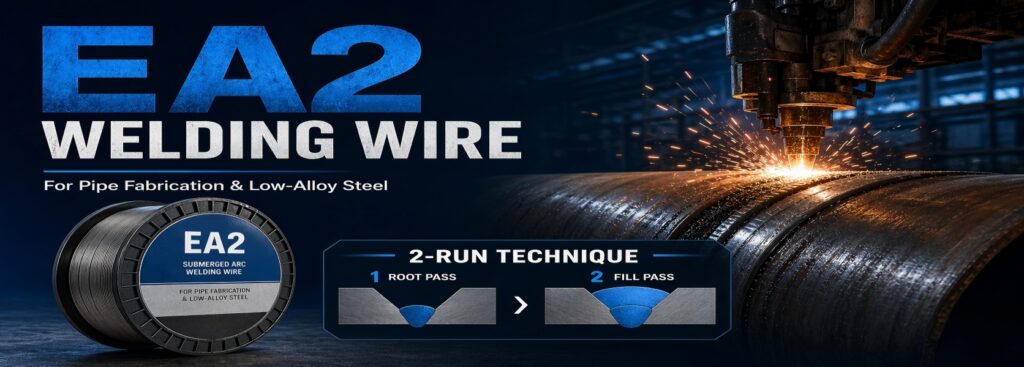
EA2 Welding Wire and 2-Run Technique
In submerged arc welding, productivity matters. But in real fabrication, productivity only creates value when weld quality and mechanical performance stay under control. That is why EA2 welding wire is so often discussed together with the 2-run technique. Across current product pages and standards references, EA2 is consistently described as a 0.5% molybdenum low-alloy SAW wire used for non-alloyed and low-alloyed steels, especially in pipe fabrication, pressure vessels, boiler steels, and limited-pass welding applications.
For buyers, engineers, and fabricators, the real question is not simply what EA2 is. The more useful question is this: why is EA2 associated with the 2-run technique, and when does that combination make commercial and technical sense? Current manufacturer literature answers that clearly. Lincoln Electric states that its AWS A5.23 EA2 / EN ISO 14171-A S2Mo wire is used on common unalloyed steels in 2-run technology and can improve impact properties, while also being suitable for multi-run welding where higher strength properties are needed.
What Is EA2 Welding Wire?
EA2 is a classification under AWS A5.23, the AWS specification covering low-alloy and high-manganese steel electrodes and fluxes for submerged arc welding. The current 2025 edition of AWS A5.23 explicitly includes two-run classification within its framework, noting that two-run classification is based on mechanical properties.
In commercial terms, EA2 is widely sold as a molybdenum-alloyed SAW wire. Supplier descriptions repeatedly identify it as a copper-coated or coppered wire for welding non-alloyed and low-alloyed steels, including fine-grain steels, pressure-vessel steels, shipbuilding steels, pipe steels, and pipeline steels up to X70.
That makes EA2 more specialized than a purely general-purpose SAW wire. It sits in the space where fabricators want a practical combination of:
stable submerged arc welding performance,
improved impact properties,
suitability for limited-pass or 2-run procedures,
and weld metal appropriate for industrial low-alloy steel applications.
What the 2-Run Technique Means
The 2-run technique refers to a welding approach where the joint is completed with two principal weld runs, often in automated or production-focused SAW applications such as pipe manufacturing. AWS A5.23 distinguishes two-run classification from multi-run classification, which matters because weld-metal properties can change significantly depending on pass sequence and heat cycle.
That distinction is one reason buyers should pay close attention to how a wire is marketed and qualified. A wire may perform well in ordinary multi-pass SAW, but its value in the market often increases when it can also deliver acceptable impact properties and reliable results in 2-run welding, where productivity is a major driver. Current Lincoln Electric literature directly ties EA2-class S2Mo wire to this use case.
Why EA2 Is Linked to the 2-Run Technique
1. EA2 is designed to improve impact properties in 2-run welding
One of the clearest reasons EA2 shows up in search results around 2-run welding is that manufacturer literature says so directly. Lincoln Electric describes its EA2-class OE-S2Mo wire as a 0.5% Mo wire for steel grades such as 16Mo3 or non-alloy steels, specifically to improve impact properties when welding in 2-run technique.
That is important because 2-run procedures can place greater emphasis on how the weld metal behaves without the refining effect of many additional passes. Buyers looking for a wire that supports both efficiency and mechanical performance naturally search EA2 in this context.
2. EA2 Welding Wire is a standard choice for pipe and limited-pass applications
Although some public pages describe the closely related S2Mo/EA2-type wire under different branding, the market message is highly consistent: these wires are common in pipe fabrication and limited-pass applications. Lincoln’s product literature for this class describes it as a standard choice for pipe fabrication and other limited-pass applications, and other suppliers position S2Mo/EA2 wires for pipe steels and pipeline steels up to X70.
That is exactly the kind of fabrication environment where 2-run technique matters most. Pipe mills and longitudinal seam welding operations benefit when fewer passes can still produce acceptable properties and consistent weld quality.
3. The molybdenum alloying supports the target performance window
Current public descriptions consistently identify EA2 as a 0.5% molybdenum wire. That alloying addition is central to its market positioning for pressure-vessel steels, boiler steels, fine-grain steels, and pipe steels.
In practical sourcing terms, the Mo addition helps differentiate EA2 from simpler SAW wires and explains why it is selected when toughness and application range need to be stronger than a basic carbon-steel wire can offer.
Best Uses for EA2 Welding Wire in 2-Run Applications
Pipe fabrication
This is the most visible and commercially important use case. Public product literature repeatedly connects EA2-class wire with pipe fabrication, pipeline steels, and 2-run technology. That makes it one of the strongest SEO and market-intent angles for EA2 content.
Pressure vessels and boilers
EA2 is also commonly marketed for heat-resistant boiler and vessel steels and steels such as 16Mo3. That makes it relevant for fabricators who need a submerged arc wire with a more defined low-alloy performance profile.
Structural and heavy fabrication
Supplier descriptions for EA2 include structural steels, construction, and shipbuilding. While 2-run technique may be most strongly associated with pipe production, the wire itself is not limited to one industry.
EA2 Welding Wire Key Advantages Buyers Should Know
Better productivity
The 2-run technique is attractive because it reduces the number of welding passes required. When paired with a wire that is intended for this method, the result can be faster throughput and more efficient production. AWS’s separate recognition of two-run classification reinforces that this is not a minor procedural detail but a meaningful performance category.
Improved impact properties
This is one of the strongest selling points visible in current manufacturer language. Lincoln explicitly positions EA2-class S2Mo wire as a way to improve impact properties in the 2-run technique.
Broad industrial relevance
EA2 is not a niche-only wire. Public references place it across pipe steels, pressure vessels, naval vessels, boilers, and low-alloy steel fabrication, which makes it commercially interesting for distributors as well as end users.
What Buyers Should Check Before Ordering EA2
Confirm the exact classification
EA2 belongs to AWS A5.23, but you should still verify the exact supplier classification and corresponding ISO designation, such as S2Mo. Not every product sold into the same market segment is interchangeable.
Confirm the flux pairing
Manufacturer literature for EA2-class wire often specifies suitable flux pairings. Lincoln references OP 132 and OP 192 for 2-run technology, while other suppliers list approved fluxes for different base materials and service needs. In SAW, wire selection without flux confirmation is incomplete.
Check application fit
Some suppliers market EA2 for 16Mo3, others for pipe steels up to X70, and others more broadly for low-alloy and structural steels. Buyers should match the wire not only to the welding process but also to the actual base material, code requirement, and service condition.
Review certification and documentation
Some product pages note the availability of Type 3.1 lot certificates showing chemical composition. That matters for traceability, especially in pressure or project-based supply.
EA2 Welding Wire vs General SAW Wires
Compared with more general submerged arc wires, EA2 is usually chosen when the project needs a more targeted low-alloy deposit and better suitability for 2-run welding, limited-pass procedures, or impact-property-sensitive fabrication. Public search results consistently position EA2 in that more demanding technical space rather than as a generic SAW consumable.
For SEO purposes, that also explains why high-intent searches around EA2 often cluster around terms like:
EA2 welding wire for pipe fabrication
EA2 2-run technique
AWS A5.23 EA2 wire
S2Mo wire for 16Mo3
best flux for EA2 wire
Those are not casual searches. They usually signal a buyer or engineer trying to reduce selection risk.
EA2 Welding Wire Conclusion
EA2 welding wire is strongly associated with the 2-run technique because the market, standards framework, and manufacturer literature all point in the same direction. Under AWS A5.23, two-run classification is a recognized part of submerged arc welding classification, and current EA2-class product literature presents this wire as a 0.5% molybdenum SAW wire used to improve impact properties in 2-run welding, especially for pipe fabrication, pressure vessels, boilers, and low-alloy steel applications.
For buyers, the takeaway is simple: EA2 is worth attention when you need a wire that supports productivity and dependable weld-metal performance in limited-pass or 2-run SAW. The best purchasing decision comes from checking the classification, flux pairing, test data, and intended application together, not from grade name alone.