
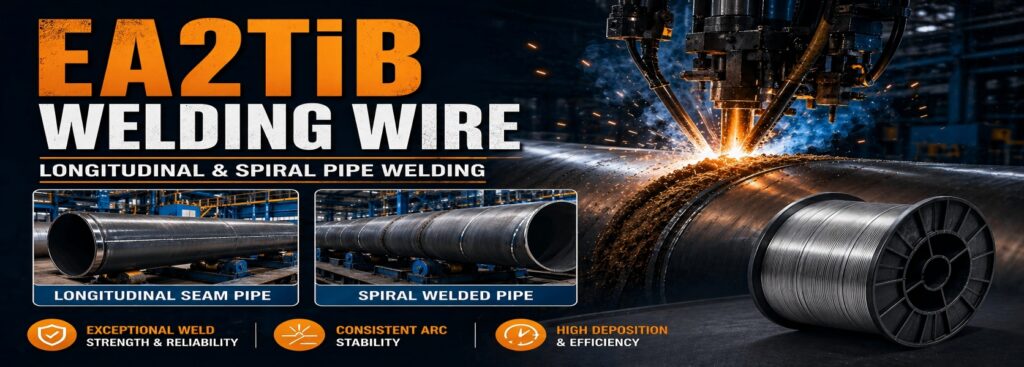
EA2TiB Welding Wire in Longitudinal and Spiral Pipe Welding
In pipe manufacturing, filler metal selection has a direct effect on productivity, weld toughness, and inspection results. That is why EA2TiB welding wire is often discussed in connection with longitudinal and spiral pipe welding, especially where submerged arc welding is used in high-output production. Public product literature consistently places EA2TiB-class wires in pipeline steel, pipe mill, and two-run/DSAW applications rather than in generic shop welding.
What Is EA2TiB Welding Wire?
EA2TiB is an AWS A5.23 submerged arc welding classification within the low-alloy electrode family. The AWS A5.23 specification covers low-alloy and high-manganese steel electrodes and fluxes for submerged arc welding, and the current edition explicitly includes classifications tied to different welding techniques and mechanical-property requirements.
In commercial product listings, EA2TiB commonly corresponds to EN ISO 14171-A S2MoTiB and is described as a 0.5% molybdenum wire with small titanium and boron additions. Those alloying additions are marketed for improving weld-metal toughness, especially in pipe welding systems that use two-run technique or similar limited-pass production methods.
Why EA2TiB Matters in Pipe Production
Longitudinal and spiral pipe mills are not simply looking for a wire that deposits metal. They need a wire that supports high line speed, consistent bead formation, and reliable impact properties in welds that may be completed with a limited number of passes. This is exactly where EA2TiB shows up repeatedly in public technical literature. Bavaria’s BA-S2MoTiB is described for optimum impact properties with the two-run technique with pipe-mill fluxes, while Lincoln’s OE-TIBOR 33 is described as suitable for limited-pass applications and for pipe grades up to X90.
That positioning matters because pipe welding is one of the most demanding production environments for SAW consumables. When the weld is part of a longitudinal seam or spiral seam, the consumable has to support both mechanical performance and manufacturing efficiency. Public supplier references consistently connect EA2TiB with that exact use case.
EA2TiB in Longitudinal Pipe Welding
Longitudinal pipe welding is commonly used in line pipe production where steel plate is formed and welded along a straight seam. In this environment, double-sided submerged arc welding and two-run technique are common process concepts, so the wire must perform under high productivity conditions while still meeting toughness targets. Product literature for EA2TiB-class wires explicitly lists longitudinal pipe welding as a typical application.
This makes EA2TiB attractive to buyers who need a wire for LSAW-type production logic: stable arc behavior, suitability for pipeline steels, and strong toughness in limited-pass welds. Fliess also describes AWS A5.23 EA2TiB / EN ISO S2MoTiB wire as optimized for multi-arc welding using DSAW (two-run) technique in pipeline steel applications with high toughness requirements.
EA2TiB in Spiral Pipe Welding
Spiral pipe welding has its own process demands. The seam geometry is different, production is continuous, and weld quality must remain stable over long runs. Public references that list EA2TiB for spiral pipe welding indicate that the wire is not limited to one pipe-making method. Lincoln’s OE-TIBOR 33 specifically lists longitudinal and spiral pipe welding among its typical applications.
For SEO and for real-world purchasing alike, this is a key insight: EA2TiB is not just a classification to mention on a datasheet. It is a wire category that suppliers openly target at both longitudinal and spiral pipe mills, which is why articles around these applications are more relevant to search intent than generic “what is welding wire” content.
Why Titanium and Boron Are Important
Titanium and boron are used in very small amounts, but their role is important in weld-metal design. Public product descriptions repeatedly connect Ti+B additions with improved fracture toughness and low-temperature performance in pipeline applications. Airgas describes Lincolnweld LA-81, an EA2TiB wire, as a low-carbon, medium-manganese, low-silicon, 0.5% molybdenum wire containing small additions of titanium and boron for improved fracture toughness, generally used in two-run applications for arctic grade line pipe.
For buyers, the commercial takeaway is straightforward: Ti and B are not added for marketing language. They are part of the weld-metal design strategy that helps EA2TiB-class wires reach the toughness window needed for demanding pipeline seams, especially where the production method does not rely on many passes to refine the weld metal.
Best Uses of EA2TiB in Pipe Welding
EA2TiB is best suited to applications where the project combines pipeline steel, high toughness requirements, and submerged arc welding in high-productivity conditions. Public references repeatedly associate it with:
longitudinal pipe welding,
spiral pipe welding,
pipeline steels,
DSAW or two-run technique,
and limited-pass production welding.
Some supplier literature also positions related S2MoTiB products for high-strength low-alloy steels and creep-resisting steels, but the clearest recurring market signal is still pipe welding. That is the strongest and most repeated application theme in current search-visible sources.
Advantages Buyers Should Know
One major advantage of EA2TiB in pipe production is toughness performance in two-run welding. This matters because many line pipe operations need to hit mechanical-property targets without sacrificing throughput. Product literature from multiple suppliers directly highlights this as a top feature.
Another advantage is application fit for higher-grade pipe steels. Lincoln’s OE-TIBOR 33 is presented as suitable for pipe grades up to X90, while Airgas describes LA-81 as usable up to API X90 grade pipe. That does not mean every procedure automatically qualifies for every pipe grade, but it does show where suppliers position the wire in the market.
A third advantage is compatibility with pipe-mill production logic. Bavaria’s BA-S2MoTiB explicitly references pipe-mill fluxes, which reinforces that the wire is intended as part of a production welding system rather than a standalone consumable choice.
Flux Matching Is Critical
In submerged arc welding, wire selection alone is never enough. Performance depends on the wire-flux combination, and several sources explicitly say so. Bavaria links BA-S2MoTiB to pipe-mill fluxes, while IABCO notes that actual mechanical properties depend on the flux, welding procedure, and base material composition and should always be confirmed through procedure approval.
This is especially important in longitudinal and spiral pipe welding, where the same wire can give different results depending on heat input, flux choice, seam geometry, and base material chemistry. So for procurement, the practical question is not only “Is this EA2TiB?” but also “Which flux system and procedure data support it for our pipe grade?”
What Buyers Should Verify Before Ordering
Before ordering EA2TiB for pipe welding, buyers should check the exact classification, the matching ISO designation, the recommended flux, and the qualified mechanical-property data for their specific project. Public listings show that sellers may describe similar products using AWS A5.23 EA2TiB and EN ISO S2MoTiB, but application data still varies by supplier and system.
Buyers should also verify the target pipe grade and service condition. Public product pages mention suitability for pipeline steels and, in some cases, pipe grades up to X90, but product sheets also warn that actual results depend on welding procedure, plate chemistry, fabrication method, and qualification.
Finally, documentation matters. If the project is quality-sensitive, it is worth asking for lot certificates, chemical composition data, and procedure support. Airgas notes that lot-specific Type 3.1 certificates are available for Lincolnweld LA-81.
Conclusion
EA2TiB welding wire is strongly linked to longitudinal and spiral pipe welding because current supplier and standards-related sources consistently place it in pipeline steel, two-run/DSAW, and high-toughness limited-pass applications. It is not just another SAW wire classification. It is a wire category designed for demanding pipe-production conditions where weld toughness and manufacturing efficiency must work together.
For buyers, the smartest approach is to evaluate EA2TiB as a system choice: wire classification, flux pairing, pipe grade, and welding procedure all have to align. When they do, EA2TiB can be a strong option for longitudinal and spiral pipe welding projects that require both productivity and dependable mechanical performance.