

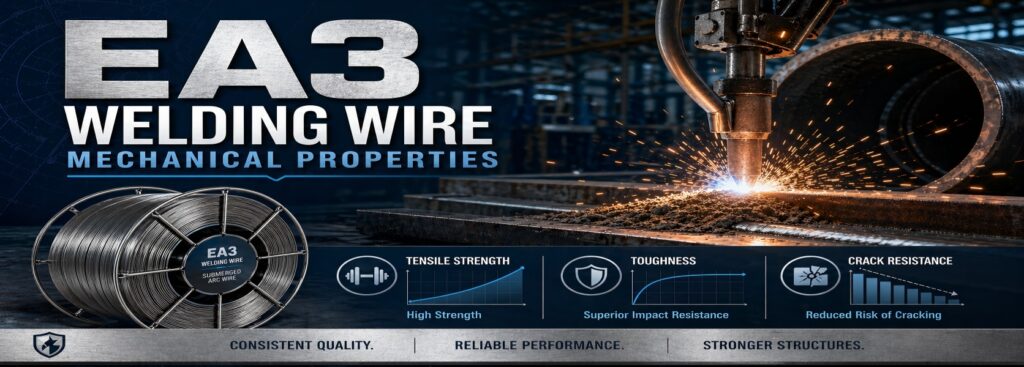
EA3 Welding Wire Mechanical Properties
When engineers and buyers evaluate submerged arc welding wire, mechanical properties are usually the deciding factor. Classification matters, application matters, and flux selection matters, but in the end the real question is simple: what kind of weld metal performance can this wire help achieve in production? For EA3 welding wire, public technical references consistently position it as a molybdenum-alloyed low-alloy SAW wire used for fine-grain steels, pipe steels, and heat-resistant boiler and vessel steels, especially where strength and crack resistance are important.
EA3 belongs to the AWS A5.23 classification system for low-alloy and high-manganese steel electrodes and fluxes for submerged arc welding. In supplier literature, EA3 is commonly paired with the EN ISO 14171-A S4Mo designation, which gives buyers an important clue: this is not a general-purpose carbon steel wire, but a wire designed around a 0.5% molybdenum alloy concept for more demanding applications.
EA3 Welding Wire What “mechanical properties” really mean for EA3
For welding consumables, mechanical properties usually refer to the performance of the weld metal, not just the wire itself. In practical terms, buyers care about whether the deposited weld can provide the right combination of tensile strength, yield strength, toughness, ductility, and crack resistance for the base material and service condition. AWS A5.23 also makes clear that submerged arc consumables are evaluated as part of a system, and that classifications can involve different welding conditions such as multiple-pass or two-run methods.
That point is especially important for EA3 because public supplier documents do not present it as a commodity wire. They repeatedly connect it with applications where weld performance is critical, including P460N/S460NL to P500Q/S500QL fine-grain steels, API X70 to X80 pipe steels, and 16Mo3/A204 Grade A/A209 Grade T1 heat-resistant steels. A wire is only used in that range of materials when its expected mechanical-property profile supports those jobs.
EA3 Welding Wire The alloy design behind EA3 performance
The chemistry behind EA3 helps explain why it is chosen for these applications. Bavaria’s S4Mo / EA3 data sheet lists a typical analysis of about 0.12% C, 0.11% Si, 1.90% Mn, and 0.50% Mo, while Union S 4 Mo shows a very similar typical analysis of 0.11% C, 0.10% Si, 2.00% Mn, and 0.50% Mo. The AWS A5.23 limits shown on the Bavaria sheet also place EA3 in a range of 0.05–0.17% carbon, up to 0.20% silicon, 1.65–2.20% manganese, and 0.45–0.65% molybdenum.
This chemistry matters because molybdenum is widely used in low-alloy weld metals to support strength and elevated-temperature performance, while manganese contributes to strength and deoxidation behavior. In commercial product language, this combination is what places EA3 in the category of high-strength low-alloy SAW wire, rather than ordinary mild-steel submerged arc wire. Akweld’s EA3 product page explicitly describes it as a low-alloy high-strength steel submerged arc welding wire that can obtain welds with excellent mechanical properties and crack resistance when used with the proper flux.
Strength-related properties buyers care about
One of the main reasons buyers search for EA3 is the need for a weld metal that can match or support high-strength low-alloy steel fabrication. Public application ranges for EA3 include structural and pressure grades such as Q490, 12MnNiVR, and 08MnNiVR in Akweld’s literature, as well as European and ASTM grades like P460N and P500Q in Bavaria’s documentation. Those references strongly suggest that EA3 is selected when higher strength is required than would normally be expected from plain carbon SAW wire.
For buyers, that means EA3 is most relevant when the application is not simply “submerged arc welding,” but submerged arc welding of higher-strength steels where the deposited metal must remain dependable under load. The fact that EA3 is repeatedly associated with pipe steels up to X80 and with structural or vessel steels further reinforces this performance positioning.
Toughness and crack resistance
Mechanical properties are not only about strength. In many welded structures, toughness is equally important, especially in applications involving thick sections, restrained joints, or service conditions where brittle behavior is a concern. Akweld’s published EA3 description specifically states that, with the corresponding flux, the weld can achieve excellent mechanical properties and crack resistance. Bavaria also positions EA3 for fine-grain steels and pipe steels, both of which are application areas where toughness is often a key requirement.
That does not mean every EA3 weld will automatically have the same toughness in every procedure. In submerged arc welding, toughness depends on more than the wire classification alone. Flux type, heat input, pass sequence, and base metal chemistry all affect the final result. Bavaria’s data sheet explicitly says the most suitable flux should be matched as closely as possible to the plate material under the existing welding conditions, while IABCO-style product literature for similar systems routinely notes that actual properties depend on the complete welding setup.
EA3 in two-run and pipe applications
A particularly useful clue about EA3 mechanical properties comes from the way suppliers describe its applications. Bavaria states that EA3 is a Mo-alloyed wire electrode with high manganese content for submerged arc welding in the two-run technique of fine-grain steels, pipe steels, and heat-resistant boiler and vessel steels. Union S 4 Mo likewise says it is used for creep-resistant 0.5% Mo steel grades (16Mo3) and also for 2-run procedures in unalloyed steel grades such as pipe manufacturing.
This matters because two-run welding puts real pressure on weld-metal design. With fewer passes, the weld deposit has less opportunity to be refined by repeated thermal cycling. If a wire is openly recommended for two-run procedures and pipe manufacturing, that is a strong market signal that its mechanical-property profile is intended to remain acceptable under those more production-driven conditions.
EA3 Welding Wire Why flux selection changes the final properties
For EA3, mechanical properties cannot be discussed without mentioning the wire-flux combination. Bavaria recommends different fluxes depending on whether the job involves fine-grain steels, pipe steels, or heat-resistant steels. For example, it lists BF 5.1 and BF 6.5 for fine-grain steels, BF 6.30 and BF 6.5 for pipe steels, and BF 10 for heat-resistant steels. Union S 4 Mo also lists several recommended SAW fluxes such as UV 309 P, UV 310 P, UV 418 TT, UV 420 TT, UV 420 TT-LH, UV 420 TTR, and UV 421 TT.
This is one of the most important points for buyers: EA3 does not have one single mechanical-property number that applies to every project. The final tensile strength, toughness, and crack resistance are the result of the system, not just the wire drum. That is also why Google searches around EA3 often overlap with search intent around best flux for EA3 welding wire, EA3 SAW wire for pipe steels, and EA3 mechanical properties with flux matching. Those are practical procurement questions, not just technical curiosities.
Typical applications that reflect EA3’s property profile
The best way to understand EA3 mechanical properties is to look at where suppliers say it is used. Across the sources, EA3 is consistently associated with:
low-alloy high-strength structural steels,
pipe steels,
fine-grain steels,
pressure vessel and boiler steels,
and heat-resistant 0.5% Mo steels such as 16Mo3.
That application range tells buyers a lot. A wire chosen for those materials must offer more than easy feeding and a smooth arc. It must support a weld-metal property balance that can work in higher-strength and more demanding service categories, especially where crack resistance and dependable mechanical behavior matter.
What buyers should verify before ordering EA3
If you are sourcing EA3 for a project, it is not enough to read the classification and assume the mechanical properties will fit automatically. Buyers should verify:
the exact AWS/ISO classification,
the recommended flux pairing,
the target base metal range,
the qualified welding procedure,
and the actual test results for the intended application.
This is particularly important because the same EA3-class wire may be used in different contexts: pipe manufacturing, pressure vessel fabrication, or heat-resistant steel welding. Each of those applications can prioritize mechanical properties differently. A boiler-steel job may care more about elevated-temperature performance, while a pipeline job may focus more on toughness and strength under production conditions. The classification tells you the family; the procedure qualification tells you whether the system truly fits your job.
EA3 Welding Wire Conclusion
EA3 welding wire mechanical properties are best understood as the result of a molybdenum-alloyed, high-manganese SAW wire design intended for higher-strength low-alloy steel applications. Public data sheets consistently show EA3 / S4Mo chemistry centered around about 0.5% Mo and high manganese, and supplier literature repeatedly places the wire in fine-grain steels, pipe steels, boiler and vessel steels, and two-run pipe applications.
For buyers, that means EA3 is not a generic submerged arc wire. It is a more specialized option used when the project needs a stronger weld-metal profile, useful crack resistance, and dependable performance in demanding low-alloy steel applications. The smartest way to evaluate EA3 is not by grade name alone, but by the full wire-flux-procedure combination that will determine the real mechanical properties in production.