
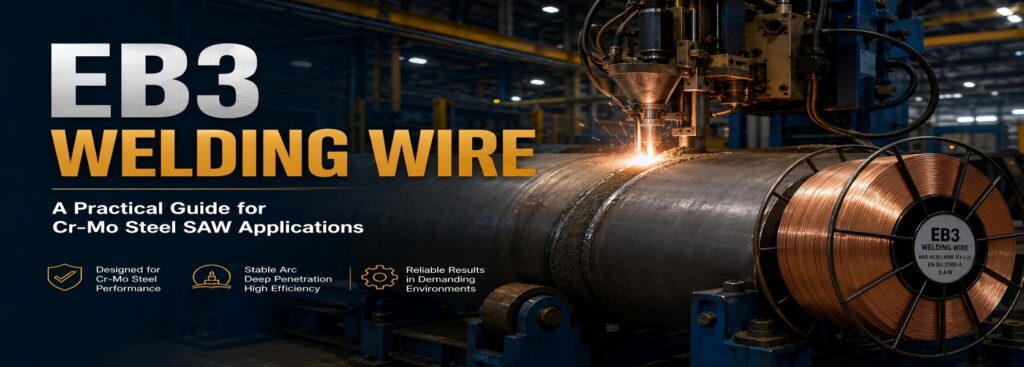
EB3 Welding Wire: A Practical Guide for Cr-Mo Steel Submerged Arc Welding
What Is EB3 Welding Wire?
EB3 welding wire is a low-alloy submerged arc welding wire designed for welding chromium-molybdenum steels, especially steels with approximately 2.25% chromium and 1% molybdenum. It is commonly classified under AWS A5.23 EB3 and is widely used in submerged arc welding applications where heat resistance, strength, and stable weld performance are important.
In international specifications, It is often associated with Cr-Mo heat-resistant steels used in pressure vessels, boilers, process piping, petrochemical equipment, and other heavy industrial structures. Hyundai Welding lists EB3 under AWS A5.23 and EN ISO 24598-A S S CrMo2, with pressure vessels as a typical application.
For buyers, EB3 welding wire should not be viewed only as a product code. It is a technical welding consumable that must be selected according to base material, welding procedure, flux combination, heat treatment requirements, and project specifications.
AK EB3 product details:https://www.akweld.com/wp-content/uploads/2026/03/EB3.pdf
Typical Applications of EB3 Welding Wire
EB3 welding wire is mainly used for submerged arc welding of 2.25Cr-1Mo steels and similar heat-resistant low-alloy steels. These materials are commonly selected for equipment that works under elevated temperature or demanding service conditions.
Typical application areas include:
Pressure vessels
Boilers and boiler components
Heat exchangers
Petrochemical equipment
Refinery equipment
High-temperature process piping
Heavy industrial fabrication
Weld Wire describes EB-3 as a submerged arc welding wire used for 2¼ chrome, 1 moly steels, while Oxford Alloys describes EB3 SAW wire as a 2½Cr-1Mo wire for submerged arc welding of steels with similar chemical composition.
This makes EB3 a common choice for industrial projects where ordinary carbon steel welding wire cannot meet the alloy and heat-resistance requirements.
Why EB3 Is Used for Cr-Mo Steels
Cr-Mo steels are designed to provide strength and creep resistance at elevated temperatures. When welding these steels, the filler metal must be compatible with the base material chemistry and service environment.
EB3 welding wire contains controlled levels of chromium and molybdenum. Chromium helps improve oxidation and corrosion resistance at high temperatures, while molybdenum contributes to strength and creep resistance. Product data from several suppliers lists EB3 chemistry with chromium around 2.25–3.00% and molybdenum around 0.90–1.10%, which matches the typical Cr-Mo application range.
Because of this chemistry, It is more suitable for Cr-Mo steel fabrication than general-purpose SAW wires.
EB3 Welding Wire and Submerged Arc Welding
EB3 is normally used in the submerged arc welding process. SAW is widely used in heavy fabrication because it offers high deposition efficiency, stable arc performance, deep penetration, and good weld appearance when the correct wire and flux are selected.
However, EB3 performance depends not only on the wire itself. The final weld metal properties are strongly influenced by the flux-wire combination. AWS A5.23 classifies electrodes and fluxes for submerged arc welding, and flux classifications may be based on mechanical properties and weld deposit composition when used with a classified electrode.
This means a buyer should not only ask whether the supplier can provide EB3 welding wire. They should also confirm which flux is recommended, whether the wire-flux combination has been tested, and whether the final weld metal meets the required standard or project specification.
Key Quality Points Buyers Should Check
When sourcing EB3 welding wire, price is only one part of the decision. For industrial applications, buyers should pay close attention to quality consistency, documentation, and welding performance.
1. Standard Classification
The product certificate should clearly show the required classification, such as:
AWS A5.23 EB3
EN ISO 24598-A S S CrMo2, if required by the project
If the project requires ASME or other inspection documents, the supplier should also provide related traceability and compliance information.
2. Chemical Composition
Chemical composition is one of the most important parts of EB3 welding wire quality. Buyers should check carbon, manganese, silicon, chromium, molybdenum, phosphorus, sulfur, and copper levels.
For EB3, chromium and molybdenum must be controlled carefully because they directly relate to the wire’s suitability for Cr-Mo steels. Several product pages list EB3 chemical requirements with Cr around 2.25–3.00% and Mo around 0.90–1.10%.
3. Wire Surface and Feedability
For submerged arc welding, smooth feeding is essential. Good EB3 welding wire should have consistent diameter, clean surface, stable cast and helix, and reliable copper coating or surface finish.
Oxford Alloys highlights superior feedability and certified material test reports for its EB3 SAW wire. In real production, poor feedability can cause arc instability, inconsistent weld beads, downtime, or rework.
4. Flux Matching
Flux matching is critical for EB3 welding wire. The correct flux helps achieve proper weld metal chemistry, mechanical properties, slag detachability, bead appearance, and impact toughness.
Bavaria Welding notes that flux suitability depends strongly on the application and that the flux should match the plate material and welding conditions as closely as possible.
For critical projects, buyers should ask the supplier for recommended flux, welding parameters, test data, and previous application experience.
5. Packaging and Storage
EB3 welding wire is often supplied in coils, spools, drums, or other SAW packaging forms. Packaging should protect the wire from moisture, rust, deformation, and contamination during transportation and storage.
For export orders, good packaging is not only about appearance. It helps maintain smooth feeding, reduce wire damage, and support stable welding performance at the customer’s site.
EB3 vs EB3R: What Is the Difference?
Some customers may see both EB3 and EB3R in the market. These two grades are related but not always interchangeable.
EB3 is the standard Cr-Mo SAW wire grade for 2.25Cr-1Mo steels. EB3R usually refers to a low-impurity version with tighter control of residual elements, often selected for applications where temper embrittlement resistance or step-cooling requirements are important. Bavaria Welding lists EB3R with additional low residual element controls, including lower P, S, Cu and limits for elements such as As, Sn, and Sb.
If a project specification asks for EB3, quote EB3. If it asks for EB3R, do not substitute EB3 unless the customer or project engineer approves it.
How to Choose a Reliable EB3 Welding Wire Supplier
A reliable EB3 welding wire supplier should provide more than product availability. Buyers should look for a supplier that can support:
Clear standard classification
Stable chemical composition
Suitable flux recommendation
Consistent wire surface quality
Export-grade packaging
Material test certificates
Batch traceability
Technical communication before shipment
Long-term supply capability
For distributors and industrial users, stable supply and consistent batch quality are often more important than a small difference in unit price.
Why EB3 Welding Wire Matters in Industrial Welding
In pressure vessel, boiler, piping, and petrochemical fabrication, welding consumables influence more than weld appearance. They affect weld chemistry, mechanical properties, productivity, inspection results, and long-term service performance.
EB3 welding wire is selected for Cr-Mo steel SAW applications because it supports the alloy requirements and welding performance needed in demanding industrial projects. When matched with the correct flux and used under a qualified welding procedure, EB3 can help improve weld consistency and production efficiency.
Working with WUHAN ARCFORT WELDING CO., LTD
WUHAN ARCFORT WELDING CO., LTD focuses on welding consumables for international markets. We support customers with welding wires, welding electrodes, TIG rods, flux-cored wires, SAW wires, and related welding materials.
For customers sourcing EB3 welding wire, we understand the importance of correct classification, stable quality, suitable packaging, and reliable documentation. Our goal is to help distributors, importers, and industrial users reduce sourcing risk and build long-term cooperation in the welding materials industry.
Conclusion
EB3 welding wire is a specialized low-alloy submerged arc welding consumable for Cr-Mo steels, especially 2.25Cr-1Mo applications. It is commonly used in pressure vessels, boilers, piping, petrochemical equipment, and other heat-resistant steel structures.
When purchasing EB3 welding wire, buyers should check the AWS or EN ISO classification, chemical composition, flux matching, feedability, packaging, certificates, and supplier reliability. A professional supplier can help ensure that the product not only meets the standard on paper, but also performs consistently in real welding production.