
E71T-8-H16 Flux-Cored Welding Wire: A Practical Guide for Self-Shielded Structural Welding
What Is E71T-8-H16 Welding Wire?
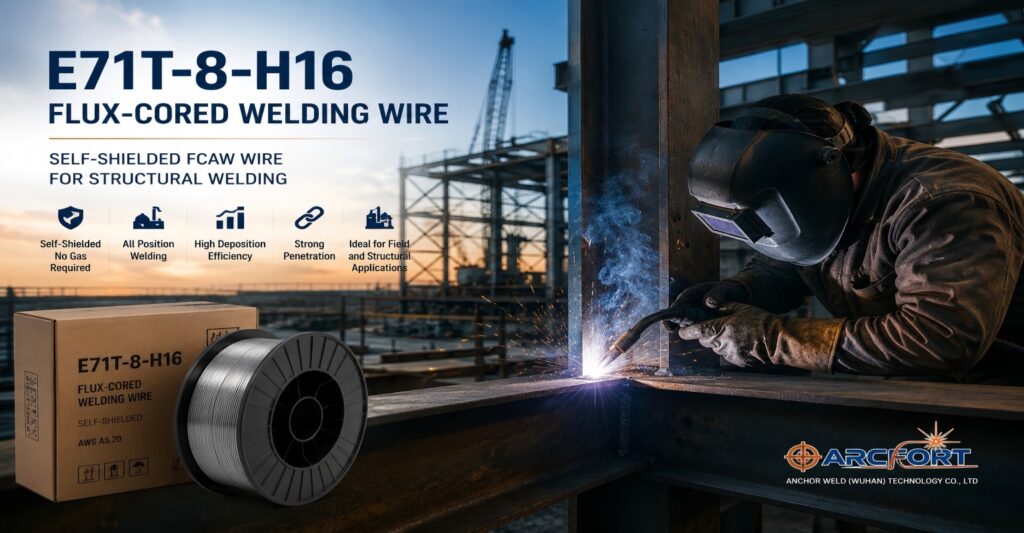
E71T-8-H16 welding wire is a self-shielded flux-cored welding wire used for carbon steel structural welding. It is designed for the FCAW-S process, which means it does not require external shielding gas during welding.
This makes E71T-8-H16 a practical choice for outdoor welding, field construction, structural fabrication, shipbuilding, heavy equipment, tanks, bridges, and other applications where gas-shielded welding may be difficult or unstable.
At ANCHOR WELD (WUHAN) TECHNOLOGY CO., LTD, we focus on welding consumables for industrial users, distributors, and fabrication companies that need reliable welding materials with stable quality and export support.
E71T-8-H16 Classification Meaning
The classification E71T-8-H16 gives useful information about the welding wire:
E means electrode.
7 indicates a 70 ksi tensile strength class.
1 means the wire is suitable for all-position welding.
T means tubular flux-cored wire.
8 indicates a self-shielded flux-cored wire type.
H16 refers to a diffusible hydrogen designator, with a maximum level of 16 ml/100 g weld metal.
A related classification often used in modern specifications is:
E71T8-A2-CS3-H16
This classification helps buyers, engineers, and inspectors understand the welding process, mechanical property level, usability type, shielding method, and hydrogen control requirement.
Why E71T-8-H16 Is Used in Structural Welding
E71T-8-H16 welding wire is commonly selected for structural applications because it combines productivity, portability, and strong welding performance.
Compared with solid wire MIG welding, self-shielded flux-cored wire does not require gas cylinders, gas regulators, or gas hoses. This is especially useful in outdoor environments, windy conditions, and construction sites.
For structural fabrication, the main advantages include:
No external shielding gas required
Suitable for all-position welding
Good deposition efficiency
Strong penetration
Fast-freezing slag system
Suitable for single-pass and multi-pass welding
Practical for field welding and heavy fabrication
Useful for structural projects where productivity matters
These features make E71T-8-H16 a valuable consumable for welding contractors, steel fabricators, shipyards, equipment manufacturers, and industrial maintenance teams.
Typical Applications of E71T-8-H16 Flux-Cored Wire
E71T-8-H16 is widely used in industries where carbon steel structures require reliable weld performance.
Typical applications include:
Steel structure fabrication
Bridge construction
Building frames
Ship and barge fabrication
Tank manufacturing
Machinery components
Heavy equipment repair
General plate fabrication
Field welding
Structural projects with seismic requirements
Because it is self-shielded, E71T-8-H16 is especially useful in jobs where wind or site conditions make gas-shielded welding less practical.
E71T-8-H16 and Welding Position
One important reason customers choose E71T-8-H16 is its all-position welding capability.
It can be used for:
Flat position
Horizontal position
Vertical position
Overhead position
This flexibility is important for structural welding because large steel components cannot always be positioned conveniently. A welding wire that performs well in different positions can help reduce downtime and improve field productivity.
Welding Process and Polarity
E71T-8-H16 is used with the self-shielded flux-cored arc welding process.
In many applications, this type of wire is used with DCEN, also known as direct current electrode negative. However, welding parameters should always follow the product data sheet, welding procedure specification, and project requirements.
Important welding factors include:
Wire diameter
Welding current
Arc voltage
Travel speed
Stick-out
Work angle
Travel angle
Base metal thickness
Joint design
Preheat and interpass temperature
Correct welding parameters help achieve stable arc performance, good bead shape, proper penetration, and reliable mechanical properties.
Common Wire Diameters and Packaging
E71T-8-H16 flux-cored welding wire is usually supplied in medium and large diameters for structural and heavy fabrication work.
Common diameters may include:
1.7 mm
1.8 mm
2.0 mm
Packaging can be supplied according to customer needs, such as coils, spools, or export packing options.
For international customers, packaging is very important. Good packaging helps protect the wire from moisture, damage, rust, and deformation during transport and storage. It also supports smooth feeding during welding.
Key Quality Points Buyers Should Check
When buying E71T-8-H16 welding wire, customers should not only compare price. For structural welding, quality consistency is critical.
Before placing an order, buyers should check the following points.
1. Standard Classification
The certificate and label should clearly show:
AWS A5.20 E71T-8-H16
or the applicable project-required classification.
If the customer requires an additional classification such as AWS A5.36 E71T8-A2-CS3-H16, this should also be confirmed before production or shipment.
2. Mechanical Properties
For structural welding, mechanical performance matters. Buyers should confirm tensile strength, yield strength, elongation, impact toughness, and any project-specific requirements.
3. Diffusible Hydrogen Level
The H16 designator is important because it relates to diffusible hydrogen control. For structural welding, hydrogen control can help reduce the risk of hydrogen-related cracking when proper welding procedures are followed.
4. Welding Performance
Good E71T-8-H16 wire should provide stable arc performance, proper penetration, manageable spatter, smooth feeding, and slag that can be removed efficiently.
5. Wire Surface and Feedability
The wire should feed smoothly through welding equipment. Poor feeding can cause unstable arc behavior, downtime, poor bead appearance, and rework.
6. Packaging and Storage
Self-shielded flux-cored wire should be protected from moisture and contamination. Export packaging should be strong enough for long-distance shipment.
7. Supplier Reliability
A reliable supplier should provide stable quality, clear documentation, professional communication, and long-term supply capability.
E71T-8-H16 vs Gas-Shielded Flux-Cored Wire
E71T-8-H16 is different from gas-shielded flux-cored wire.
Gas-shielded flux-cored wire requires external shielding gas, such as CO₂ or mixed gas. E71T-8-H16 does not require external shielding gas because the flux core creates its own shielding protection during welding.
This difference makes E71T-8-H16 more suitable for outdoor work, field welding, and job sites where gas supply is inconvenient.
However, gas-shielded wires may still be preferred in some shop fabrication environments where gas protection is stable and weld appearance requirements are different. The correct choice depends on the application, equipment, welding position, productivity target, and project specification.
How to Choose a Reliable E71T-8-H16 Supplier
For distributors, importers, and industrial users, choosing the right supplier is as important as choosing the right product.
A reliable E71T-8-H16 welding wire supplier should provide:
Correct standard classification
Stable chemical composition
Reliable mechanical properties
Consistent welding performance
Smooth wire feeding
Strong export packaging
Material test certificates
Batch traceability
Flexible supply support
Professional communication
For structural welding projects, poor consumable quality can increase spatter, downtime, repair welding, inspection risk, and total project cost. Stable consumables help improve welding efficiency and reduce production uncertainty.
Why Work with ANCHOR WELD (WUHAN) TECHNOLOGY CO., LTD
ANCHOR WELD (WUHAN) TECHNOLOGY CO., LTD focuses on manufacturing welding consumables for international markets.
Our product range includes welding electrodes, MIG welding wire, TIG rods, flux-cored welding wire, submerged arc welding wire, welding flux, and other welding materials.
For customers sourcing E71T-8-H16 self-shielded flux-cored welding wire, we understand that stable quality, correct classification, reliable packaging, and clear documentation are essential.
We support distributors, importers, industrial suppliers, and fabrication companies looking for dependable welding consumables and long-term cooperation.
Conclusion
E71T-8-H16 flux-cored welding wire is a self-shielded FCAW wire designed for carbon steel structural welding. It is suitable for all-position welding and is widely used in steel structures, bridges, ships, tanks, heavy equipment, and field fabrication.
When selecting E71T-8-H16 welding wire, buyers should check the standard classification, welding performance, mechanical properties, diffusible hydrogen designation, packaging, certificates, and supplier reliability.
For customers who need stable welding consumables for structural and industrial applications, ANCHOR WELD (WUHAN) TECHNOLOGY CO., LTD can provide professional support and reliable welding material solutions.