

EF4 Welding Wire: A Practical Guide for High-Strength Submerged Arc Welding
What Is EF4 Welding Wire?
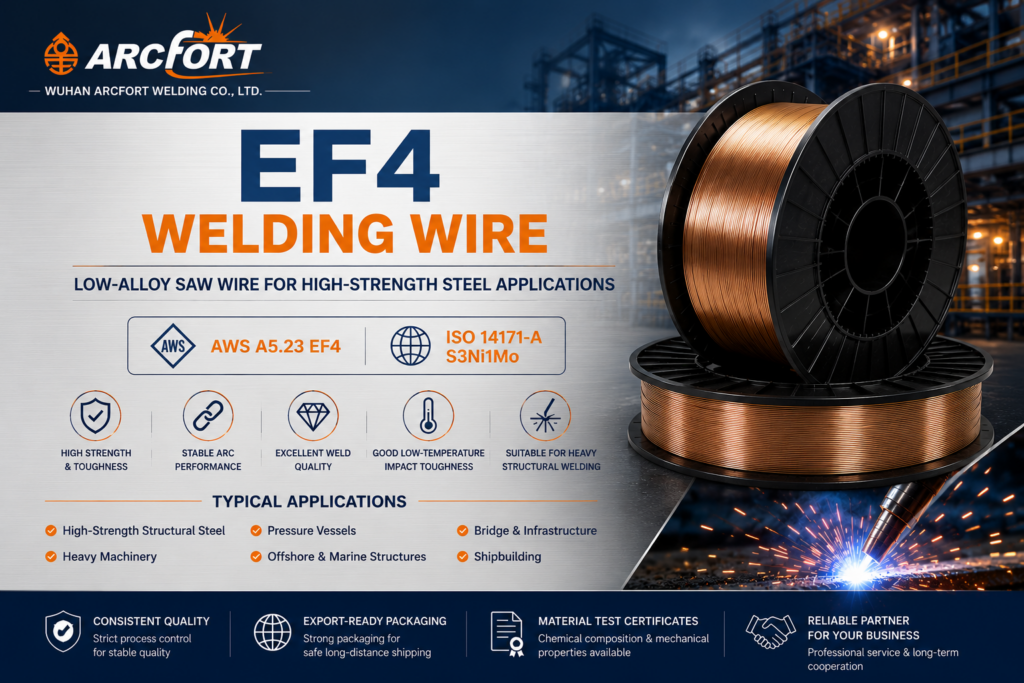
EF4 welding wire is a low-alloy solid wire electrode used for submerged arc welding, also known as SAW. It is commonly classified under AWS A5.23 EF4 and is designed for demanding high-strength steel welding applications.
EF4 is not a general-purpose submerged arc welding wire. It belongs to a group of alloyed SAW wires where controlled chromium, nickel, and molybdenum contents help support weld metal strength, toughness, and performance in heavy industrial fabrication.
For buyers, distributors, and welding engineers, EF4 should not be selected only by product name. The correct selection depends on the base material, welding procedure, flux combination, mechanical property requirements, heat treatment condition, inspection standard, and end-user specification.
EF4 Welding Wire Standard Classification
The common classification for EF4 welding wire is:
AWS A5.23 EF4
It may also appear in some project documents as:
ASME SFA-5.23 EF4
AWS A5.23 covers low-alloy steel electrodes and fluxes for submerged arc welding. In this system, solid wire electrode classification is mainly based on the chemical composition of the electrode.
A professional EF4 quotation should clearly show:
Product name
AWS or ASME classification
Wire diameter
Package form
Lot number
Chemical composition
Recommended flux
Certificate availability
Traceability information
For international purchasing, the standard shown on the quotation, certificate, product label, and packing list should remain consistent.
Chemical Composition of EF4 Welding Wire
EF4 welding wire is typically associated with a controlled Cr-Ni-Mo alloy system.
Important chemical elements may include:
Carbon
Silicon
Manganese
Chromium
Nickel
Molybdenum
Phosphorus
Sulfur
Copper
Chromium, nickel, and molybdenum are important alloying elements for EF4. Nickel helps support weld metal toughness. Molybdenum contributes to strength. Chromium can support hardenability and strength behavior in low-alloy weld metal systems.
For critical projects, buyers should not only check the nominal classification. They should also request a material test certificate and confirm whether the actual chemical composition meets the required EF4 standard range.
Typical Applications of EF4 Welding Wire
EF4 is mainly used in submerged arc welding applications where higher strength and reliable toughness are required.
Typical application areas include:
High-strength structural fabrication
Heavy machinery manufacturing
Pressure vessel fabrication
Offshore structures
Shipbuilding structures
Bridge and infrastructure projects
Crane and lifting equipment
Construction machinery
Industrial equipment fabrication
High-strength low-alloy steel components
These applications often require weld metal with stable strength, toughness, and inspection performance. This is why EF4 is usually selected for more demanding welding projects instead of ordinary carbon steel SAW wires.
Why EF4 Is Used for High-Strength Steel Welding
High-strength steels are widely used when structures must carry higher loads, reduce weight, or meet demanding service conditions. However, welding these steels requires careful filler metal selection.
If the welding wire does not match the base material and procedure requirements, the final weld may fail to meet tensile strength, impact toughness, hardness, or inspection requirements.
EF4 helps meet these demands because its alloy design supports higher-performance weld metal. When used with a suitable submerged arc flux and correct welding parameters, EF4 can help produce stable welds for heavy-duty fabrication work.
The key point is that EF4 is part of a complete welding system. The wire, flux, base material, heat input, preheating, interpass temperature, post-weld heat treatment, and testing requirements all influence final weld quality.
EF4 Welding Wire and Flux Matching
Because EF4 is used in submerged arc welding, the final weld result depends heavily on the wire-flux combination.
A suitable flux can influence:
Arc stability
Slag detachability
Bead appearance
Weld metal chemistry
Tensile strength
Impact toughness
Hydrogen level
Radiographic quality
Welding efficiency
This is why buyers should not only ask, “Do you have EF4 welding wire?” They should also ask:
Which flux is recommended for EF4?
Has the wire-flux combination been tested?
Can you provide chemical and mechanical test data?
Is the combination suitable for our base material?
Can the weld metal meet our project specification?
Is the product suitable for single-pass or multi-pass welding?
For pressure vessels, offshore structures, heavy machinery, and high-strength structures, choosing the wrong flux can create welding risks even when the wire itself meets the required classification.
Common Diameter and Packaging
EF4 welding wire is normally supplied in common submerged arc welding diameters according to customer requirements and welding procedures.
Common diameter ranges may include:
2.5 mm
3.2 mm
4.0 mm
5.0 mm
Packaging may include:
Coils
Spools
Drums
Export pallets
Customized packing according to customer requirements
For international buyers, packaging is not just a logistics detail. Good packaging helps protect the wire surface, reduce rust risk, maintain feeding stability, and support consistent welding performance after long-distance shipment.
Wire Surface and Feedability
In submerged arc welding, feeding stability is essential. A good EF4 welding wire should have a clean, smooth, and consistent surface.
Important quality points include:
Stable diameter tolerance
Smooth copper coating or clean surface finish
Consistent cast and helix
No serious rust or contamination
No surface defects or foreign matter
Reliable feeding through SAW equipment
Feedability directly affects arc stability, welding efficiency, bead consistency, downtime, and rework rate.
For automatic or mechanized SAW production, small feeding problems can cause major production interruptions. That is why wire surface condition, packaging quality, and batch consistency should be carefully controlled.
EF4 Welding Wire vs General SAW Wire
EF4 welding wire is different from general carbon steel submerged arc welding wires.
General SAW wires are commonly used for ordinary carbon steel structures. EF4, however, is designed for higher-strength applications where controlled Cr-Ni-Mo alloying is required.
If a project specification requires EF4, buyers should not replace it with a general SAW wire unless approved by the project engineer or end user.
This distinction is especially important in international trade because the wrong classification may lead to inspection rejection, even if the wire looks similar in appearance.
What Buyers Should Check Before Ordering EF4 Welding Wire
Before placing an order, buyers should confirm the following points.
1. Standard and Classification
The certificate should clearly show:
AWS A5.23 EF4
or, if required:
ASME SFA-5.23 EF4
The same classification should appear on the quotation, product label, packing list, and material certificate.
2. Chemical Composition
Check key elements such as carbon, silicon, manganese, chromium, nickel, molybdenum, phosphorus, sulfur, and copper. The actual results should match the required EF4 classification.
3. Flux Compatibility
Ask for recommended flux and available test data for the wire-flux combination. For critical welding projects, flux compatibility is essential.
4. Mechanical Properties
For high-strength steel applications, mechanical properties may be required after welding. Buyers should confirm tensile strength, yield strength, elongation, impact toughness, and any heat treatment requirements.
5. Packaging and Traceability
Confirm package form, net weight, lot number, label information, and export packing method. Traceability is important for project-controlled welding applications.
6. Supplier Experience
A reliable supplier should understand welding standards, export documentation, batch control, and customer application requirements.
How to Choose a Reliable EF4 Welding Wire Supplier
A reliable EF4 welding wire supplier should provide more than a product name and price. Buyers should look for a supplier that can support:
Correct AWS A5.23 EF4 classification
Stable chemical composition
Smooth wire surface
Reliable feedability
Suitable flux recommendation
Export-grade packaging
Material test certificates
Lot traceability
Technical communication
Long-term supply capability
For distributors and industrial users, supplier reliability is often more important than a small difference in unit price. EF4 is used in demanding projects, so stable quality and documentation support are essential.
EF4 Welding Wire from WUHAN ARCFORT WELDING CO., LTD
WUHAN ARCFORT WELDING CO., LTD focuses on welding consumables for international customers. Our product range includes welding electrodes, MIG wire, TIG rods, flux-cored wire, submerged arc welding wire, welding flux, and related welding materials.
For customers sourcing EF4 welding wire, we understand the importance of correct classification, stable quality, proper packaging, and reliable documentation. We support distributors, importers, industrial suppliers, and fabrication companies looking for dependable welding material solutions.
Our goal is to help customers reduce sourcing risk and build long-term cooperation through stable welding consumables and professional service.
Conclusion
EF4 welding wire is a specialized low-alloy submerged arc welding wire used for high-strength steel applications. It is commonly classified as AWS A5.23 EF4 and is associated with Cr-Ni-Mo alloyed weld metal performance for demanding industrial fabrication.
When selecting EF4 welding wire, buyers should check the standard classification, chemical composition, flux compatibility, wire surface, packaging, certificates, and supplier experience.
For customers who need reliable EF4 welding wire for submerged arc welding applications, WUHAN ARCFORT WELDING CO., LTD can provide professional welding consumable solutions and long-term supply support