
EM11K Welding Wire: AWS A5.17 SAW Wire for Structural Steel Welding
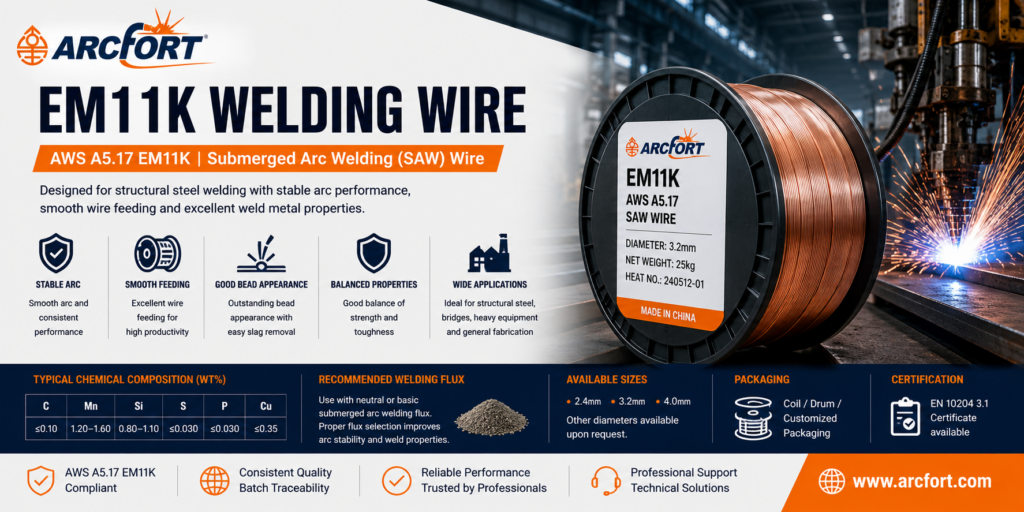
EM11K welding wire is a solid carbon steel wire used for submerged arc welding, also known as SAW. It is designed for automatic and mechanized welding applications where stable arc performance, reliable wire feeding, and a good balance of weld strength and toughness are required.
For structural steel fabricators, bridge manufacturers, heavy equipment producers, and welding consumable distributors, EM11K is a practical choice when consistent submerged arc welding performance is needed. This guide explains what EM11K welding wire is, where it is used, how it works with flux, and what buyers should check before choosing a supplier.
What Is EM11K Welding Wire?
EM11K welding wire is a submerged arc welding wire commonly classified under AWS A5.17. In the SAW process, the wire is continuously fed into the weld joint while granular flux covers the arc. The flux protects the molten weld pool, stabilizes the arc, supports bead formation, and helps control final weld quality.
EM11K is generally understood as a low-carbon, medium-manganese, high-silicon solid wire for submerged arc welding. This chemistry helps support stable welding behavior and a useful balance between strength and toughness, especially in structural steel applications.
Because welding wire names can vary by market and supplier, buyers should always confirm the exact AWS classification, chemical composition, recommended flux, and batch certificate before ordering.
Key Features of EM11K Submerged Arc Welding Wire
EM11K welding wire is used in production environments where weld consistency and mechanical reliability are important.
Key features may include:
Stable arc performance in submerged arc welding
Smooth and consistent wire feeding
Good bead appearance with suitable flux
Balanced strength and toughness
Low-carbon design for structural applications
Medium manganese and high silicon for deoxidation support
Suitable for automatic and mechanized welding systems
Practical use for long weld seams and repetitive fabrication
The final welding result depends on the complete welding system. Wire chemistry, flux type, base metal, welding current, voltage, travel speed, heat input, and procedure qualification all influence final weld quality.
AWS A5.17 EM11K Classification
EM11K is commonly associated with AWS A5.17, the specification for carbon steel electrodes and fluxes for submerged arc welding. This standard covers solid electrodes, composite electrodes, and flux-electrode combinations used in SAW.
For buyers, AWS classification is important because it provides a recognized reference for product selection. However, classification alone is not enough for critical projects. Buyers should also review the supplier’s certificate, chemical composition, wire diameter, recommended flux, and actual welding performance data.
When purchasing EM11K welding wire, request:
AWS A5.17 EM11K classification
Product specification
Wire diameter
Chemical composition
Batch number or heat number
Material test certificate
Recommended welding flux
Packaging information
Traceability documents
For structural or code-related work, the wire-flux combination should be qualified according to the applicable welding procedure.
Chemical Composition of EM11K Welding Wire
EM11K welding wire is typically described as a low-carbon, medium-manganese, high-silicon SAW wire. The controlled chemistry helps support stable arc performance and weld metal quality.
Typical controlled elements include:
Carbon
Manganese
Silicon
Sulfur
Phosphorus
Copper
Other residual elements depending on the supplier and standard
The exact chemical composition should always be verified on the material test certificate. For professional buyers, batch-level certificates are especially important because they help confirm traceability and consistency.
If the customer requires EN 10204 Type 3.1 certification or similar batch documentation, this requirement should be confirmed before production and shipment.
EM11K and Flux Matching
EM11K welding wire should be selected together with a suitable submerged arc welding flux. In SAW, the final weld metal is produced by the interaction of wire, flux, base metal, and welding parameters.
A suitable flux can help improve:
Arc stability
Slag removal
Weld bead profile
Weld metal toughness
Weld chemistry control
Deposition efficiency
Resistance to welding defects
Flux selection depends on the base metal, required mechanical properties, welding current, voltage, plate thickness, joint design, and project standard.
Before choosing flux for EM11K wire, confirm:
Base metal grade
Required tensile strength
Required impact toughness
AC or DC welding condition
Single-wire or multi-wire setup
Heat input range
Plate thickness
Welding speed
Inspection requirement
Applicable welding code
For important structural applications, welding procedure qualification is recommended before mass production.
Common Applications of EM11K Welding Wire
EM11K submerged arc welding wire is mainly used in industrial fabrication where stable welding performance and structural reliability are required.
1. Structural Steel Fabrication
EM11K is suitable for structural steel applications such as beams, columns, frames, and fabricated assemblies. It can help provide stable welding results in automated production environments.
2. Bridge Fabrication
Bridge components often require consistent weld quality and reliable mechanical performance. EM11K can be used where the welding procedure, base metal, and flux combination meet the project requirements.
3. Heavy Equipment Manufacturing
Heavy machinery frames and structural components often need long weld seams and efficient production. EM11K wire can support automatic welding systems used in this type of fabrication.
4. Industrial Steel Components
EM11K may be used for general industrial steel fabrication, including large frames, equipment bases, platforms, and welded structural assemblies.
5. AWS D1.8 Structural Applications
Some EM11K products are promoted for AWS D1.8 and structural steel jobs. For these applications, buyers should confirm the full welding procedure, base metal, flux, and qualification requirements before use.
EM11K vs EM12K Welding Wire
EM11K and EM12K are both submerged arc welding wires, but they should not be treated as identical products. The difference is mainly related to chemical composition and intended welding performance.
EM12K is a more common general-purpose SAW wire used across many carbon steel fabrication applications. EM11K is often positioned for structural applications where a specific balance of strength and toughness is desired.
When comparing EM11K and EM12K, check:
AWS classification
Chemical composition
Recommended flux
Required mechanical properties
Welding procedure qualification
Base metal grade
Customer specification
Certificate requirements
If a project specifies EM11K, do not replace it with EM12K or another grade unless approved by the welding engineer or project owner.
Available Sizes and Packaging
EM11K welding wire is commonly supplied in diameters suitable for submerged arc welding production. Typical sizes may include:
2.4 mm
3.2 mm
4.0 mm
Customized sizes depending on supplier capability
Common packaging options include:
Coils
Drums
Speed-feed drums
Bulk packaging
Customized OEM packaging
For automatic welding, packaging quality is important. Poor winding, damaged packaging, moisture exposure, or unclear labeling can cause feeding problems and production downtime.
A professional supplier should provide clear labels showing:
Product name
AWS classification
Wire diameter
Net weight
Batch number
Heat number
Manufacturing date
Applicable standard
How to Choose a Reliable EM11K Welding Wire Supplier
Choosing a supplier for EM11K welding wire should not be based only on price. Buyers should focus on quality consistency, documentation, and technical support.
1. Confirm Standard Compliance
Check whether the product meets AWS A5.17 EM11K or the equivalent standard required by your project.
2. Request Batch Certificates
Ask for certificates showing batch number, chemical composition, specification, wire diameter, and inspection results.
3. Confirm Type 3.1 Certificate Availability
If your customer requires EN 10204 Type 3.1 or similar batch certification, confirm this before placing the order.
4. Check Wire Surface Quality
The wire should be clean, smooth, and suitable for stable feeding. If copper-coated, the coating should be uniform and well bonded.
5. Confirm Flux Compatibility
Ask the supplier which fluxes are recommended for EM11K wire and whether wire-flux test data is available.
6. Review Mechanical Performance
For structural applications, confirm tensile strength, yield strength, elongation, impact toughness, and applicable test requirements.
7. Check Packaging and Traceability
Each package should have clear batch identification. Proper packaging helps protect the wire during transportation and storage.
8. Evaluate Technical Support
A strong supplier should support flux matching, welding parameters, documentation, and troubleshooting.
Practical Welding Tips for EM11K Wire
To achieve stable performance with EM11K welding wire, follow these practical recommendations:
Match EM11K wire with a suitable submerged arc welding flux.
Keep wire and flux dry and clean during storage.
Follow the flux manufacturer’s drying instructions.
Remove heavy rust, oil, moisture, and contamination from the welding area.
Control welding current, voltage, travel speed, and heat input.
Check wire feeding before continuous production.
Use qualified welding procedures for structural applications.
Inspect weld appearance, slag removal, penetration, and final weld quality.
Keep full traceability for each batch of wire and flux.
Do not substitute EM11K with another wire grade without technical approval.
Why EM11K Is a Practical Choice for Structural Welding
EM11K welding wire is useful for manufacturers that need stable submerged arc welding performance and reliable structural weld quality. Its low-carbon, medium-manganese, high-silicon design helps support a balance between strength, toughness, and welding stability.
For the best results, EM11K should be treated as part of a complete welding system. The wire, flux, base metal, welding parameters, procedure qualification, and quality control all work together to determine final weld performance.
Conclusion
EM11K welding wire is an AWS A5.17 submerged arc welding wire used for structural steel and industrial fabrication. It is selected for stable arc performance, smooth wire feeding, balanced mechanical properties, and dependable automatic welding operation.
For buyers, the key points are standard compliance, chemical composition, flux matching, mechanical performance, packaging, Type 3.1 certificate availability, and batch traceability. With the right supplier, suitable flux, and qualified welding procedure, EM11K welding wire can deliver reliable performance for structural and heavy fabrication applications.