
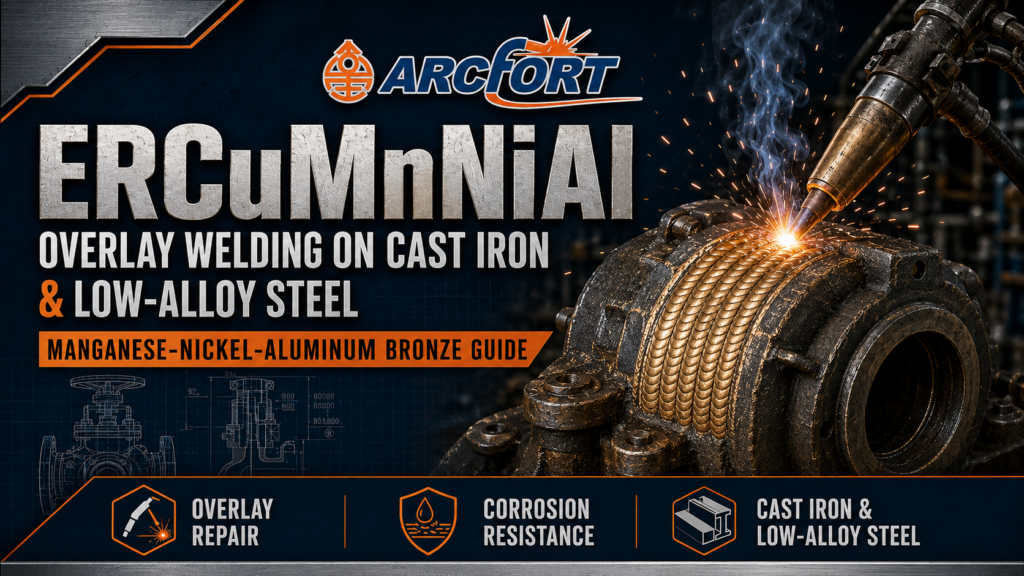
ERCuMnNiAl Overlay Welding on Cast Iron and Low-Alloy Steel
Overlay welding is often used when a component needs a stronger, harder, or more corrosion-resistant surface. Instead of replacing the whole part, a suitable weld metal is deposited onto the surface. This helps restore worn areas, protect the base metal, and improve service life.ERCuMnNiAl
For demanding repair and surfacing work, ERCuMnNiAl is an important copper alloy filler metal.
ERCuMnNiAl is a manganese-nickel-aluminum bronze welding wire. It is widely associated with corrosion-resistant overlay welding, marine repair, cavitation-resistant surfacing, and industrial maintenance. It is often used on cast iron, unalloyed steel, and low-alloy steel when the surface must resist wear, seawater, erosion, or harsh service conditions.
This article explains how ERCuMnNiAl is used for overlay welding on cast iron and low-alloy steel. It also covers key benefits, welding preparation, process control, common problems, and best practices.
What Is ERCuMnNiAl Welding Wire?
ERCuMnNiAl is a copper-based welding filler metal from the manganese-nickel-aluminum bronze family. It contains copper as the main element, with alloying elements such as manganese, nickel, aluminum, and iron.
These elements give the weld deposit a useful balance of toughness, hardness, wear resistance, and corrosion resistance. This makes ERCuMnNiAl suitable for surfacing and repair applications where ordinary steel filler metal may not provide the required surface performance.
ERCuMnNiAl is commonly supplied as:
TIG rods
MIG wires
Bare filler rods
Spooled welding wire
Industrial surfacing consumables
It is used in both repair welding and production welding. In many cases, it is selected when the weld deposit must perform better than the original surface.
Why Use ERCuMnNiAl for Overlay Welding?
Overlay welding with ERCuMnNiAl is not only about filling a damaged area. It is about creating a functional surface.
Cast iron and low-alloy steel are widely used in industrial equipment. However, they may suffer from corrosion, wear, erosion, impact, or cavitation. In some applications, the base material has enough strength but lacks the surface resistance needed for long-term service.
ERCuMnNiAl can help solve this problem by adding a bronze alloy layer onto the surface.
This overlay layer may provide:
Better corrosion resistance
Improved wear resistance
Good toughness
Resistance to erosion
Resistance to cavitation damage
A repairable bronze surface
Longer service life for selected components
This is why ERCuMnNiAl is often considered for industrial repair, marine equipment, pump parts, sliding surfaces, valve components, and cast iron or low-alloy steel parts exposed to demanding service conditions.
ERCuMnNiAl on Cast Iron
Cast iron is useful but difficult to weld. It contains a high level of carbon and can be sensitive to cracking. The risk depends on the type of cast iron, part thickness, restraint, heat input, and cooling rate.
Overlay welding on cast iron requires careful preparation. The goal is to place a useful surface layer while reducing cracking, porosity, and lack of bonding.
ERCuMnNiAl can be used as a surfacing material on cast iron when a corrosion-resistant or wear-resistant overlay is needed. It is especially valuable when the repaired surface must perform better than a standard cast iron surface.
Common cast iron overlay applications include:
Pump housings
Valve bodies
Marine castings
Bearing surfaces
Sliding components
Worn industrial parts
Repair of bronze-contact areas
Corrosion-exposed cast iron surfaces
Before welding cast iron, the damaged area should be inspected carefully. Cracks, oil contamination, old repair welds, and surface defects should be removed before overlay welding begins.
ERCuMnNiAl on Low-Alloy Steel
Low-alloy steel is often used where strength and toughness are required. It appears in heavy machinery, marine equipment, power plant components, pressure-related equipment, and structural parts.
However, low-alloy steel may need surface protection in corrosive or erosive environments. ERCuMnNiAl overlay welding can add a bronze alloy surface while keeping the strength of the steel base material.
This approach can be useful when the component needs:
A corrosion-resistant surface
A wear-resistant working face
Reduced metal loss in service
Resistance to seawater or industrial fluids
Repair of damaged surfaces
A bronze layer on a steel body
The main challenge is controlling dilution between the steel base metal and the bronze overlay. Too much dilution can change the chemistry of the deposit and reduce its performance. A good welding procedure should control heat input, bead placement, and layer thickness.
Key Applications of ERCuMnNiAl Overlay Welding
ERCuMnNiAl is used in applications where the surface must resist harsh conditions. It is especially useful when the base material is strong enough, but the surface needs better protection.
Marine Components
Marine environments are aggressive. Saltwater, impact, erosion, and cavitation can damage many metal surfaces. ERCuMnNiAl is often used for marine repair and surfacing where manganese-nickel-aluminum bronze performance is required.
Pump and Valve Parts
Pump and valve components can face fluid flow, pressure changes, erosion, and corrosion. Overlay welding can help restore worn areas and protect surfaces exposed to aggressive media.
Cast Iron Repair
Some cast iron components are expensive or difficult to replace. ERCuMnNiAl overlay welding may be used to repair selected surfaces and add a protective bronze layer.
Low-Alloy Steel Surfacing
Low-alloy steel parts may need a bronze overlay when exposed to seawater, sliding contact, impact, or corrosion. ERCuMnNiAl can be used for surfacing when the application requires this alloy system.
Cavitation-Resistant Surfaces
Cavitation can damage propellers, pumps, impellers, and fluid-handling parts. ERCuMnNiAl is often linked with applications where resistance to cavitation and erosion is important.
Surface Preparation Before Overlay Welding
Good overlay welding starts with good preparation. ERCuMnNiAl cannot perform well if it is deposited over oil, rust, scale, moisture, paint, or cracked material.
Before welding, the surface should be cleaned to sound metal. Any damaged or loose material should be removed. If cracks are present, they should be fully investigated and removed according to the repair procedure.
Important preparation steps include:
Remove oil and grease
Remove rust and scale
Grind out damaged metal
Remove paint and coatings
Clean the surface to bright metal
Avoid carbon steel contamination when required
Dry the component before welding
Check the joint or repair area before starting
For cast iron, cleaning is especially important. Cast iron may absorb oil or contamination during service. If this contamination remains in the surface, it can cause porosity during welding.
Welding Process Options
ERCuMnNiAl can be used with common arc welding processes, depending on the application, part size, and production requirement.
TIG Welding
TIG welding gives excellent control. It is suitable for smaller repair areas, precision work, and applications where the welder needs to control the weld pool carefully.
TIG welding is often chosen when:
The part is valuable
The repair area is small
Bead placement must be precise
Heat input must be carefully controlled
Appearance and control are important
MIG Welding
MIG welding offers higher deposition rates. It is useful for larger overlay areas, repeated repair work, and industrial surfacing.
MIG welding is often chosen when:
Larger areas must be covered
Productivity is important
Consistent bead placement is needed
Wire feeding can be controlled properly
The repair process is repeated often
Both processes require proper shielding gas, clean filler metal, controlled heat input, and a qualified procedure.
Heat Control and Dilution Control
Heat control is one of the most important parts of ERCuMnNiAl overlay welding.
If heat input is too low, the overlay may not bond properly. If heat input is too high, the weld deposit may become overly diluted by the base metal. This can reduce corrosion resistance, change hardness, and affect the final performance of the overlay.
For cast iron, excessive heat can also increase cracking risk. For low-alloy steel, excessive heat may increase distortion and affect the heat-affected zone.
Good practice includes:
Use a controlled welding procedure
Avoid overheating the part
Control interpass temperature
Use suitable bead overlap
Keep travel speed consistent
Avoid excessive weaving
Build up the overlay in controlled layers
Inspect each layer when required
In many overlay jobs, the first layer acts as a transition layer. The final surface layer should have the chemistry and properties required for service.
Common Problems in ERCuMnNiAl Overlay Welding
Even with the right filler metal, welding problems can still occur. Most problems come from poor preparation, wrong parameters, or lack of process control.
Porosity
Porosity is often caused by contamination, moisture, poor shielding gas, or unstable welding conditions.
To reduce porosity, clean the base metal thoroughly. Keep the filler metal dry. Check gas flow. Avoid drafts. Remove oil and moisture before welding.
Cracking
Cracking can occur when the base metal is highly restrained, contaminated, or cooled too quickly. Cast iron is especially sensitive to cracking.
To reduce cracking risk, use a proper procedure. Control heat input. Consider preheat when required. Avoid sudden cooling. Remove existing cracks before welding.
Lack of Bonding
Lack of bonding means the overlay does not properly fuse with the base material. It can happen when the surface is dirty, the heat input is too low, or the torch angle is wrong.
To prevent this, prepare the surface correctly and watch the weld pool carefully. The overlay should wet into the base surface without excessive dilution.
Excessive Dilution
Excessive dilution can reduce the performance of the bronze overlay. It may happen when heat input is too high or bead placement is not controlled.
To reduce dilution, use controlled parameters and avoid excessive penetration into the base metal.
Distortion
Overlay welding adds heat to the component. This can cause distortion, especially on thin or restrained parts.
To reduce distortion, use balanced welding sequences, controlled heat input, and suitable fixturing when needed.
Best Practices for Cast Iron Overlay Welding
Cast iron requires extra care. Before using ERCuMnNiAl on cast iron, confirm the type of cast iron and the service requirement.
Recommended practices include:
Identify the cast iron grade
Remove cracks before welding
Clean oil and contamination from the surface
Use suitable preheat when required
Avoid rapid cooling
Keep the weld area dry
Use controlled bead placement
Avoid excessive heat input
Inspect the overlay after welding
Not every cast iron part is suitable for repair welding. If the casting is severely cracked, contaminated, or structurally damaged, replacement may be safer than repair.
Best Practices for Low-Alloy Steel Overlay Welding
Low-alloy steel is usually more weldable than cast iron, but it still requires procedure control.
Recommended practices include:
Confirm the steel grade
Check carbon equivalent when needed
Follow preheat requirements
Control interpass temperature
Avoid hydrogen contamination
Control dilution
Use proper bead overlap
Build enough overlay thickness
Inspect the finished surface
For critical parts, the overlay procedure should be qualified. This helps confirm that the weld deposit, bond line, hardness, and final surface properties meet the requirement.
Inspection After Overlay Welding
Inspection is important after ERCuMnNiAl overlay welding. A good-looking bead does not always mean the overlay is sound.
Common inspection steps include:
Visual inspection
Dimensional inspection
Dye penetrant testing
Hardness testing
Bond quality evaluation
Surface finish inspection
Thickness check
Final machining inspection when required
For components in marine or industrial service, inspection should match the risk level of the part. Critical components need stronger quality control than general repair parts.
ERCuMnNiAl vs ERCuNiAl for Overlay Welding
ERCuMnNiAl and ERCuNiAl are both copper alloy filler metals used in demanding applications. However, they are not the same material.
ERCuNiAl is a nickel-aluminum bronze filler metal. It is often used for marine welding, propeller repair, pumps, valves, and corrosion-resistant bronze components.
ERCuMnNiAl is a manganese-nickel-aluminum bronze filler metal. It is often selected where toughness, hardness, corrosion resistance, and surfacing performance are important.
The right choice depends on the base material, service environment, repair goal, and welding procedure. If the job involves overlay welding on cast iron or low-alloy steel, ERCuMnNiAl may be a strong candidate when the specification allows it.
How to Choose ERCuMnNiAl Welding Wire
When choosing ERCuMnNiAl welding wire, do not focus only on price. Overlay welding is often used for important repair work, so material consistency matters.
Check the following points before purchase:
AWS A5.7 classification
Chemical composition
Wire diameter
TIG or MIG form
Surface quality
Diameter tolerance
Packaging condition
Material test certificate
Batch traceability
Supplier experience with overlay welding
For export projects, certificates, packaging, and traceability are also important. A reliable supplier should provide consistent product quality and clear technical documentation.
ERCuMnNiAl Conclusion
ERCuMnNiAl is a valuable filler metal for overlay welding on cast iron and low-alloy steel. Its manganese-nickel-aluminum bronze weld deposit can help improve surface resistance to corrosion, wear, erosion, and cavitation in demanding industrial environments.
For cast iron, ERCuMnNiAl overlay welding requires careful cleaning, heat control, and cracking prevention. For low-alloy steel, the main focus is dilution control, bonding quality, and procedure consistency.
A successful overlay is not created by filler metal alone. It requires the right base material evaluation, surface preparation, welding process, heat control, inspection, and quality documentation.
When used correctly, ERCuMnNiAl can help repair valuable components, extend service life, and provide a durable bronze alloy surface for industrial and marine applications.