

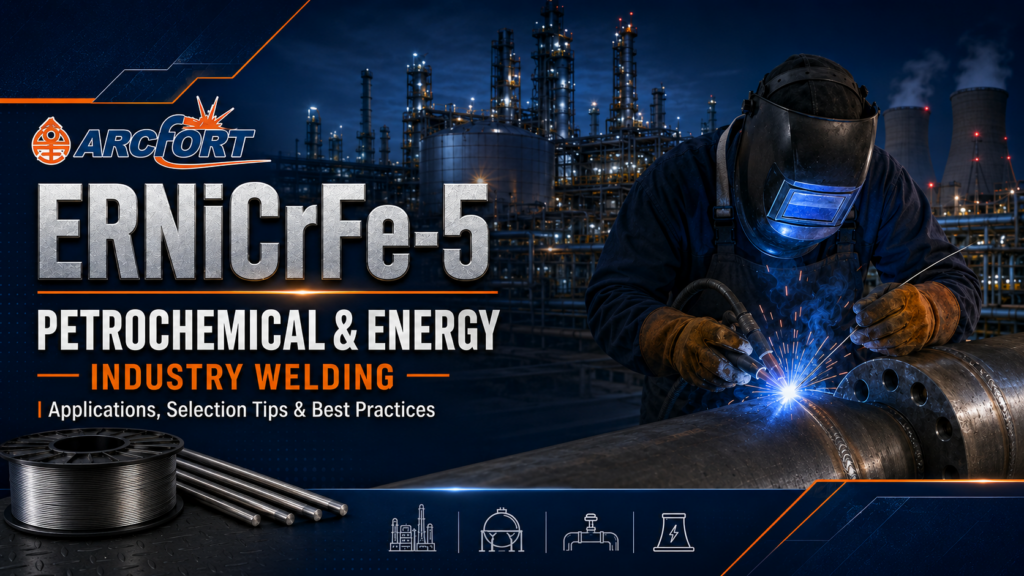
ERNiCrFe-5 in Petrochemical and Energy Industry Welding
In petrochemical plants and energy facilities, welding quality directly affects equipment reliability, production safety and long-term operating stability. Pipelines, pressure equipment, heat-resistant components and maintenance welds are often exposed to demanding service conditions. For these applications, filler metal selection becomes a critical part of welding procedure planning.ERNiCrFe-5
ERNiCrFe-5 is a nickel-based welding filler metal commonly used in industrial welding projects where material compatibility, joint reliability and service resistance are important. In petrochemical and energy industry welding, ERNiCrFe-5 is often considered for dissimilar metal joints, repair welding, overlay applications and fabrication involving nickel alloy materials.
Why It Is Important in Petrochemical Welding
Petrochemical facilities include refineries, chemical processing units, storage systems, reactors, pressure vessels and piping networks. These systems often operate under complex conditions involving heat, pressure, process media and continuous production cycles.
In such environments, welding consumables must support stable weld quality and reduce the risk of premature joint failure. ERNiCrFe-5 is selected when ordinary filler metals may not provide the required compatibility for specific base materials or joint designs.
Its role is especially important in areas such as:
Process piping
Heat exchanger components
Pressure equipment fabrication
Maintenance and repair welding
Dissimilar metal joining
Weld overlay work
High-value industrial assemblies
For petrochemical fabricators, choosing ERNiCrFe-5 is not only a technical decision. It is also a way to support equipment reliability and reduce the possibility of costly downtime.
This Wire in Energy Industry Welding
The energy industry includes power plants, thermal systems, industrial boilers, turbine-related equipment, pressure systems and maintenance operations. These applications often require welding materials that can perform reliably in demanding service environments.
ERNiCrFe-5 can be used in energy-related welding projects where nickel alloy filler metals are required for joint compatibility and stable welding performance. It is often applied in fabrication and repair work involving critical components, especially where dissimilar materials are joined.
Typical energy industry applications include:
Power plant maintenance
Boiler-related welding
Heat-resistant component fabrication
Pressure system repair
Industrial pipeline welding
Equipment refurbishment
Weld overlay for service protection
Because energy facilities often require strict quality control, ERNiCrFe-5 is usually used with qualified welding procedures, controlled parameters and proper inspection requirements.
Dissimilar Metal Welding with ERNiCrFe-5
One of the main reasons ERNiCrFe-5 is used in petrochemical and energy projects is its suitability for dissimilar metal welding. In industrial systems, different metals may be joined because each material serves a different purpose in the final equipment.
Dissimilar metal welding can be challenging because the base materials may respond differently during welding and service. The filler metal must help create a stable transition between them. ERNiCrFe-5 is often selected when a nickel-based filler metal is needed to support this type of joint.
Common dissimilar welding situations may include:
Nickel alloy to steel
Nickel alloy to stainless steel
Repair welding on mixed-material equipment
Joining new components to existing systems
Fabrication involving corrosion-resistant or heat-resistant materials
For welding engineers, the key is not only choosing the right filler metal, but also controlling the full welding process, including preparation, procedure qualification and inspection.
ERNiCrFe-5 for Repair and Maintenance Welding
Petrochemical and energy plants often run for long periods, and equipment maintenance is part of normal operation. When components require repair, the welding filler metal must be selected carefully to match the service condition and the existing material.
ERNiCrFe-5 can be useful in repair welding because it is applied in demanding industrial environments where weld reliability matters. Maintenance welding may involve aged materials, limited access, complex joint designs or strict shutdown schedules.
In these cases, welding teams should focus on:
Careful surface cleaning
Correct identification of base materials
Proper joint preparation
Suitable welding process selection
Controlled heat input
Traceable consumables
Post-weld inspection
A successful repair is not only about depositing weld metal. It is about restoring service reliability while minimizing production interruption.
Welding Process Selection for ERNiCrFe-5
ERNiCrFe-5 may be used with different welding processes depending on the product form, application and project requirements. In petrochemical and energy fabrication, common process considerations include joint quality, productivity, welding position, accessibility and inspection standards.
TIG welding is often selected for precision work, root passes, repair welding and applications requiring clean weld control.
MIG welding may be used when higher productivity is required, especially in shop fabrication or larger weldments.
Submerged arc welding can be considered for heavy sections, long seams or high-deposition production work when the project conditions allow it.
The best welding process depends on the base material, component design, welding position and applicable project standard. For critical equipment, welding procedures should be qualified before production welding begins.
Best Practices for Using ERNiCrFe-5
To achieve reliable results with ERNiCrFe-5, welding teams should follow disciplined preparation and quality control practices.
Before welding, the base material should be clean and free from oil, moisture, paint, oxide scale and other contamination. Nickel-based filler metals are often used in critical applications, so cleanliness is especially important.
During welding, stable parameters should be maintained. Excessive heat input, poor shielding gas coverage, incorrect travel speed or improper technique may lead to weld defects. Welders should follow approved welding procedures and avoid unnecessary variation during production.
Consumables should be stored in a dry and clean environment. Packaging should remain sealed before use, and batch information should be recorded when traceability is required.
After welding, inspection should be performed according to project requirements. Visual inspection, dimensional checks and additional testing may be needed for critical petrochemical and energy equipment.
What Buyers Should Consider When Sourcing ERNiCrFe-5
For industrial buyers, distributors and project contractors, sourcing ERNiCrFe-5 is not only about price. Consistency, documentation and delivery reliability are equally important.
Key purchasing considerations include:
Product form and size availability
Welding process compatibility
Batch traceability
Quality documentation
Packaging condition
Stable supply capacity
Technical support
OEM or private label options
Experience with export and industrial projects
For distributors serving petrochemical and energy customers, ERNiCrFe-5 can be an important specialty product in a nickel alloy welding consumables portfolio. It supports customers who need dependable filler metals for demanding applications rather than general-purpose welding work.
ERNiCrFe-5 as a Strategic Product for Distributors
Welding consumables distributors often serve many customer groups, including fabricators, maintenance contractors, engineering companies, shipyards, pipeline contractors and industrial plants. ERNiCrFe-5 can help distributors expand into higher-value applications.
Compared with common welding consumables, specialty nickel alloy filler metals usually require more technical communication. Customers may ask about application suitability, welding process, packaging, certificates and delivery time. A distributor that can provide fast response and reliable product support has a stronger chance of winning repeat business.
For this reason, ERNiCrFe-5 is not just another welding wire or rod. It is a technical product that can strengthen a distributor’s position in petrochemical and energy industry supply chains.
Conclusion
ERNiCrFe-5 plays an important role in petrochemical and energy industry welding, especially in applications involving nickel alloys, dissimilar metal joints, repair welding and critical industrial equipment. Its value comes from its suitability for demanding fabrication and maintenance environments where weld reliability is essential.
For welding engineers, ERNiCrFe-5 should be selected as part of a complete welding procedure strategy. For buyers and distributors, it represents a professional-grade welding consumable with strong application value in industrial markets.
By using proper welding procedures, clean handling practices, suitable process selection and reliable product sourcing, ERNiCrFe-5 can support safer, more stable and more dependable welding results in petrochemical and energy applications.