

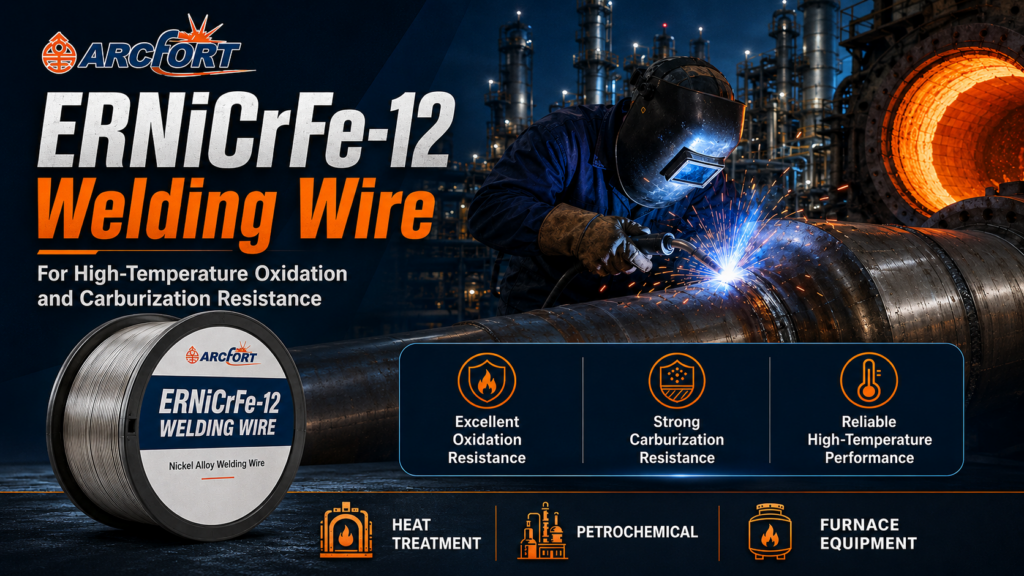
ERNiCrFe-12 Welding Wire for High-Temperature Oxidation and Carburization Resistance
Introduction
ERNiCrFe-12 welding wire is a nickel-chromium-iron filler metal designed for demanding high-temperature welding applications. It is commonly used for welding heat-resistant nickel alloys where excellent oxidation resistance, carburization resistance and long-term thermal stability are required.
In industries such as heat treatment, furnace manufacturing, petrochemical processing, power generation and chemical equipment fabrication, welded components are often exposed to extreme temperatures, aggressive atmospheres and repeated thermal cycling. Under these conditions, ordinary welding materials may lose strength, scale heavily, crack or fail prematurely.
ERNiCrFe-12 welding wire provides a reliable solution for applications where the weld metal must resist oxidation, carburization and high-temperature corrosion. It is especially suitable for equipment operating in severe thermal environments.
What Is ERNiCrFe-12 Welding Wire?
ERNiCrFe-12 is a nickel-based welding wire classified under nickel alloy filler metals. It is mainly used for welding high-temperature nickel-chromium-iron alloys, including Alloy 602 CA and similar heat-resistant alloys.
The weld deposit contains nickel, chromium, iron and alloying elements that support oxidation resistance and stability at elevated temperatures. This makes ERNiCrFe-12 a preferred filler metal for applications where welded joints must perform in oxidizing, carburizing and thermal cycling conditions.
ERNiCrFe-12 welding wire is available in different forms depending on the welding process, including:
TIG welding rod
MIG welding wire
Straight length wire
Spool wire
Nickel alloy filler wire
Because of its special high-temperature performance, ERNiCrFe-12 is widely used in equipment where both heat resistance and corrosion resistance are important.
Why High-Temperature Oxidation Resistance Matters
High-temperature oxidation occurs when metal reacts with oxygen at elevated temperatures. In furnace systems, heat treatment lines and thermal processing equipment, oxidation can cause scaling, metal loss and surface degradation.
If the weld metal has poor oxidation resistance, the welded area may become the weakest part of the equipment. This can lead to cracking, thinning, distortion and reduced service life.
ERNiCrFe-12 welding wire is designed to help form oxidation-resistant weld deposits. Its chromium content supports the formation of a protective oxide layer, while the nickel-based structure helps maintain weld toughness and stability under heat.
For industrial equipment exposed to continuous high temperature, oxidation resistance is not only a performance advantage. It is a key factor in safety, maintenance cost and production reliability.
Why Carburization Resistance Is Important
Carburization is a high-temperature damage mechanism where carbon enters the metal surface and changes the material structure. This often occurs in furnace atmospheres, petrochemical environments and heat treatment processes where carbon-containing gases are present.
Carburization can cause:
Loss of ductility
Embrittlement
Surface cracking
Reduced thermal fatigue resistance
Shorter equipment service life
Weld failure under cyclic heating
ERNiCrFe-12 welding wire is used where carburization resistance is required in addition to oxidation resistance. This makes it suitable for welding components used in carburizing furnaces, heat treatment equipment and high-temperature petrochemical units.
Key Features of ERNiCrFe-12 Welding Wire
1. Excellent Oxidation Resistance
ERNiCrFe-12 provides strong resistance to high-temperature oxidation. This makes it suitable for welding parts exposed to furnace atmospheres, hot gases and thermal processing conditions.
2. Good Carburization Resistance
The alloy design helps the weld metal resist carbon penetration in high-temperature carburizing environments. This is important for heat treatment and petrochemical applications.
3. High-Temperature Strength
ERNiCrFe-12 weld deposits are designed to maintain stability under elevated temperatures. This helps welded components withstand long-term thermal service.
4. Resistance to Thermal Cycling
Many industrial components experience repeated heating and cooling. ERNiCrFe-12 welding wire helps produce welds that can better tolerate thermal expansion, contraction and cyclic stress when used with proper welding procedures.
5. Reliable Weldability
With correct surface preparation, shielding gas and welding parameters, ERNiCrFe-12 welding wire provides stable welding performance, smooth bead appearance and consistent weld quality.
6. Suitable for Severe Industrial Environments
ERNiCrFe-12 is used in applications involving heat, oxidation, carburization and high-temperature corrosion, making it valuable for demanding industrial equipment.
Main Applications of ERNiCrFe-12 Welding Wire
ERNiCrFe-12 welding wire is selected for applications where high-temperature performance is critical. Common applications include:
Heat treatment furnace components
Carburizing furnace parts
Furnace rolls and furnace fixtures
Radiant tubes
Muffles and retorts
Kiln and thermal processing equipment
Petrochemical process heaters
High-temperature reformer components
Chemical processing equipment
Power generation equipment
Heat-resistant alloy fabrication
Industrial maintenance and repair welding
These applications require filler metals that can provide stable performance in harsh operating environments.
ERNiCrFe-12 for Heat Treatment Furnaces
Heat treatment furnaces often operate at high temperatures and may use atmospheres that promote oxidation or carburization. Components such as trays, baskets, tubes, fixtures, muffles and retorts are exposed to thermal cycling and chemical attack.
ERNiCrFe-12 welding wire is suitable for furnace-related fabrication and repair because it helps provide weld metal with oxidation and carburization resistance.
In heat treatment furnace applications, ERNiCrFe-12 can be used for:
Carburizing furnace fixtures
Heat-resistant trays and baskets
Furnace tube repair
Retort and muffle welding
Thermal processing equipment
High-temperature structural parts
Using the correct welding wire helps improve equipment durability and reduce the risk of premature weld failure.
ERNiCrFe-12 for Petrochemical Equipment
Petrochemical equipment may operate under high temperatures, pressure and chemically aggressive atmospheres. In some process units, components are exposed to hot gases, carbon-rich environments and oxidation conditions.
ERNiCrFe-12 welding wire is a suitable option for selected petrochemical applications where nickel alloy welds must resist high-temperature corrosion, oxidation and carburization.
Typical petrochemical-related applications include:
Process heaters
Reforming units
Thermal cracking equipment
High-temperature piping parts
Furnace tubes
Heat exchanger components
Chemical processing vessels
Refinery maintenance parts
In these environments, weld quality has a direct effect on operational reliability. A properly selected nickel alloy welding wire can help reduce maintenance problems and improve service life.
ERNiCrFe-12 for Oxidizing and Carburizing Atmospheres
One of the main advantages of ERNiCrFe-12 welding wire is its suitability for both oxidizing and carburizing high-temperature environments. This makes it useful for equipment exposed to complex service conditions.
Oxidizing atmospheres may appear in:
Heat treatment lines
Industrial furnaces
Thermal processing systems
Hot gas ducts
Kilns and combustion equipment
Carburizing atmospheres may appear in:
Carburizing furnaces
Petrochemical process units
Carbon-rich gas environments
High-temperature treatment systems
Certain refinery operations
When both oxidation and carburization are concerns, ERNiCrFe-12 is often considered because it supports more durable weld performance in severe conditions.
Welding Process Options
ERNiCrFe-12 welding wire can be used in different welding processes depending on the application, equipment and production requirement.
TIG Welding
TIG welding is often selected for precision work, root passes, repair welding and high-quality nickel alloy joints. ERNiCrFe-12 TIG rod provides good control over heat input and weld pool quality.
MIG Welding
MIG welding may be used when higher productivity is required. ERNiCrFe-12 MIG wire is suitable for fabrication work where stable wire feeding, proper shielding gas and controlled parameters are available.
Repair Welding
ERNiCrFe-12 is also used for repair welding of high-temperature equipment, especially when existing components are made from compatible nickel-chromium-iron alloys.
Welding Tips for ERNiCrFe-12
To obtain good weld quality, proper welding preparation is essential. Nickel alloy welding requires more careful control than ordinary carbon steel welding.
Important welding tips include:
Clean the base metal before welding
Remove oil, grease, paint, oxide and moisture
Use suitable shielding gas coverage
Avoid contamination from carbon steel tools
Control heat input carefully
Use qualified welding parameters
Maintain proper interpass temperature
Use compatible filler metal for the base alloy
Follow approved welding procedures
Check material certificates when required
Good welding practice helps reduce the risk of porosity, cracking, lack of fusion and reduced corrosion resistance.
Chemical Composition Considerations
The performance of ERNiCrFe-12 welding wire comes from its nickel-chromium-iron alloy system. Nickel provides toughness and corrosion resistance. Chromium improves oxidation resistance. Other alloying elements help support high-temperature strength and resistance to carburization.
Because project requirements may vary, buyers should always check the actual chemical composition according to the applicable standard, welding procedure specification and material certificate.
For critical applications, chemical composition, mechanical properties and weld procedure qualification should be confirmed before production welding.
How to Select ERNiCrFe-12 Welding Wire
Choosing the correct ERNiCrFe-12 welding wire requires more than simply matching a product name. Industrial buyers should consider the full service environment and welding requirements.
1. Confirm the Base Metal
ERNiCrFe-12 is commonly used for Alloy 602 CA and similar high-temperature nickel alloys. Always confirm base metal compatibility before welding.
2. Identify the Service Temperature
High-temperature equipment may have different requirements depending on operating temperature, thermal cycling and atmosphere.
3. Check the Atmosphere
Determine whether the component will be exposed to oxidation, carburization, sulfidation, hot gas corrosion or mixed environments.
4. Choose the Welding Process
Select TIG rod, MIG wire or another suitable form based on the welding method and production needs.
5. Review Quality Documents
For industrial applications, request material certificates, chemical composition reports and relevant quality documents.
6. Consider Packaging and Storage
Nickel alloy welding wire should be stored in clean, dry conditions to avoid contamination and surface damage.
Advantages for Industrial Buyers
ERNiCrFe-12 welding wire offers several benefits for manufacturers, distributors, fabricators and maintenance companies:
Suitable for high-temperature nickel alloy welding
Helps resist oxidation and carburization
Supports furnace and petrochemical equipment applications
Useful for both fabrication and repair welding
Helps improve weld reliability in severe environments
Suitable for industrial buyers needing specialized nickel alloy filler metals
Helps reduce rework and premature equipment failure when properly applied
For equipment that operates continuously at high temperature, welding wire quality is an important part of long-term performance.
Common Industries Using ERNiCrFe-12 Welding Wire
ERNiCrFe-12 welding wire is used in industries that require heat-resistant and corrosion-resistant welding solutions, including:
Heat treatment industry
Furnace manufacturing
Petrochemical industry
Chemical processing
Power generation
Refinery maintenance
Thermal processing equipment
Industrial equipment fabrication
Nickel alloy component repair
High-temperature alloy manufacturing
These industries value welding materials that can perform reliably under heat, oxidation and chemically aggressive conditions.
ERNiCrFe-12 vs General Nickel Alloy Welding Wire
Not all nickel alloy welding wires are designed for the same service conditions. Some filler metals are mainly used for corrosion resistance at moderate temperatures, while others are designed for high-temperature strength or dissimilar metal welding.
ERNiCrFe-12 is different because it is focused on demanding high-temperature performance, especially where oxidation and carburization resistance are required.
When compared with general nickel alloy welding wire, ERNiCrFe-12 is often preferred for:
Higher temperature service
Furnace atmospheres
Carburizing environments
Heat treatment equipment
Alloy 602 CA welding
Severe thermal cycling applications
Correct filler metal selection helps ensure that the weld metal matches the demands of the operating environment.
Quality Control for ERNiCrFe-12 Welding Wire
For critical industrial applications, quality control is essential. Buyers should pay attention to:
Wire surface condition
Diameter tolerance
Chemical composition
Heat number traceability
Packaging condition
Material certificate availability
Welding performance consistency
Batch control and inspection records
Reliable quality control helps fabricators maintain stable welding performance and reduce production risk.
Conclusion
ERNiCrFe-12 welding wire is a high-performance nickel alloy filler metal for applications requiring high-temperature oxidation and carburization resistance. It is widely used in furnace equipment, heat treatment systems, petrochemical units, chemical processing equipment and other heat-resistant industrial applications.
Its nickel-chromium-iron composition helps provide weld metal with strong oxidation resistance, carburization resistance and thermal stability. For welding Alloy 602 CA and similar high-temperature nickel alloys, ERNiCrFe-12 is an important filler metal choice.
When selecting ERNiCrFe-12 welding wire, buyers should consider base metal compatibility, operating temperature, service atmosphere, welding process and quality documentation. With proper selection and correct welding procedures, ERNiCrFe-12 welding wire can help improve weld reliability, reduce maintenance problems and support long service life in severe high-temperature environments.