

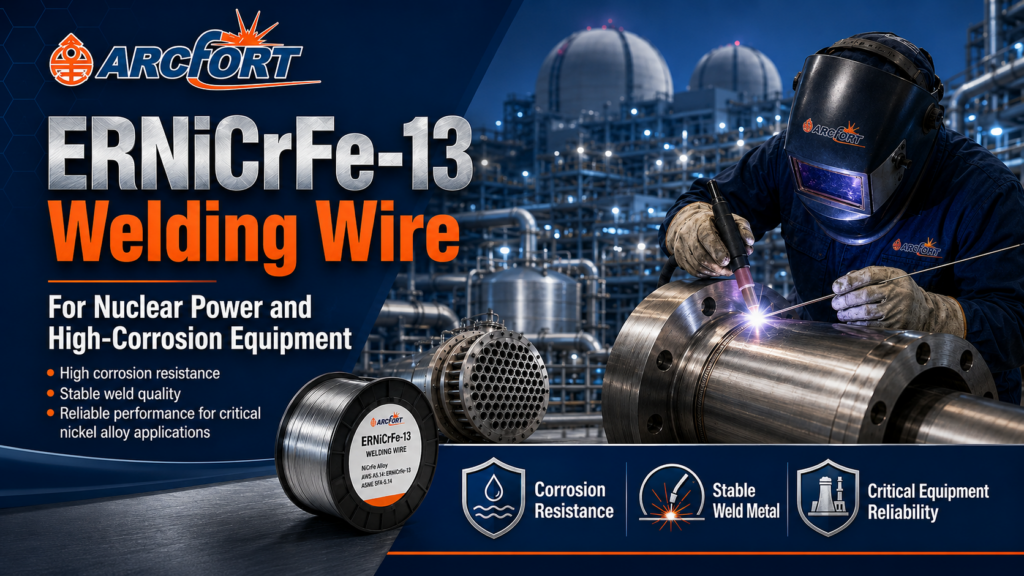
ERNiCrFe-13 Welding Wire for Nuclear Power and High-Corrosion Equipment
ERNiCrFe-13 welding wire is a specialized nickel-chromium-iron filler metal designed for demanding welding applications where corrosion resistance, weld stability and long-term service reliability are critical. It is commonly used for welding high-chromium nickel alloys, especially in nuclear power equipment, high-corrosion industrial systems, pressure components and critical dissimilar metal joints.
In industries such as nuclear power, chemical processing, high-pressure equipment manufacturing and corrosion-resistant alloy fabrication, weld quality is not only a production requirement. It is directly related to safety, service life and long-term performance. ERNiCrFe-13 welding wire is selected when the welded joint must resist corrosion, stress-related damage and cracking under severe operating conditions.
For buyers, engineers and welding fabricators, understanding ERNiCrFe-13 helps ensure correct filler metal selection for critical nickel alloy welding applications.
What Is ERNiCrFe-13 Welding Wire?
ERNiCrFe-13 is a nickel-based welding wire classified under nickel and nickel-alloy bare welding electrodes and rods. It belongs to the nickel-chromium-iron filler metal family and is designed for high-performance welding of corrosion-resistant nickel alloys.
This welding wire is often associated with welding Alloy 690-type materials and similar high-chromium nickel alloys. These base metals are commonly used where resistance to high-temperature water corrosion, oxidation and aggressive corrosion environments is required.
ERNiCrFe-13 welding wire is typically used in:
TIG welding
MIG welding
Automated welding systems
Overlay welding
Repair welding
Dissimilar metal welding
Critical nickel alloy fabrication
Its weld deposit is engineered to provide a strong balance of corrosion resistance, crack resistance and mechanical stability.
Why ERNiCrFe-13 Is Used in Nuclear Power Equipment
Nuclear power equipment requires materials that can perform safely for long service periods under strict operating conditions. Components may face high temperature, pressure, water chemistry, stress and corrosion challenges.
ERNiCrFe-13 welding wire is suitable for nuclear-related applications because it supports corrosion-resistant weld metal and stable welding performance in critical nickel alloy joints.
Common nuclear power applications may include:
Steam generator components
Reactor-related nickel alloy parts
Alloy 690-type component welding
Pressure boundary components
Dissimilar metal joints
Corrosion-resistant cladding
Repair welding of critical equipment
High-integrity structural welds
In nuclear equipment manufacturing, weld defects can create serious risks. Therefore, filler metal selection must focus on long-term reliability, weld integrity and resistance to cracking.
ERNiCrFe-13 for High-Corrosion Equipment
High-corrosion equipment is widely used in chemical processing, power generation, pressure vessels, petrochemical systems and environmental control equipment. In these industries, weld metal can be exposed to aggressive media, high temperature and complex stress conditions.
ERNiCrFe-13 welding wire is used where ordinary stainless steel or general nickel alloy filler metals may not provide enough corrosion resistance or crack resistance.
Typical high-corrosion applications include:
Chemical processing vessels
Heat exchangers
Corrosion-resistant piping
Pressure equipment
High-temperature water systems
Nickel alloy cladding
Dissimilar metal transition joints
Industrial corrosion-resistant equipment
Repair of high-value components
For high-corrosion service, the weld metal must match the performance requirements of the base material. ERNiCrFe-13 helps provide reliable performance when welding compatible high-chromium nickel alloys.
Key Properties of ERNiCrFe-13 Welding Wire
1. Excellent Corrosion Resistance
ERNiCrFe-13 contains a high level of nickel and chromium. Nickel provides strong resistance to many corrosive environments, while chromium helps improve resistance to oxidation and corrosion in aggressive service conditions.
This makes the wire suitable for equipment exposed to high-temperature water, steam, chemical media and corrosion-sensitive service environments.
2. Good Resistance to Ductility-Dip Cracking
Ductility-dip cracking, also known as DDC, is a concern in certain nickel alloy weld metals. It can occur in the solid state during welding thermal cycles and may affect weld integrity in critical applications.
ERNiCrFe-13 is designed to improve resistance to DDC compared with some earlier nickel-chromium-iron filler metal systems. This is one reason it is considered for high-reliability welding applications.
3. Stable Weld Metal Performance
Critical equipment requires welds with consistent performance. ERNiCrFe-13 welding wire provides stable weld deposits when used with proper welding procedures, clean base metals and suitable process control.
Stable weld metal helps reduce the risk of cracking, poor fusion and inconsistent corrosion resistance.
4. Suitable for Alloy 690-Type Welding
Alloy 690-type materials are often used in high-temperature and corrosion-resistant service. ERNiCrFe-13 welding wire is commonly selected for welding similar high-chromium nickel alloys and related components.
Correct matching between base metal and filler metal helps improve weld reliability and service performance.
5. Useful for Dissimilar Metal Welding
In many industrial systems, nickel alloys must be joined to stainless steels, low-alloy steels or other corrosion-resistant alloys. ERNiCrFe-13 can be considered for certain dissimilar metal welding applications where corrosion resistance and weld metal stability are required.
The final filler metal selection should always depend on the base metals, service temperature, corrosion environment and welding procedure requirements.
ERNiCrFe-13 Chemical Composition and Performance Logic
The performance of ERNiCrFe-13 comes from its nickel-chromium-iron alloy design.
Nickel helps provide toughness, corrosion resistance and compatibility with nickel alloy base metals. Chromium supports oxidation resistance and corrosion resistance. Iron contributes to alloy balance and compatibility. Additional alloying elements may be used to improve weld metal stability and cracking resistance.
Because ERNiCrFe-13 is used in critical applications, chemical composition should always be verified through material certificates, applicable standards and project specifications.
For nuclear power and high-corrosion equipment, buyers should pay close attention to:
Chemical composition
Heat number traceability
Mechanical properties
Welding procedure qualification
Surface condition
Wire diameter tolerance
Batch consistency
Cleanliness and packaging
These details are important for quality control and final weld performance.
Welding Processes for ERNiCrFe-13
ERNiCrFe-13 welding wire can be used in different welding processes depending on the application and production method.
TIG Welding
TIG welding is often used for critical root passes, precision welding, repair welding and high-quality nickel alloy joints. ERNiCrFe-13 TIG rod provides good control over heat input and weld pool behavior.
TIG welding is suitable for applications where weld quality and appearance are very important.
MIG Welding
MIG welding with ERNiCrFe-13 wire can improve productivity in suitable fabrication conditions. It is commonly used where higher deposition efficiency is required while maintaining stable weld quality.
Wire feeding stability, shielding gas coverage and parameter control are important for consistent results.
Automated Welding
For nuclear power equipment and corrosion-resistant components, automated welding can help improve repeatability and reduce human variation. ERNiCrFe-13 can be used in automated systems when proper process qualification is completed.
Overlay and Cladding
ERNiCrFe-13 may also be used for corrosion-resistant overlay or cladding applications where a nickel alloy surface layer is required on another base material.
In overlay welding, dilution control is especially important because excessive dilution can reduce corrosion resistance.
Important Welding Considerations
Nickel alloy welding requires strict process control. Even a high-quality welding wire cannot deliver good results if welding conditions are poor.
Clean the Base Metal Thoroughly
Before welding, remove:
Oil
Grease
Moisture
Paint
Oxides
Rust
Dirt
Cutting fluid
Surface contamination
Nickel alloy welds are sensitive to contamination. Poor cleaning can lead to porosity, cracking or reduced corrosion resistance.
Control Heat Input
Heat input affects weld metal structure, residual stress and cracking tendency. Too much heat input may increase distortion and reduce corrosion performance. Too little heat input may cause poor fusion or unstable welding.
Welding parameters should follow a qualified welding procedure.
Use Proper Shielding Gas
For TIG and MIG welding, shielding gas quality and coverage are essential. Poor shielding can cause oxidation, porosity and surface defects.
The welding area should be protected from drafts and contamination.
Control Interpass Temperature
For multi-pass welding, interpass temperature control helps maintain consistent weld properties. Excessive interpass temperature can affect weld metal performance, while insufficient thermal control may increase stress and cracking risk.
Avoid Contamination from Carbon Steel Tools
Tools used on carbon steel should not be used directly on nickel alloy surfaces without proper cleaning. Cross-contamination can affect corrosion performance.
Use dedicated stainless or nickel alloy cleaning tools when required.
ERNiCrFe-13 in Dissimilar Metal Welding
Dissimilar metal welding is common in nuclear power and chemical equipment. It may involve joining nickel alloys to stainless steels or low-alloy steels. These joints often face different thermal expansion rates, metallurgical compatibility issues and corrosion concerns.
ERNiCrFe-13 welding wire can be used in selected dissimilar metal welding applications where high corrosion resistance and weld metal stability are needed.
Key factors include:
Base metal combination
Service temperature
Corrosion environment
Joint design
Dilution level
Heat input
Welding process
Post-weld heat treatment requirements
Inspection standards
For critical service, dissimilar metal welding should always be supported by procedure qualification and engineering review.
ERNiCrFe-13 vs General Nickel Alloy Welding Wire
Not every nickel alloy welding wire is designed for the same purpose. Some are intended for general corrosion resistance, some for high-temperature service, some for dissimilar metal welding and some for nuclear-related applications.
ERNiCrFe-13 is more specialized. It is selected when the application requires:
High corrosion resistance
Alloy 690-type compatibility
Good DDC resistance
Stable weld metal performance
Critical equipment reliability
Nuclear power or high-corrosion service suitability
Consistent quality control
For ordinary fabrication, a general nickel alloy filler may be enough. For critical nickel alloy equipment, ERNiCrFe-13 may be the better technical choice when specified by the project.
Quality Control Requirements for ERNiCrFe-13 Welding Wire
Because ERNiCrFe-13 is often used in critical industries, quality control is extremely important. Industrial buyers should evaluate more than price.
Important quality factors include:
Material Certificate
A complete material certificate should include chemical composition, heat number and relevant inspection information.
Traceability
Traceability helps ensure that each batch of wire can be linked to production and inspection records.
Surface Quality
The wire surface should be clean, smooth and free from contamination, rust, oil or mechanical damage.
Diameter Accuracy
Stable diameter tolerance supports consistent wire feeding and arc stability, especially in automated welding.
Packaging
Proper packaging helps protect the wire from moisture, contamination and damage during transportation and storage.
Welding Test Performance
For critical applications, test welding may be required to confirm arc stability, bead appearance, crack resistance and mechanical properties.
How to Select ERNiCrFe-13 Welding Wire
When selecting ERNiCrFe-13 welding wire, consider the following points:
1. Confirm the Base Metal
Check whether the base metal is Alloy 690-type material, another nickel alloy or a dissimilar metal combination.
2. Identify the Service Environment
Determine whether the equipment will face high-temperature water, steam, chemical corrosion, pressure, thermal cycling or stress corrosion conditions.
3. Review Project Specifications
Nuclear and high-corrosion equipment usually have strict welding specifications. Confirm the required AWS classification, diameter, process and testing requirements.
4. Choose the Correct Welding Form
ERNiCrFe-13 may be supplied as TIG rod, MIG wire or other welding forms depending on the production process.
5. Check Quality Documents
Request chemical composition reports, material certificates and batch traceability documents.
6. Verify Welding Procedure Compatibility
Ensure that the welding wire matches the qualified welding procedure and inspection requirements.
Common Industries Using ERNiCrFe-13 Welding Wire
ERNiCrFe-13 welding wire is used in industries that demand corrosion-resistant and high-reliability welding solutions, including:
Nuclear power equipment
Chemical processing
Power generation
Pressure vessel manufacturing
Heat exchanger production
Petrochemical equipment
Corrosion-resistant alloy fabrication
Dissimilar metal welding
Nickel alloy cladding
Critical repair welding
These industries require welding consumables that can support long service life and stable performance under demanding operating conditions.
Benefits for Industrial Buyers
ERNiCrFe-13 welding wire offers several practical benefits for industrial buyers and fabricators:
Suitable for high-corrosion equipment
Supports nuclear-related nickel alloy welding
Helps improve resistance to cracking
Provides stable weld metal performance
Suitable for Alloy 690-type welding
Useful for critical dissimilar metal joints
Supports high-quality TIG and MIG welding
Helps meet demanding project specifications
Improves confidence in long-term service reliability
For critical projects, using the correct welding wire can reduce rework, inspection failures and long-term maintenance risks.
ERNiCrFe-13 Storage and Handling Recommendations
Proper storage and handling help maintain wire quality before welding.
Recommended practices include:
Store in a clean and dry environment
Keep original packaging sealed until use
Avoid moisture exposure
Prevent contact with oil or grease
Protect from dust and shop contamination
Handle carefully to avoid surface scratches
Use clean gloves when handling TIG rods
Keep wire spools covered when not in use
Follow batch traceability procedures
Clean handling is especially important for nickel alloy welding because contamination can reduce corrosion performance.
ERNiCrFe-13 welding wire is a specialized nickel alloy filler metal for nuclear power equipment and high-corrosion industrial applications. Its corrosion resistance, weld metal stability and improved cracking resistance make it suitable for critical nickel alloy welding projects.
It is commonly used for Alloy 690-type welding, dissimilar metal joints, corrosion-resistant cladding, pressure equipment and high-integrity industrial components.
For buyers and engineers, selecting ERNiCrFe-13 means paying attention to more than the product name. Base metal compatibility, service environment, welding process, heat input, quality documents and inspection requirements must all be considered.
When used with proper welding procedures and strict quality control, ERNiCrFe-13 welding wire can help support safer, more reliable and longer-lasting welded equipment in nuclear power and high-corrosion service environments.