

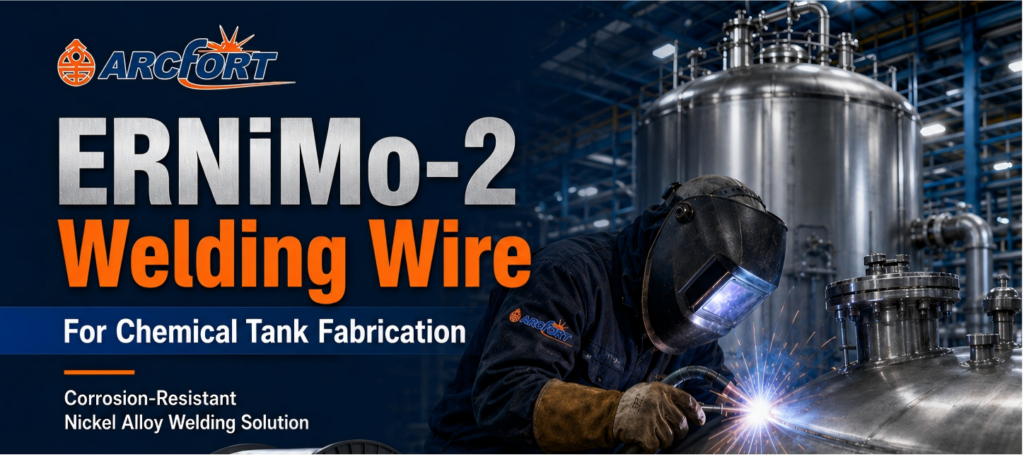
ERNiMo-2 Welding Wire for Chemical Tank Fabrication
Chemical tanks are often exposed to aggressive media, high-purity chemicals, acids, alkaline solutions, and demanding operating conditions. In these applications, welding quality is not only about joint strength. It is also about corrosion resistance, weld cleanliness, material compatibility, and long-term service stability.ERNiMo-2
ERNiMo-2 welding wire is a nickel-molybdenum alloy filler metal used for welding nickel-based alloys and corrosion-resistant equipment. For chemical tank fabrication, it is often selected when the welded structure must resist corrosive environments while maintaining stable weld performance.
Why Chemical Tank Fabrication Requires Special Welding Wire
Chemical tanks are widely used in industries such as chemical processing, petrochemical production, pharmaceutical manufacturing, environmental treatment, acid storage, and industrial fluid handling. These tanks may store or process media that can attack ordinary stainless steel or carbon steel welds.
Common welding challenges in chemical tank fabrication include:
Corrosion at the weld seam
Heat-affected zone degradation
Cracking caused by unsuitable filler metal
Poor weld metal compatibility
Contamination during welding
Loss of corrosion resistance after fabrication
Because the weld area is often the weakest point in chemical equipment, choosing the correct welding wire is critical. A tank body may use corrosion-resistant base material, but if the filler metal is not suitable, premature failure can still begin from the weld joint.
What Is ERNiMo-2 Welding Wire?
ERNiMo-2 is a nickel-molybdenum welding wire designed for demanding corrosion-resistant welding applications. It is commonly used where nickel-molybdenum alloy weld metal is required and where strong resistance to chemical attack is important.
The high nickel content helps provide excellent corrosion resistance and metallurgical stability, while molybdenum contributes to resistance in reducing acid environments and other severe chemical conditions. This makes ERNiMo-2 suitable for fabrication and repair work involving chemical tanks, reaction vessels, storage equipment, piping systems, and corrosion-resistant industrial components.
Benefits of ERNiMo-2 for Chemical Tank Welding
1. Strong Corrosion Resistance
Chemical tanks often work in environments where weld seams are exposed to acids, solvents, chlorides, or other aggressive media. ERNiMo-2 welding wire helps improve the corrosion resistance of welded joints when matched with suitable base materials and proper welding procedures.
For chemical tank fabrication, this is especially important because internal tank surfaces may remain in continuous contact with corrosive liquids. A stable weld metal can help reduce the risk of localized corrosion and early leakage.
2. Suitable for Nickel-Molybdenum Alloy Fabrication
ERNiMo-2 is commonly used for welding nickel-molybdenum alloy materials. In chemical tank production, this type of filler metal is selected when the base material requires similar corrosion-resistant weld metal.
Using a compatible filler wire helps maintain the overall performance of the fabricated tank and reduces the risk of metallurgical mismatch.
3. Reliable Weld Performance in Harsh Service
Chemical tanks may experience temperature changes, pressure fluctuations, cleaning cycles, and long-term chemical exposure. ERNiMo-2 welding wire can support stable weld performance in demanding industrial service when used under correct welding conditions.
For fabricators, this means better confidence in weld quality, especially for tanks used in chemical storage and processing systems.
4. Useful for Fabrication and Repair
In addition to new chemical tank fabrication, ERNiMo-2 welding wire can also be used for repair welding of corrosion-resistant alloy equipment. When tanks, vessels, or pipelines require maintenance, the filler metal must restore not only the joint but also corrosion resistance.
This makes ERNiMo-2 a practical option for both original equipment manufacturing and industrial maintenance projects.
Typical Applications of ERNiMo-2 Welding Wire
ERNiMo-2 welding wire can be used in many industrial fields where chemical resistance is required. Typical applications include:
Chemical storage tanks
Acid processing tanks
Reaction vessels
Corrosion-resistant piping
Heat exchanger components
Petrochemical equipment
Pharmaceutical process equipment
Waste treatment equipment
Industrial tank repair
Nickel alloy fabrication
For chemical tank manufacturers, ERNiMo-2 is especially relevant when the project requires welding wire for severe corrosion service and high-quality nickel alloy welds.
Key Welding Considerations for Chemical Tanks
Selecting ERNiMo-2 welding wire is only one part of achieving a reliable chemical tank weld. Fabricators should also control the complete welding process.
Base Material Compatibility
Before welding, the base material must be confirmed. ERNiMo-2 should be used only when it matches the design requirement, welding procedure, and service environment. Chemical tank projects often follow strict material specifications, so filler metal selection should be based on engineering standards and working media.
Clean Welding Surface
Nickel alloy welding requires clean surfaces. Oil, moisture, oxide scale, sulfur, lead, zinc, and other contaminants can cause weld defects. For chemical tank fabrication, cleaning before welding is essential because contamination may reduce corrosion resistance and weld quality.
Proper Heat Input Control
Excessive heat input can affect weld structure and corrosion performance. Welders should follow approved welding parameters and avoid overheating the joint. Stable heat control helps reduce distortion, cracking risk, and unnecessary metallurgical changes.
Suitable Shielding Gas
For GTAW and GMAW welding processes, shielding gas quality is important. Poor shielding can cause oxidation, porosity, and unstable weld appearance. For chemical tank welds, clean and stable shielding helps produce better weld surfaces and reduces post-weld quality risks.
Inspection and Quality Control
Chemical tanks usually require strict inspection. Common quality checks may include visual inspection, dimensional inspection, penetrant testing, radiographic testing, pressure testing, and material certificate review. For export and industrial projects, batch traceability and welding documentation are also important.
Why Buyers Choose ERNiMo-2 Welding Wire
Industrial buyers do not only look for a welding wire name. They care about stable quality, reliable supply, clear documentation, and technical support. For chemical tank fabrication, ERNiMo-2 welding wire should provide:
Consistent chemical composition
Stable wire feeding performance
Clean weld appearance
Reliable corrosion-resistant weld metal
Batch traceability
Complete quality certificates
Suitable packaging for export and storage
For tank manufacturers, EPC contractors, maintenance companies, and industrial suppliers, these factors can directly influence project quality and delivery reliability.
ERNiMo-2 vs Ordinary Welding Wire
Ordinary stainless steel or carbon steel welding wire is not suitable for many severe chemical tank applications. When the tank material is a nickel-based corrosion-resistant alloy, the filler metal must be carefully selected.
ERNiMo-2 provides nickel-molybdenum alloy weld metal for specialized corrosion-resistant applications. Compared with general-purpose welding wire, it is more suitable for projects where chemical resistance and base metal compatibility are critical.
Using the wrong filler metal may lead to corrosion failure, cracking, poor service life, or rejection during inspection. Therefore, ERNiMo-2 should be considered when the chemical tank design requires nickel-molybdenum alloy welding performance.
Storage and Handling Recommendations
To maintain welding quality, ERNiMo-2 welding wire should be stored properly before use. Recommended handling practices include:
Keep the wire dry and clean
Avoid contact with dust, oil, and moisture
Store in original packaging before welding
Prevent mechanical damage during transport
Use clean gloves when handling nickel alloy wire
Confirm batch number before production
Good storage and handling help reduce porosity, contamination, and welding instability.
ERNiMo-2 Conclusion
ERNiMo-2 welding wire for chemical tank fabrication is a specialized nickel-molybdenum filler metal for corrosion-resistant industrial welding. It is suitable for chemical tanks, acid processing equipment, corrosion-resistant piping, reaction vessels, and industrial repair applications where weld quality and chemical resistance are critical.
For chemical tank manufacturers and industrial buyers, the correct welding wire can help improve equipment reliability, reduce corrosion risks, and support long-term service performance. When combined with proper base material selection, clean welding preparation, controlled welding parameters, and strict inspection, ERNiMo-2 can be an effective solution for demanding chemical tank fabrication projects.