

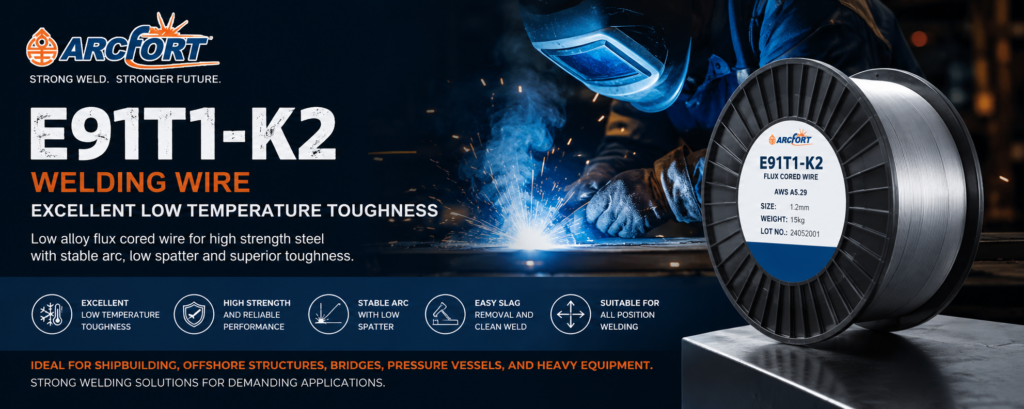
E91T1-K2 Welding Wire with Excellent Low Temperature Toughness
E91T1-K2 welding wire is a low alloy flux cored welding wire designed for applications that require high strength, stable welding performance, and reliable low temperature toughness. It is commonly used in demanding fabrication environments where weld metal must maintain mechanical properties under cold service conditions.
For industries such as shipbuilding, offshore engineering, bridge construction, pressure vessel fabrication, heavy machinery, and structural steel manufacturing, choosing the right welding consumable is essential. E91T1-K2 flux cored wire provides a practical solution for projects that need strong weld deposits, good impact toughness, and efficient welding productivity.
What Is E91T1-K2 Welding Wire?
E91T1-K2 is a gas-shielded flux cored welding wire for low alloy steel welding. It is developed to produce weld metal with high tensile strength and excellent toughness at low temperatures. Compared with general carbon steel welding wires, E91T1-K2 is more suitable for high strength steel structures and applications exposed to harsh working environments.
The wire is designed for flux cored arc welding, also known as FCAW. This welding process offers high deposition efficiency, stable arc characteristics, and good adaptability for industrial fabrication. With proper shielding gas, welding parameters, and joint preparation, E91T1-K2 can provide smooth weld beads, reduced spatter, and easy slag removal.
Key Features of E91T1-K2 Flux Cored Welding Wire
E91T1-K2 welding wire is selected by fabricators because it combines strength, toughness, and operational stability. Its main features include excellent low temperature impact toughness, stable arc performance, good bead appearance, low spatter, easy slag detachability, and suitability for single-pass or multi-pass welding.
The wire also supports efficient welding production. For manufacturers handling large steel structures or thick plates, flux cored welding wire helps improve deposition rate and reduce welding time. This makes E91T1-K2 a valuable choice for both productivity and weld quality.
Excellent Low Temperature Toughness
Low temperature toughness is one of the most important advantages of E91T1-K2 welding wire. In cold environments, ordinary weld metal may become more sensitive to brittle fracture. E91T1-K2 is designed to maintain impact resistance under low temperature conditions, helping welded structures perform more reliably in demanding service environments.
This property is especially important for offshore structures, ships, bridges, lifting equipment, construction machinery, and steel components exposed to outdoor or low-temperature working conditions. When weld toughness is required by project specifications, E91T1-K2 flux cored wire can help meet the mechanical performance needs of critical structures.
Applications of E91T1-K2 Welding Wire
E91T1-K2 welding wire is widely used for welding high strength low alloy steels. It is suitable for structural steel fabrication, offshore platforms, shipbuilding, bridge construction, heavy machinery manufacturing, pressure vessels, mining equipment, and transportation equipment.
In these industries, welded joints must often resist dynamic loads, impact forces, vibration, and low-temperature service conditions. E91T1-K2 provides strong weld deposits with reliable toughness, making it suitable for projects where both strength and safety are important.
Why Choose E91T1-K2 for High Strength Steel Welding?
High strength steel requires a welding wire that can match mechanical performance while maintaining weldability. E91T1-K2 welding wire offers a balance between tensile strength and impact toughness. It helps reduce the risk of cracking when correct welding procedures are followed.
The stable arc and smooth welding behavior also make it easier for welders to control the weld pool. This improves bead consistency and reduces post-weld cleaning work. For production lines and fabrication workshops, these advantages can improve welding efficiency and reduce overall labor costs.
Welding Performance and Usability
E91T1-K2 flux cored wire offers good usability in industrial welding operations. It provides stable arc ignition, smooth metal transfer, low spatter, and easy slag removal. These features help welders achieve clean weld surfaces and consistent weld profiles.
The wire is suitable for all-position welding depending on the specific welding procedure and wire design. It can be used for flat, horizontal, vertical, and overhead welding applications when proper parameters are applied. This flexibility makes it useful for complex steel structures that require welding in different positions.
Shielding Gas and Welding Conditions
E91T1-K2 welding wire is generally used with external shielding gas. The actual shielding gas should be selected according to the welding procedure specification, base material, project requirements, and product classification. Common options may include carbon dioxide or argon-carbon dioxide mixed gas.
Correct welding parameters are essential for achieving the best performance. Wire diameter, current, voltage, travel speed, stick-out length, interpass temperature, and heat input should all be controlled carefully. Before production welding, it is recommended to perform procedure qualification and mechanical testing according to project standards.
Quality Control for E91T1-K2 Welds
For critical steel structures, welding quality control is very important. The use of E91T1-K2 welding wire should be supported by suitable base metal preparation, proper storage, qualified welders, and approved welding procedures.
Typical quality checks may include visual inspection, impact testing, tensile testing, bend testing, hardness testing, ultrasonic testing, radiographic testing, or magnetic particle testing. These inspections help verify that the welded joint meets project requirements for strength, toughness, and safety.
Storage and Handling
Proper storage helps maintain the welding performance of flux cored wire. E91T1-K2 welding wire should be stored in a dry, clean, and well-ventilated environment. Moisture, oil, rust, and dust should be avoided because they may affect arc stability and weld quality.
Before use, the wire package should be checked for damage. During welding, operators should protect the wire from moisture exposure and contamination. Good handling practice helps ensure stable feeding, consistent arc performance, and reliable weld metal quality.
How to Select the Right E91T1-K2 Welding Wire
When selecting E91T1-K2 welding wire, buyers should consider base material grade, required tensile strength, impact temperature, shielding gas, welding position, wire diameter, project standard, and inspection requirements. For critical applications, technical data such as chemical composition, mechanical properties, diffusible hydrogen level, and impact test results should be reviewed carefully.
A reliable supplier should be able to provide product certificates, technical data sheets, sample testing support, welding parameter recommendations, and packaging options. This helps distributors, fabricators, and end users choose the correct welding consumable for their project.
Conclusion
E91T1-K2 welding wire is a strong choice for low alloy steel welding applications that require excellent low temperature toughness and reliable mechanical performance. With stable arc characteristics, good weld appearance, low spatter, and efficient deposition, it supports high-quality welding in demanding industrial environments.
For shipbuilding, offshore engineering, bridge construction, heavy equipment, and structural steel fabrication, E91T1-K2 flux cored welding wire offers a practical combination of strength, toughness, and productivity. When used with proper welding procedures and quality control, it can help produce durable welds for critical steel structures.