

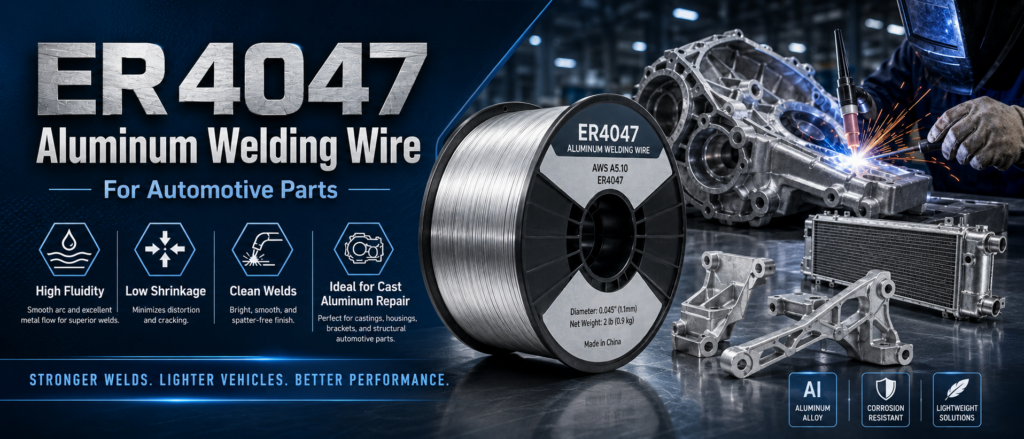
ER4047 Aluminum Welding Wire for Automotive Parts
Automotive manufacturing and repair increasingly rely on aluminum components to reduce weight, improve efficiency, and support modern vehicle design. From heat exchangers and radiators to cast aluminum housings and lightweight structural parts, aluminum welding requires a filler metal that provides stable performance, smooth weld formation, and reliable joint quality. ER4047 aluminum welding wire for automotive parts is a practical choice for applications that need high fluidity, low shrinkage, and clean weld appearance.
ER4047 is an aluminum-silicon welding wire, commonly known as AlSi12. With a higher silicon content than many standard aluminum filler wires, 4047 offers excellent flow characteristics, good wetting ability, and reduced shrinkage during solidification. These properties make it especially useful for welding and repair work involving automotive aluminum components, cast aluminum parts, thin sections, and joints that require smooth bead appearance.
What Is ER4047 Aluminum Welding Wire?
ER4047 aluminum welding wire is a high-silicon aluminum filler metal used for MIG welding, TIG welding, and aluminum brazing applications. Its silicon content helps lower the melting range and improves weld pool fluidity. This allows the filler metal to flow smoothly into the joint, creating a clean and uniform weld bead.
In automotive applications, weld quality is not only about strength. It also affects dimensional accuracy, sealing performance, surface finish, and production efficiency. 4047 welding wire is often selected when fabricators need a filler metal that can reduce cracking tendency, minimize shrinkage, and provide smooth weld results on compatible aluminum alloys.
Why ER4047 Is Used for Automotive Aluminum Parts
Automotive parts often have complex shapes, thin walls, cast surfaces, and tight fit-up requirements. Welding these parts can be challenging because aluminum conducts heat quickly and is sensitive to surface contamination. A filler metal with good fluidity and stable melting behavior can help improve welding control.
ER4047 aluminum welding wire is suitable for automotive aluminum parts because it offers:
High silicon content for excellent weld pool fluidity
Low shrinkage during cooling
Smooth and clean weld bead appearance
Good wetting ability on compatible aluminum alloys
Reduced hot cracking tendency
Suitable performance for cast aluminum repair
Stable welding results in properly controlled processes
These advantages make ER4047 a useful filler metal for automotive component production, repair, and maintenance.
Common Automotive Applications of ER4047 Welding Wire
ER4047 aluminum welding wire can be used in many automotive-related aluminum welding applications, depending on the base material and technical requirements. Common uses include:
Automotive heat exchangers
Aluminum radiators
Cast aluminum housings
Engine-related aluminum components
Aluminum brackets and supports
Transmission housings
Aluminum tanks and containers
Air conditioning system components
Thin aluminum assemblies
General automotive aluminum repair
Because 4047 provides good flow and wetting behavior, it is often useful for components where leak-tight joints, smooth surfaces, and controlled heat input are important.
Key Benefits of ER4047 Aluminum Welding Wire
High Fluidity
One of the main advantages of ER4047 welding wire is its excellent fluidity. The high silicon content allows the molten filler metal to flow smoothly into the joint area. This helps create a flatter, smoother weld bead and can improve the overall appearance of the finished weld.
For automotive parts with complex shapes or narrow joint areas, good fluidity helps the weld metal fill gaps more effectively when proper welding parameters are used.
Low Shrinkage
Shrinkage can affect the shape, fit, and dimensional accuracy of welded aluminum components. ER4047 has lower shrinkage compared with many other aluminum filler metals, making it useful for parts that require stable dimensions after welding.
In automotive production and repair, low shrinkage helps reduce distortion and supports more consistent results.
Good Crack Resistance
Hot cracking is a common concern in aluminum welding. ER4047 helps reduce cracking tendency in many compatible aluminum welding applications because of its silicon-rich composition and smooth solidification behavior.
This makes it useful for cast aluminum parts and automotive components that are sensitive to welding stress.
Clean Weld Bead Appearance
Automotive parts often require welds that are not only functional but also visually clean. ER4047 welding wire can produce smooth, bright, and uniform weld beads when the base material is properly cleaned and the welding process is well controlled.
A clean weld appearance can reduce post-weld finishing work and improve the final quality of the component.
Suitable for MIG, TIG, and Brazing Applications
ER4047 can be used in different aluminum joining processes. ER4047 MIG welding wire is suitable for efficient production welding. ER4047 TIG rod is useful for repair work, precision welding, and small-batch fabrication. ER4047 aluminum brazing wire can also be used where lower-temperature joining and excellent flow are required.
ER4047 MIG Welding Wire for Automotive Parts
MIG welding is commonly used in automotive aluminum fabrication because it supports faster welding speed and continuous production. ER4047 MIG welding wire provides smooth feeding, stable melting, and good weld pool control when used with suitable aluminum welding equipment.
For best results, welders should use clean wire, proper drive rolls, correct contact tips, and a suitable liner for aluminum wire feeding. Since aluminum wire is softer than steel wire, feeding system stability is important for preventing burnback, bird nesting, and inconsistent arc behavior.
ER4047 TIG Welding Rod for Automotive Repair
ER4047 TIG welding rod is often used for automotive repair applications that require precision and careful heat control. TIG welding allows the operator to control the arc and filler metal more accurately, which is useful for thin aluminum parts, cast aluminum repair, and visible welds.
When welding automotive aluminum components, TIG welding with ER4047 can help produce smooth beads and controlled weld profiles. It is especially useful for repair jobs where appearance and accuracy are important.
How to Get Better Results with ER4047 Welding Wire
To achieve high-quality welds with ER4047 aluminum welding wire, proper preparation is essential.
First, clean the aluminum surface carefully before welding. Remove oil, grease, oxide layers, dust, and moisture. Aluminum contamination can cause porosity, poor fusion, and unstable arc performance.
Second, choose the correct shielding gas. Pure argon is commonly used for aluminum MIG and TIG welding. Proper gas flow helps protect the molten weld pool and improves weld quality.
Third, control heat input. Automotive aluminum parts may be thin or heat-sensitive. Excessive heat can cause distortion, burn-through, or changes in component shape. Correct welding current, voltage, travel speed, and wire feed speed are important.
Fourth, select the correct wire diameter for the part thickness and welding process. A suitable wire size helps improve arc stability, bead shape, and penetration control.
Finally, store ER4047 welding wire in a clean and dry environment. Moisture, dust, and surface contamination can affect weld quality and feeding performance.
How to Choose ER4047 Welding Wire for Automotive Applications
When selecting ER4047 aluminum welding wire for automotive parts, buyers should consider both product quality and application requirements. A good ER4047 wire should have consistent chemical composition, clean surface finish, stable wire diameter, smooth feeding performance, and reliable packaging.
Important selection factors include:
Base aluminum alloy compatibility
Welding process, such as MIG, TIG, or brazing
Wire diameter and packaging type
Required weld appearance
Dimensional control requirements
Crack resistance needs
Production efficiency requirements
Availability of quality certificates and technical data
Choosing the right ER4047 welding wire helps improve welding consistency and reduce unnecessary rework.
ER4047 vs ER4043 for Automotive Aluminum Welding
ER4047 and ER4043 are both aluminum-silicon filler metals, but ER4047 contains higher silicon. This gives ER4047 better fluidity, lower shrinkage, and a lower melting range compared with ER4043. For automotive parts that require smooth flow, cast aluminum repair, or reduced distortion, ER4047 can be a strong option.
ER4043 remains a common general-purpose aluminum welding wire, while ER4047 is often selected when higher fluidity, better wetting, and lower shrinkage are more important. The final choice should always depend on the base material, welding process, mechanical requirements, and project specification.
Conclusion
ER4047 aluminum welding wire for automotive parts is a high-silicon aluminum filler metal designed for smooth flow, low shrinkage, clean weld appearance, and reliable performance on compatible aluminum alloys. Its AlSi12 composition makes it suitable for automotive heat exchangers, radiators, cast aluminum housings, brackets, tanks, and general aluminum repair.
For automotive manufacturers, fabricators, and repair workshops, ER4047 welding wire offers a practical solution for applications that require good fluidity, controlled distortion, and clean weld results. With proper surface preparation, shielding gas, welding parameters, and quality-controlled wire, ER4047 can help achieve stable and professional aluminum welding performance.