

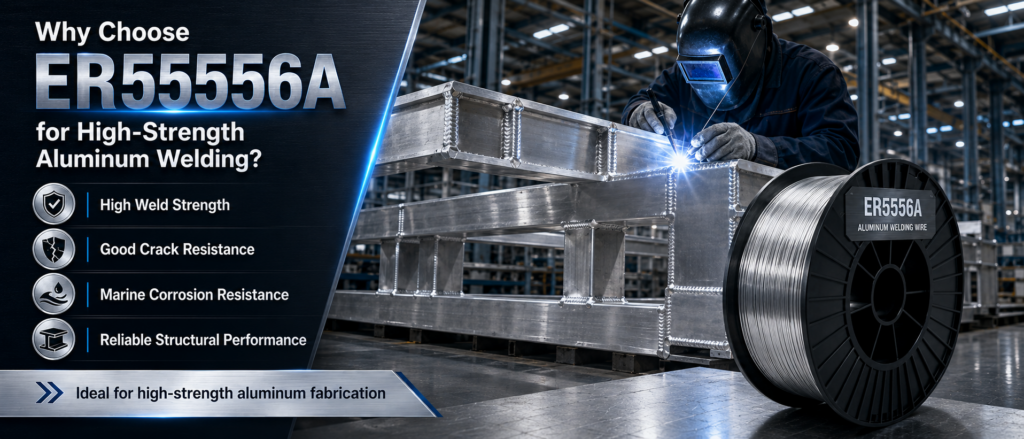
Why Choose ER5556A for High-Strength Aluminum Welding?
High-strength aluminum structures require more than an ordinary filler metal. The welding wire must provide sufficient joint strength, resist cracking, maintain ductility, and perform reliably in demanding environments. For these reasons, ER5556A aluminum welding wire is widely considered for applications where structural performance is a primary concern.
ER5556A is a high-magnesium aluminum filler wire containing controlled additions of manganese. It is designed for welding high-strength aluminum alloys, particularly compatible 5xxx series materials such as 5083. It can also provide useful mechanical properties when welding selected 6xxx series aluminum alloys.
Compared with general-purpose aluminum filler wires, ER5556A is selected when higher weld-metal strength, corrosion resistance, and structural reliability are required.
What Is ER5556A Aluminum Welding Wire?
ER5556A is an aluminum-magnesium-manganese filler metal classified under AWS A5.10. It is primarily supplied as aluminum MIG welding wire for joining compatible wrought aluminum alloys.
The controlled alloy composition helps produce weld deposits with:
High tensile and shear strength
Good ductility
Improved resistance to weld cracking
Strong corrosion resistance
Reliable performance in demanding structural applications
ER5556A is especially suitable for projects where the welded joint must carry significant loads or withstand vibration, impact, moisture, or saltwater exposure.
1. Higher Weld Strength for Structural Applications
One of the main reasons to choose ER5556A is its ability to produce high-strength weld deposits.
The alloying elements in ER5556A are controlled to provide greater weld-metal strength than commonly used general-purpose 5xxx series filler wires. This makes it suitable for structural aluminum components where the strength of fillet welds and load-bearing joints is important.
Typical applications include:
Aluminum ship structures
Heavy transportation equipment
Structural frames
Marine platforms
Military vehicles
High-strength aluminum tanks
Industrial aluminum assemblies
In these applications, filler-metal strength can directly affect joint size, welding productivity, and the overall weight of the finished structure.
2. Excellent Compatibility with 5083 Aluminum
ER5556A is commonly selected for welding 5083 aluminum, one of the most widely used high-strength, non-heat-treatable aluminum alloys.
5083 aluminum offers a valuable combination of strength, corrosion resistance, and weldability. It is frequently used in shipbuilding, marine structures, pressure vessels, transportation equipment, and heavy-duty fabricated products.
When ER5556A is used with compatible 5083 base material, it can help produce a strong welded joint while maintaining the corrosion resistance required for severe service conditions.
However, filler-metal selection should always be based on:
Base-metal grade
Base-metal temper
Joint design
Required mechanical properties
Service temperature
Corrosion environment
Applicable welding standard
A qualified welding procedure should be used for critical structures.
3. Strong Resistance to Marine Corrosion
Aluminum structures used near seawater require a filler wire with dependable corrosion resistance.
ER5556A performs well in marine and coastal environments because its aluminum-magnesium composition provides good resistance to atmospheric and saltwater corrosion. This makes it a suitable option for welded components exposed to moisture, seawater spray, and changing weather conditions.
Common marine applications include:
Boat hulls
Deck structures
Marine panels
Offshore equipment
Aluminum gangways
Workboats
Patrol vessels
Coastal transportation systems
Proper base-metal preparation and correct filler-metal compatibility remain essential. Even a corrosion-resistant wire cannot compensate for contamination, incorrect alloy selection, or poor welding technique.
4. Good Ductility and Crack Resistance
High strength alone is not enough for a dependable aluminum weld. The joint must also tolerate deformation, vibration, and changing loads without premature failure.
ER5556A provides good ductility, allowing the weld metal to absorb stress before cracking. Its composition also supports improved resistance to solidification cracking when it is used with compatible base alloys and proper welding parameters.
This is especially valuable in structures exposed to:
Dynamic loading
Mechanical vibration
Repeated stress
Impact
Thermal expansion
Structural movement
Good ductility helps reduce the risk of brittle weld behavior and improves the reliability of fabricated aluminum components.
5. Suitable for Demanding Fillet Welds
Fillet weld strength is heavily influenced by filler-metal composition. In many aluminum structures, fillet welds carry shear loads and connect frames, stiffeners, panels, brackets, and supporting members.
A high-strength filler wire such as ER5556A can provide an advantage when the design requires strong fillet-weld performance. Depending on the engineering requirements, a stronger filler metal may help achieve the required load capacity without unnecessarily increasing weld size.
This can provide several practical benefits:
Lower filler-metal consumption
Fewer welding passes
Reduced heat input
Less distortion
Faster production
Lower overall fabrication costs
Actual weld size must always follow approved drawings, welding codes, and engineering calculations.
6. Reliable Performance on Selected 6xxx Series Alloys
ER5556A may also be used for welding selected 6xxx series aluminum alloys when high joint strength is important.
The 6xxx series contains magnesium and silicon and includes common structural grades used in frames, profiles, transportation components, and fabricated assemblies. These alloys require filler metal because welding them without filler can create crack-sensitive weld-metal chemistry.
A 5xxx series filler such as ER5556A can improve ductility and fillet-weld shear strength. However, it may not be the best choice when the main priorities are:
Bright color matching after anodizing
Post-weld heat treatment
Elevated-temperature service
Maximum fluidity of the weld pool
For this reason, ER5556A should not automatically be used for every 6xxx series application. The final choice must consider the complete service requirements.
ER5556A vs. ER5356
ER5356 is a widely used general-purpose aluminum-magnesium filler wire. It offers good weldability, strength, corrosion resistance, and availability for many standard aluminum welding jobs.
ER5556A is generally chosen when higher weld strength is required.
Choose ER5556A when:
High weld-metal strength is a major priority
Welding compatible high-strength 5xxx series alloys
Fabricating marine or heavy structural components
Strong fillet-weld performance is required
The structure is exposed to vibration or dynamic loading
Choose ER5356 when:
A versatile general-purpose filler is sufficient
Standard structural strength is acceptable
Broad availability and routine welding performance are priorities
The application does not require the additional strength of ER5556A
The best filler metal is not always the strongest one. It is the filler metal that provides the correct balance of strength, ductility, corrosion resistance, weldability, and service performance.
Typical Applications of ER5556A
ER5556A aluminum welding wire is suitable for a wide range of high-strength fabrication projects.
Shipbuilding and Marine Fabrication
Its corrosion resistance and high weld strength make it suitable for hulls, decks, structural frames, marine panels, and offshore aluminum equipment.
Transportation Equipment
ER5556A can be used in trucks, trailers, rail vehicles, specialized transport systems, and other lightweight structures requiring strong aluminum joints.
Military and Defense Structures
The wire is suitable for selected high-strength aluminum structures exposed to impact, vibration, and demanding operating conditions.
Aircraft and Aerospace Fabrication
ER5556A may be considered for compatible aluminum components where high-strength weld deposits are required. All aerospace applications must follow approved material specifications and qualified welding procedures.
Heavy Aluminum Structures
It can be used for industrial frames, platforms, pressure-related equipment, tanks, structural panels, and other load-bearing aluminum assemblies.
Recommended Welding Practices
The final quality of an ER5556A weld depends on more than the filler wire. Aluminum is highly sensitive to oxide, moisture, oil, and hydrogen contamination.
Clean the Base Metal Thoroughly
Remove grease, oil, paint, moisture, and other contamination before welding. After degreasing, remove the aluminum oxide layer with a clean stainless-steel brush reserved only for aluminum.
Use Suitable Wire-Feeding Equipment
Because aluminum wire is soft, poor feeding can cause tangling, shaving, or inconsistent arc behavior. A push-pull system or spool gun is often recommended.
Use:
U-groove drive rolls
A clean aluminum-compatible liner
The correct contact-tip size
Low and consistent drive-roll pressure
A short and properly aligned feeding path
Maintain Adequate Shielding Gas Coverage
Pure argon is commonly used for MIG welding aluminum. Thicker materials may require a different shielding-gas arrangement depending on the welding procedure and desired penetration.
Protect the weld area from drafts and check the gas system for leaks.
Control Heat Input
Excessive heat input can increase distortion, widen the heat-affected zone, and reduce the strength of the base material. Use suitable travel speed, wire-feed speed, voltage, and interpass-temperature control.
Store the Wire Correctly
Keep ER5556A wire clean, dry, and sealed until use. Avoid exposure to dust, humidity, shop chemicals, and sudden temperature changes that may cause condensation.
Important Service-Temperature Limitation
ER5556A contains more than 3% magnesium. High-magnesium aluminum filler metals are generally not recommended for prolonged service at temperatures above approximately 65°C or 150°F.
Long-term elevated-temperature exposure can promote magnesium segregation and increase susceptibility to stress-corrosion cracking.
For components exposed to continuous elevated temperatures, a different filler alloy may be required. Always review the operating temperature before approving ER5556A for the application.
How to Select the Right ER5556A Wire
Before choosing ER5556A, confirm the following information:
Exact base-metal alloy and temper
Required weld strength
Joint type and weld position
Material thickness
MIG welding equipment configuration
Required wire diameter
Corrosion environment
Minimum and maximum service temperature
Applicable welding code
Post-weld treatment requirements
For safety-critical applications, welding procedure qualification and mechanical testing should be completed before production begins.
Frequently Asked Questions
Is ER5556A stronger than ER5356?
ER5556A is designed to provide higher weld-metal strength than ER5356. It is often selected for high-strength structures and demanding fillet-weld applications.
Can ER5556A be used for welding 5083 aluminum?
Yes. ER5556A is commonly used for welding compatible 5083 aluminum structures, especially where high strength and marine corrosion resistance are required.
Is ER5556A suitable for marine welding?
Yes. Its high strength and corrosion resistance make it suitable for many shipbuilding, offshore, and marine fabrication applications.
Can ER5556A weld 6061 aluminum?
It may be used for selected 6061 and other 6xxx series applications when strength and ductility are priorities. However, the choice should also consider anodizing color, service temperature, post-weld treatment, and joint requirements.
Is ER5556A suitable for high-temperature service?
It is generally not recommended for prolonged service above approximately 65°C or 150°F because of its high magnesium content.
What shielding gas is used with ER5556A?
Pure argon is commonly used for MIG welding. The final shielding-gas selection should be based on material thickness, welding position, penetration requirements, and the qualified procedure.
Conclusion
ER5556A is an excellent filler-wire option for high-strength aluminum welding when joint strength, ductility, crack resistance, and corrosion resistance are critical.
It is particularly suitable for compatible 5083 and other high-strength aluminum structures used in shipbuilding, transportation, marine fabrication, military equipment, and heavy industrial applications.
The most important advantages of ER5556A include:
Higher weld-metal strength
Good fillet-weld performance
Strong marine corrosion resistance
Good ductility
Improved crack resistance
Reliable performance under structural loading
ER5556A should still be selected carefully. Base-metal compatibility, service temperature, joint design, welding parameters, and applicable standards must all be evaluated before production. When used with the correct welding procedure, ER5556A can provide strong, durable, and dependable aluminum welded joints.