

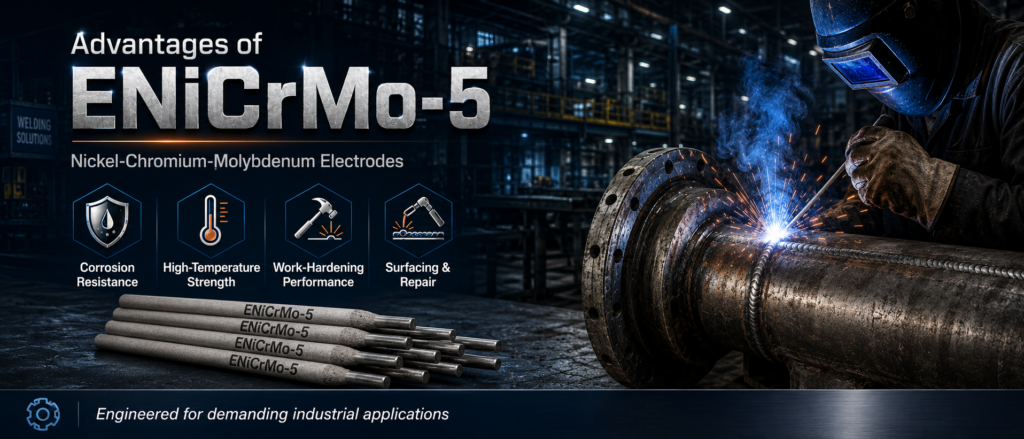
Advantages of ENiCrMo-5 Nickel-Chromium-Molybdenum Electrodes
ENiCrMo-5 nickel-chromium-molybdenum electrodes are designed for demanding welding and surfacing applications where ordinary filler metals may not provide sufficient resistance to heat, corrosion, impact, or mechanical stress. Their nickel-rich weld deposit is alloyed primarily with chromium, molybdenum, and tungsten, creating a strong combination of durability and environmental resistance.
These covered electrodes are commonly used for surfacing steel components, repairing nickel-alloy parts, rebuilding industrial tools, and depositing nickel-chromium-molybdenum weld metal on components exposed to aggressive operating conditions. When the correct welding procedure is followed, ENiCrMo-5 electrodes can help extend equipment service life and reduce the frequency of component replacement.
What Is an ENiCrMo-5 Electrode?
ENiCrMo-5 is a covered electrode classification associated with shielded metal arc welding, also known as SMAW or manual metal arc welding. It produces a nickel-based weld deposit containing significant levels of chromium and molybdenum, together with tungsten and controlled amounts of iron and other alloying elements.
A typical ENiCrMo-5 deposited-metal composition contains nickel as the balance, approximately 14.5–16.5% chromium, 15–17% molybdenum, 3–4.5% tungsten, and 4–7% iron. Exact values may vary according to the applicable standard, production batch, and product formulation.
Each major alloying element contributes to weld performance:
Nickel provides a tough, ductile base and supports performance in corrosive and elevated-temperature environments.
Chromium improves resistance to oxidation and many forms of chemical attack.
Molybdenum strengthens the weld deposit and improves resistance in aggressive environments.
Tungsten contributes to high-temperature strength, hardness retention, and wear performance.
This carefully balanced chemistry makes ENiCrMo-5 electrodes particularly valuable for specialized surfacing, maintenance, and repair operations.
1. Strong Corrosion Resistance
One of the main advantages of ENiCrMo-5 electrodes is the corrosion resistance of the deposited weld metal. The combination of nickel, chromium, molybdenum, and tungsten helps the weld deposit withstand aggressive industrial environments more effectively than many conventional steel welding consumables.
ENiCrMo-5 electrodes may be selected for components exposed to chloride-containing environments, chemical processing conditions, moisture, and other corrosive media. They are also used for depositing protective nickel-chromium-molybdenum layers on steel surfaces.
Actual corrosion performance depends on several factors, including:
Chemical concentration
Operating temperature
Weld-metal dilution
Surface condition
Welding parameters
Post-weld treatment
Component design
For critical corrosion-service equipment, the filler metal should always be evaluated against the specific operating environment rather than selected only by its general alloy classification.
2. Reliable Performance at Elevated Temperatures
Industrial tools, handling equipment, furnace components, and hot-working parts can experience significant mechanical stress at elevated temperatures. Under these conditions, ordinary weld deposits may soften, oxidize, crack, or lose strength.
ENiCrMo-5 weld metal is designed to retain useful strength and hardness at elevated temperatures. Technical product data also describe good resistance to thermal stress, scaling, static loading, and cyclic loading in high-temperature service.
This characteristic makes ENiCrMo-5 electrodes suitable for maintenance and surfacing applications involving:
Hot-working tools
Dies and punches
High-temperature handling components
Furnace-related equipment
Heat-exposed machine parts
Components subjected to repeated thermal cycling
The exact allowable service temperature must be determined by engineering design, base-metal properties, weld procedure qualification, and service conditions.
3. Excellent Work-Hardening Behavior
Another important advantage of ENiCrMo-5 nickel-chromium-molybdenum electrodes is their work-hardening capability. A work-hardening weld deposit can become harder when subjected to repeated impact or mechanical deformation.
This behavior is beneficial for components that must tolerate both heat and impact. Instead of relying only on high initial hardness, the deposited metal can develop increased surface hardness in service while maintaining a comparatively tough underlying structure. Technical descriptions of ENiCrMo-5 deposits highlight their ability to work harden under impact and retain hardness at elevated temperatures.
Potential applications include:
Tool surfaces
Impact-loaded machine components
Gripping and handling equipment
Dies and forming tools
Repair areas exposed to repeated mechanical contact
Work-hardening performance will vary with deposit chemistry, heat input, layer thickness, dilution, and actual loading conditions.
4. Suitable for Protective Surfacing
ENiCrMo-5 electrodes are especially useful for surfacing applications. Surfacing involves depositing a layer of specialized weld metal onto a less expensive or less resistant base material.
According to published classification guidance, ENiCrMo-5 electrodes can be used for surfacing steel clad with nickel-chromium-molybdenum alloy weld metal. Product data also identify low dilution and high weld-metal recovery as useful characteristics for overlay applications.
Protective surfacing can offer several benefits:
Improved corrosion resistance
Better heat resistance
Greater surface durability
Restoration of worn dimensions
Reduced replacement costs
Longer component service life
Instead of manufacturing an entire component from a costly nickel alloy, a fabricator may apply ENiCrMo-5 weld metal only to the surface or area requiring enhanced performance.
5. ENiCrMo-5 Good Resistance to Impact and Cyclic Loading
Many industrial components are not exposed to constant loads. They experience repeated impacts, vibration, pressure fluctuations, start-stop cycles, or thermal expansion and contraction.
ENiCrMo-5 weld deposits are valued for their ability to withstand demanding static and cyclic loading conditions, particularly when combined with elevated-temperature exposure. Their nickel-based structure provides toughness, while molybdenum and tungsten contribute to strength and hardness retention.
This combination can be valuable for:
Heavy industrial machinery
Material-handling equipment
Forming and pressing tools
Repaired cast components
Components exposed to vibration
Equipment operating under changing thermal loads
Correct joint design and welding technique remain essential because even a high-performance filler metal cannot compensate for excessive restraint, contamination, poor bead placement, or uncontrolled heat input.
6. ENiCrMo-5 Useful for Repairing High-Value Components
Replacing a large nickel-alloy casting, hot-working tool, or specialized machine component can be expensive and time-consuming. ENiCrMo-5 electrodes provide a practical option for rebuilding worn surfaces and repairing localized damage.
Published technical information identifies applications involving nickel-base castings, machine components, tools, dies, punches, and corrosion-resistant surfaces.
Repair welding with ENiCrMo-5 may help:
Restore damaged edges
Fill worn areas
Rebuild working surfaces
Repair localized cracks
Recover original dimensions
Add a more resistant protective layer
Before repair welding, the damaged area should be inspected carefully. Cracks, oil, oxides, previous weld metal, and contaminated material must be removed. For safety-critical equipment, the repair procedure should be reviewed and qualified by a welding engineer.
7. ENiCrMo-5 Reduced Dilution in Overlay Welding
Dilution occurs when the base metal mixes with the deposited weld metal. Excessive dilution can change the chemistry of a corrosion-resistant overlay and reduce its intended performance.
Some ENiCrMo-5 electrode formulations are designed to provide relatively low dilution when applied with suitable welding parameters. This helps the overlay reach its target composition with fewer layers and reduces the negative effect of iron pickup from the base material.
To control dilution, welders should carefully manage:
Welding current
Travel speed
Arc length
Electrode angle
Bead width
Interpass temperature
Number of deposited layers
Stringer beads are often preferred over excessive weaving when chemistry control and low heat input are important.
8. ENiCrMo-5 Stable Manual Welding Performance
ENiCrMo-5 electrodes are used with the SMAW process, which offers flexibility for workshop, field, repair, and maintenance operations. SMAW equipment is portable, relatively simple to set up, and suitable for locations where wire-feeding equipment or external shielding gas may be inconvenient.
Available technical data describe ENiCrMo-5 electrodes as having smooth operation, limited spatter, manageable slag removal, and suitable bead formation when used under recommended conditions. Many formulations are intended for direct-current electrode-positive operation, although welders should always follow the product-specific instructions.
The process is especially useful for:
On-site repairs
Short production runs
Maintenance welding
Confined working areas
Multi-layer surfacing
Components with complex shapes
Electrode handling is particularly important because moisture contamination can affect arc stability, porosity risk, hydrogen control, and deposited-metal quality.
Common Applications of ENiCrMo-5 Electrodes
ENiCrMo-5 nickel-chromium-molybdenum electrodes may be considered for the following applications:
Corrosion-Resistant Overlays
They can deposit nickel-chromium-molybdenum weld metal on steel surfaces that require improved resistance to aggressive environments.
Hot-Working Tools
The weld deposit’s heat resistance, hardness retention, and work-hardening characteristics make it useful for rebuilding selected tools, dies, and punches.
Industrial Maintenance
Worn machine components can be restored through surfacing instead of being completely replaced.
Nickel-Alloy Repairs
ENiCrMo-5 may be used for repairing certain nickel-alloy castings and components when the deposited-metal chemistry is compatible with the base material and service requirements.
Impact-Loaded Components
The combination of toughness and work-hardening behavior can benefit surfaces exposed to repeated mechanical impact.
High-Temperature Equipment
ENiCrMo-5 may be applied to components requiring useful mechanical performance under elevated-temperature conditions.
ENiCrMo-5 Recommended Welding Practices
The advantages of ENiCrMo-5 electrodes can only be achieved when the welding procedure is properly controlled.
Clean the Joint Thoroughly
Remove oil, grease, paint, moisture, sulfur-containing contaminants, oxides, and damaged material. Nickel-based weld deposits are sensitive to contamination.
Keep a Short Arc
A short and stable arc helps reduce oxidation, spatter, and atmospheric contamination. Excessive arc length can produce an irregular bead and increase the risk of defects.
Control Heat Input
Avoid unnecessarily high current or slow travel speed. Excessive heat input can increase dilution, enlarge the heat-affected zone, and reduce control over the weld deposit.
Use Appropriate Bead Placement
Narrow stringer beads generally provide better heat-input and dilution control than wide weaving. Clean the slag completely before depositing the next layer.
Manage Interpass Temperature
Excessive interpass temperature may affect microstructure, distortion, and corrosion performance. Follow the qualified welding procedure and base-material requirements.
Store Electrodes Correctly
Keep electrodes in dry storage and protect opened packages from moisture. Re-drying conditions should follow the electrode manufacturer’s instructions rather than a general temperature assumption.
Confirm Material Compatibility
ENiCrMo-5 should not automatically be treated as a universal electrode for every nickel alloy. Base-metal chemistry, required mechanical properties, corrosion environment, operating temperature, and applicable code must all be evaluated.
ENiCrMo-5 Compared with Conventional Electrodes
Compared with general-purpose carbon-steel or stainless-steel electrodes, ENiCrMo-5 offers a more specialized weld-metal chemistry. Its main advantages are not low purchase cost or high deposition speed. Its value lies in protecting expensive equipment and maintaining performance in demanding service.
ENiCrMo-5 can provide:
Better corrosion resistance in selected environments
Improved high-temperature strength
Greater hardness retention
Useful work-hardening behavior
Strong surfacing performance
Better suitability for specialized nickel-alloy repairs
Longer service life for selected industrial components
However, these benefits come with higher material cost and more demanding welding controls. ENiCrMo-5 should therefore be selected based on total service value rather than electrode price alone.
How to Select the Right ENiCrMo-5 Electrode
Before purchasing or specifying ENiCrMo-5 electrodes, evaluate the following information:
Base-metal grade and condition
Required weld-metal chemistry
Operating temperature
Corrosive chemicals and concentrations
Joint-welding or surfacing requirements
Desired overlay thickness
Impact and wear conditions
Welding position
Available power source
Required certifications and test reports
A reliable ENiCrMo-5 product should have clear classification information, deposited-metal chemical data, recommended welding parameters, storage instructions, and batch traceability.
ENiCrMo-5 Conclusion
The principal advantages of ENiCrMo-5 nickel-chromium-molybdenum electrodes include strong corrosion resistance, elevated-temperature performance, work-hardening capability, hardness retention, and suitability for protective surfacing.
These electrodes are especially valuable when repairing expensive components, rebuilding hot-working tools, or depositing a durable nickel-chromium-molybdenum layer on steel. Their higher initial cost can be justified when the weld deposit extends equipment life, reduces replacement frequency, and improves reliability in severe industrial service.
For the best results, ENiCrMo-5 electrodes should be used with clean base materials, controlled heat input, proper electrode storage, suitable welding parameters, and a procedure matched to the actual operating environment.