

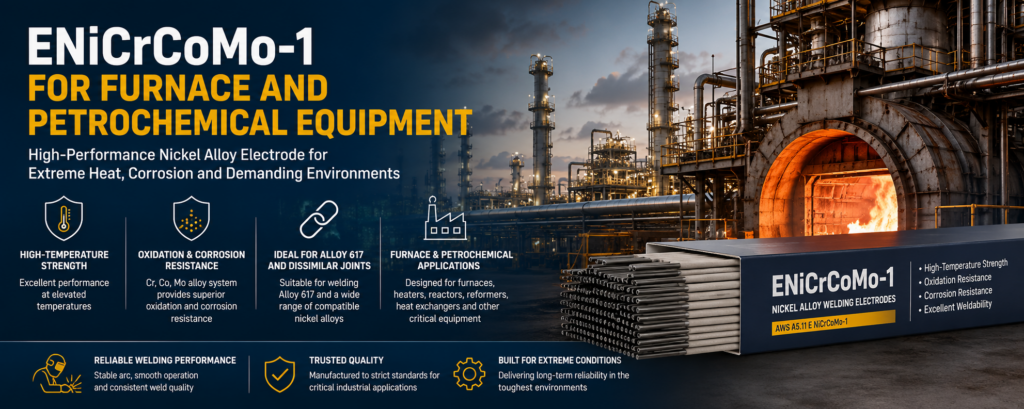
ENiCrCoMo-1 for Furnace and Petrochemical Equipment
Furnace and petrochemical equipment often operates under a demanding combination of high temperature, corrosive gases, thermal cycling, mechanical stress, and prolonged exposure to aggressive process environments. Welded joints in these systems must maintain strength and stability while resisting oxidation, carburization, and other forms of high-temperature degradation.ENiCrCoMo-1
ENiCrCoMo-1 is a nickel-chromium-cobalt-molybdenum covered electrode developed for shielded metal arc welding of high-temperature nickel alloys and selected dissimilar-metal combinations. It is commonly associated with Alloy 617 and similar heat-resistant materials used in furnaces, chemical processing systems, power-generation equipment, and other critical industrial applications.
Its combination of elevated-temperature strength, oxidation resistance, corrosion resistance, and metallurgical stability makes ENiCrCoMo-1 an important option for fabricating and repairing equipment exposed to severe operating conditions.
What Is an ENiCrCoMo-1 Welding Electrode?
ENiCrCoMo-1 is an AWS A5.11 nickel-alloy covered electrode designed for shielded metal arc welding, also known as SMAW or stick welding.
The deposited weld metal has a nickel-rich composition containing significant levels of chromium, cobalt, and molybdenum. These alloying elements work together to provide the properties required for high-temperature service:
Nickel supports metallurgical stability and resistance to various corrosive environments.
Chromium improves resistance to oxidation and high-temperature surface attack.
Cobalt contributes to elevated-temperature strength and structural stability.
Molybdenum supports solid-solution strengthening and resistance in demanding service conditions.
ENiCrCoMo-1 is especially suitable for welding Alloy 617 to itself. It may also be considered for joining compatible heat-resistant nickel alloys, high-temperature cast alloys, and approved dissimilar-metal combinations.
The final filler-metal selection must always be based on the base materials, operating temperature, process atmosphere, design code, and a qualified welding procedure.
Why ENiCrCoMo-1 Furnace Equipment Requires Specialized Weld Metal
Industrial furnaces expose welded components to conditions that ordinary carbon-steel or stainless-steel electrodes may not tolerate over extended service periods.
Common challenges include:
High-Temperature Oxidation
Furnace components may remain in contact with hot air, combustion gases, or oxygen-containing atmospheres for thousands of operating hours. At elevated temperatures, rapid scale formation can reduce wall thickness and weaken a welded joint.
The chromium content of ENiCrCoMo-1 weld metal helps form a protective oxide layer, improving resistance to continued high-temperature oxidation.
Thermal Cycling
Furnaces are repeatedly heated, held at temperature, and cooled. These cycles create expansion and contraction across base metals, welds, and heat-affected zones.
A suitable weld deposit must maintain ductility and metallurgical stability during these repeated temperature changes. ENiCrCoMo-1 is selected for demanding applications where thermal fatigue and joint reliability are important concerns.
Carburizing Environments
Some heat-treatment and petrochemical furnaces contain carbon-rich atmospheres. Carbon can diffuse into exposed materials, causing embrittlement, dimensional changes, or loss of mechanical properties.
Nickel-chromium alloy systems are frequently used where resistance to carburization is required. However, actual performance depends on temperature, gas composition, exposure time, and the metallurgy of the complete welded assembly.
Creep and Stress Rupture
Components subjected to load at high temperature can gradually deform through creep. This process may eventually cause cracking or rupture, even when the applied stress is below the room-temperature yield strength.
Because ENiCrCoMo-1 is designed for high-temperature nickel-alloy welding, it can provide a more compatible weld-metal structure than conventional electrodes in approved elevated-temperature applications.
Benefits of ENiCrCoMo-1 for Furnace Applications
1. High-Temperature Strength
ENiCrCoMo-1 weld metal is designed to retain useful mechanical strength at temperatures where many standard welding consumables lose performance.
This characteristic is valuable for furnace parts exposed to both heat and structural loading, including supports, transition sections, internal fixtures, hot-gas components, and welded attachments.
2. Resistance to Oxidation
The electrode produces chromium-containing nickel-alloy weld metal with strong resistance to high-temperature oxidation. This helps protect the joint from accelerated surface deterioration in combustion and heat-treatment environments.
3. Metallurgical Stability
Long-term exposure to elevated temperature can cause unwanted phase formation, embrittlement, or loss of ductility in improperly matched weld metal.
ENiCrCoMo-1 is formulated to provide stable performance in high-temperature nickel-alloy joints when applied through a qualified welding procedure.
4. Compatibility with Heat-Resistant Alloys
The electrode is commonly used for welding Alloy 617 and may be suitable for selected high-temperature nickel alloys and heat-resistant cast materials.
A compatible weld deposit helps reduce large differences in thermal expansion, corrosion behavior, and elevated-temperature mechanical properties between the weld and base metal.
5. Suitability for Maintenance Welding
SMAW equipment is portable and practical for field repairs, shutdown maintenance, and restricted-access locations. This can make ENiCrCoMo-1 useful when repairing furnace equipment that cannot be easily moved or welded with automated processes.
ENiCrCoMo-1 Typical Furnace Applications
ENiCrCoMo-1 may be considered for the fabrication, rebuilding, or repair of compatible components such as:
Industrial furnace internals
Heat-treatment fixtures and baskets
High-temperature supports
Combustion-system components
Furnace transition sections
Hot-gas ducts
Radiant heating components
Retorts and process chambers
High-temperature cast-alloy parts
Nickel-alloy-to-cast-alloy transition joints
Not every furnace component requires ENiCrCoMo-1. The electrode is most relevant when the base material and service environment require nickel-chromium-cobalt-molybdenum weld metal or comparable high-temperature performance.
ENiCrCoMo-1 in Petrochemical Equipment
Petrochemical plants contain process heaters, reforming units, pressure systems, piping assemblies, reactors, and hot-gas equipment. Welded parts may encounter high temperature, pressure, hydrogen-containing atmospheres, hydrocarbons, sulfur compounds, and frequent startup and shutdown cycles.
ENiCrCoMo-1 can be used in approved applications where the welded joint requires a combination of high-temperature strength and resistance to process-related degradation.
Potential applications include:
Petrochemical process-furnace components
High-temperature heater internals
Hot-gas transfer components
Furnace supports and attachments
Nickel-alloy transition joints
Compatible reformer-furnace components
Chemical processing equipment
High-temperature pressure-system repairs
Heat-resistant cast-alloy repairs
Selected dissimilar-metal joints
The electrode should not be selected solely because a component is located in a petrochemical plant. Service temperature, corrosion medium, hydrogen exposure, sulfur content, pressure, base-metal grade, and applicable construction codes must all be reviewed.
Using ENiCrCoMo-1 for Dissimilar-Metal Welding
Dissimilar-metal welding is often required when a high-temperature nickel alloy is joined to a heat-resistant casting, stainless steel, or another engineering alloy.
ENiCrCoMo-1 can provide useful results in selected dissimilar joints because its nickel-rich weld deposit can tolerate dilution from different base metals. It also offers strong elevated-temperature performance compared with many general-purpose electrodes.
However, dissimilar-metal welding requires careful engineering evaluation. Important factors include:
Chemical dilution from both base materials
Thermal-expansion differences
Carbon migration
Formation of brittle phases
Heat-affected-zone cracking
Service temperature
Corrosion conditions
Post-weld heat treatment
Long-term creep behavior
A qualified welding procedure should confirm that the selected electrode provides acceptable mechanical, corrosion, and metallurgical performance.
ENiCrCoMo-1 Recommended Welding Practices
Actual parameters must follow the electrode data sheet and approved welding procedure. The following practices are generally important when welding high-temperature nickel alloys with ENiCrCoMo-1.
Keep the Joint Clean
Remove oil, grease, paint, oxide, sulfur-containing contamination, moisture, and embedded carbon-steel particles. Nickel-alloy welds are sensitive to contamination, which can cause porosity, cracking, or reduced corrosion resistance.
Use clean tools dedicated to nickel-alloy fabrication whenever possible.
Store Electrodes Correctly
Keep electrodes dry and protected from atmospheric moisture. Opened packages should be stored according to the consumable supplier’s recommendations.
Improper storage can increase hydrogen pickup, porosity, arc instability, and slag-related defects.
Control Heat Input
Excessive heat input can increase distortion, widen the heat-affected zone, and promote undesirable metallurgical changes.
Use a stable arc, controlled travel speed, and appropriate current for the electrode diameter. Avoid unnecessarily wide weaving unless permitted by the welding procedure.
Use Short, Controlled Beads
Stringer beads are often preferred for nickel-alloy welding because they improve heat control and allow better management of the molten weld pool.
Clean all slag completely between passes to prevent inclusions.
Control Interpass Temperature
Allowing the joint to become excessively hot may reduce weld quality. The maximum interpass temperature should be defined in the welding procedure based on the base material, thickness, joint design, and service requirements.
Fill Craters Properly
Nickel-alloy weld deposits can develop crater cracks when the arc is stopped abruptly. Reduce current or use a controlled back-step technique to fill the crater before breaking the arc.
Inspect Critical Welds
Depending on the equipment code and service conditions, inspection may include:
Visual testing
Liquid penetrant testing
Radiographic testing
Ultrasonic testing
Chemical composition verification
Hardness testing
Mechanical testing
Corrosion or high-temperature qualification testing
Inspection requirements should be established before production welding begins.
How to Select ENiCrCoMo-1 Electrodes
Before purchasing ENiCrCoMo-1, review the following information:
Classification Compliance
Confirm that the electrode complies with the required AWS or ASME classification. The classification should appear on the product packaging, inspection certificate, and technical data sheet.
Chemical Composition
Verify that the deposited weld-metal composition falls within the required limits for ENiCrCoMo-1. Chemical consistency is particularly important for high-temperature and corrosion-sensitive applications.
Mechanical Properties
Review tensile strength, elongation, and any project-specific elevated-temperature requirements. Room-temperature mechanical values alone may not be sufficient for critical furnace equipment.
Diameter Availability
Select electrode diameters that match the joint thickness, welding position, heat-input limits, and accessibility of the repair area.
Traceability
For pressure equipment and critical petrochemical applications, request lot or batch traceability, inspection documents, classification certificates, and manufacturing records when required.
Packaging
Moisture-resistant or hermetically sealed packaging helps protect electrode quality during transportation and storage.
ENiCrCoMo-1 vs. General-Purpose Nickel Electrodes
General-purpose nickel-alloy electrodes may provide acceptable corrosion resistance or dissimilar-welding capability, but they do not all offer the same high-temperature performance.
ENiCrCoMo-1 is distinguished by its nickel-chromium-cobalt-molybdenum alloy system. It is particularly relevant when a project requires compatibility with Alloy 617 or weld metal designed for elevated-temperature strength and oxidation resistance.
It should not automatically replace every nickel-alloy electrode. A different classification may be more suitable when the main requirement is resistance to seawater, strong acids, chloride pitting, low-temperature toughness, or a specific dissimilar-metal combination.
Filler-metal selection should always match the dominant service condition.
ENiCrCoMo-1 Conclusion
ENiCrCoMo-1 is a specialized high-temperature nickel-alloy electrode for furnace and petrochemical equipment exposed to oxidation, corrosion, thermal cycling, and sustained elevated-temperature stress.
Its nickel-chromium-cobalt-molybdenum weld deposit provides high strength, metallurgical stability, and resistance to demanding operating environments. These characteristics make it a strong candidate for welding Alloy 617, selected heat-resistant alloys, furnace internals, petrochemical heater components, and qualified dissimilar-metal joints.
Successful application depends on correct filler-metal selection, clean joint preparation, controlled heat input, dry electrode storage, qualified welding procedures, and appropriate inspection. When these factors are properly managed, ENiCrCoMo-1 can help improve the reliability and service life of critical high-temperature welded equipment.