

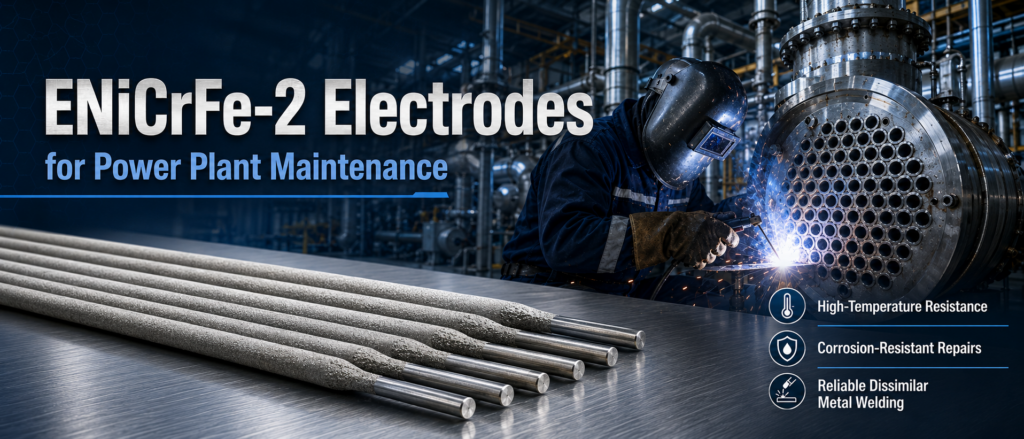
ENiCrFe-2 Electrodes for Power Plant Maintenance
Power plants contain boilers, steam systems, heat exchangers, piping, furnaces, and auxiliary equipment that operate under demanding conditions. High temperatures, corrosive media, thermal cycling, vibration, and differences between base metals can gradually cause cracking, wear, oxidation, and joint deterioration.ENiCrFe-2
When maintenance teams must repair nickel-alloy components or join dissimilar metals, selecting the correct welding consumable is essential. ENiCrFe-2 electrodes provide a practical shielded metal arc welding solution for many specialized maintenance applications involving nickel-chromium-iron alloys, nickel steels, stainless steels, and selected carbon steel combinations.
Their combination of weldability, ductility, oxidation resistance, and compatibility with several engineering alloys makes ENiCrFe-2 welding electrodes valuable for planned outages, emergency repairs, component restoration, and equipment modification.
What Is an ENiCrFe-2 Electrode?
ENiCrFe-2 is a covered nickel-chromium-iron welding electrode designed for the shielded metal arc welding process, commonly known as SMAW or stick welding.
The deposited weld metal contains a high proportion of nickel together with chromium, iron, and controlled additions of other alloying elements. This composition helps the weld deposit maintain useful mechanical properties while resisting oxidation and corrosion in demanding industrial environments.
ENiCrFe-2 electrodes are commonly considered for:
Welding nickel-chromium-iron alloys
Joining nickel alloys to selected steels
Welding certain nickel steels
Producing dissimilar metal joints
Repairing alloy components exposed to heat
Restoring corrosion-resistant surfaces
Maintenance welding in difficult access areas
Because SMAW equipment is portable and relatively simple to deploy, ENiCrFe-2 electrodes are particularly useful during power plant shutdowns and field maintenance operations.
Why ENiCrFe-2 Is Useful in Power Plant Maintenance
Power plant maintenance frequently involves more than joining two identical pieces of metal. Repair teams may need to weld an aged nickel-alloy component, connect different alloy systems, rebuild a damaged surface, or repair equipment that has experienced repeated heating and cooling.
ENiCrFe-2 electrodes offer several advantages in these situations.
High-Temperature Oxidation Resistance
Chromium contributes to the formation of a protective oxide layer on the weld surface. This helps the deposited metal resist scaling and oxidation when exposed to elevated temperatures.
This characteristic can be valuable for components near boilers, furnaces, burners, exhaust systems, and other hot sections of a power plant.
Good Compatibility with Nickel Alloys
The high nickel content makes ENiCrFe-2 suitable for welding several nickel-chromium-iron materials. It can help produce a compatible weld deposit without introducing an excessively hard or brittle joint.
Correct filler-metal compatibility is especially important when repairing heat-resistant alloy equipment.
Dissimilar Metal Welding Capability
Maintenance teams often need to join nickel alloys to stainless steel or carbon steel. These joints are challenging because the base metals have different chemical compositions, thermal expansion rates, and metallurgical behavior.
A nickel-rich weld deposit can help accommodate dilution and reduce the risk of forming an excessively brittle weld structure. For this reason, ENiCrFe-2 electrodes may be selected for approved dissimilar metal welding procedures.
Ductility During Thermal Cycling
Power plant equipment repeatedly expands during heating and contracts during cooling. These thermal cycles can place considerable stress on welds, especially where different materials are joined.
The ductility of a nickel-based weld deposit helps the joint tolerate strain and movement more effectively than a rigid or highly hardened weld metal.
Convenient Field Welding
SMAW equipment can be used in areas where automated processes are difficult to install. ENiCrFe-2 stick electrodes are therefore useful for localized repairs, short welds, restricted locations, and maintenance work where portability is important.
ENiCrFe-2 Common Power Plant Applications
ENiCrFe-2 electrodes can support several types of maintenance work, provided the base materials, service environment, and approved welding procedure are compatible.
Boiler and Furnace Components
Boiler and furnace areas experience high temperatures, oxidation, and repeated thermal cycling. ENiCrFe-2 electrodes may be considered when repairing compatible nickel-alloy parts, heat-resistant attachments, transition joints, or localized damaged sections.
Typical maintenance work may include:
Repairing cracks in compatible alloy components
Replacing damaged sections
Welding alloy attachments
Restoring transition joints
Performing localized weld buildup
Heat Exchangers
Heat exchangers can suffer from corrosion, thermal fatigue, erosion, and cracking around tubes, tube sheets, nozzles, and welded connections.
ENiCrFe-2 electrodes may be used for approved repairs involving nickel-chromium-iron alloys, nickel steels, or suitable dissimilar metal combinations. Careful control of heat input is important because many heat exchanger components are relatively thin or highly restrained.
Steam and Process Piping
Power plant piping systems may contain different alloys selected according to temperature, pressure, and corrosion conditions. Maintenance modifications can therefore require transition joints between materials with different compositions.
ENiCrFe-2 electrodes may provide a useful nickel-based weld deposit for certain transition joints. However, the final selection must consider design temperature, pressure, creep requirements, corrosion conditions, and applicable construction codes.
Turbine and Auxiliary Equipment
Not every turbine component is suitable for ENiCrFe-2 welding. However, the electrode may be considered for compatible auxiliary parts, casings, attachments, exhaust-related components, or nickel-alloy sections when permitted by the repair specification.
Critical rotating components require detailed engineering evaluation before welding.
Corrosion-Resistant Overlays
A corrosion-resistant weld layer can sometimes be applied to a steel surface to restore protection or isolate the base material from an aggressive environment.
ENiCrFe-2 may be used for selected overlay or buildup applications, but dilution must be carefully managed. Multiple layers may be required before the deposited surface reaches the intended chemical composition and corrosion performance.
Emergency Maintenance Repairs
During an unplanned shutdown, repair teams need welding consumables that can be deployed efficiently. The portability of SMAW makes ENiCrFe-2 electrodes useful for certain emergency repairs where access is limited and rapid equipment setup is necessary.
Emergency conditions should never replace proper engineering controls. Material identification, defect assessment, procedure selection, and inspection remain essential.
Key Factors When Selecting ENiCrFe-2
ENiCrFe-2 is versatile, but it is not suitable for every nickel-alloy or power plant application. Several factors must be reviewed before welding.
Confirm the Base Metal
Positive material identification is strongly recommended when documentation is incomplete. Similar-looking alloys can require very different filler metals, heat treatments, and welding techniques.
Never select an electrode based only on the appearance of the component.
Review the Operating Temperature
The service temperature affects oxidation resistance, strength, thermal fatigue, and long-term metallurgical stability. A consumable that performs well during a short repair test may not be suitable for years of high-temperature operation.
For creep-sensitive equipment, filler-metal selection should be supported by engineering evaluation.
Identify the Corrosive Environment
The repair may be exposed to steam, combustion gases, sulfur compounds, chlorides, acids, alkalis, or treated water. Each environment creates different corrosion risks.
The corrosion resistance of the weld metal should be evaluated together with the base metal and the heat-affected zone.
Evaluate Dissimilar Metal Dilution
When nickel alloy is welded to steel, elements from both base metals enter the weld pool. Excessive dilution can change the weld chemistry and reduce the intended performance.
Joint design, electrode angle, bead placement, amperage, and layer sequence should be controlled to manage dilution.
Check Code and Procedure Requirements
Power plant components may be governed by pressure equipment, piping, boiler, or structural welding requirements. The selected electrode should be listed in the approved welding procedure specification.
Procedure qualification may be required before production welding begins.
ENiCrFe-2 Recommended Welding Practices
Successful power plant maintenance depends on more than selecting the correct electrode. Surface preparation, moisture control, welding technique, and inspection all affect repair quality.
ENiCrFe-2 Remove Contamination Completely
Nickel-alloy welds are sensitive to contamination. Before welding, remove:
Oil
Grease
Paint
Rust
Oxide scale
Moisture
Sulfur-containing residues
Cutting fluids
Carbon deposits
Use clean tools dedicated to nickel alloys whenever possible. Contaminated grinding wheels and wire brushes can transfer unwanted material to the joint.
Prepare the Defect Properly
Cracks should be removed completely rather than simply welded over. The excavation should have a smooth profile that allows access to the root and reduces the chance of slag entrapment.
Non-destructive examination can be used to confirm that the crack has been fully removed before repair welding.
Keep Electrodes Dry
Covered electrodes should be stored and handled according to the applicable consumable instructions. Moisture in the coating can contribute to arc instability, porosity, and poor weld quality.
Only use electrode reconditioning procedures that are specifically permitted for the product.
ENiCrFe-2 Use Controlled Heat Input
Excessive amperage or slow travel can create an unnecessarily large weld pool, increase dilution, and enlarge the heat-affected zone.
A controlled arc length, appropriate electrode size, and steady travel speed generally produce better results. Stringer beads are often preferred to wide weaving for nickel-alloy maintenance welds.
Clean Between Passes
Slag and oxide residues must be removed after every bead. Incomplete cleaning can cause slag inclusions and lack of fusion in subsequent layers.
The groove and adjacent surfaces should be inspected before depositing the next pass.
Control Interpass Temperature
High interpass temperatures can increase heat accumulation and affect the microstructure of both the weld and base metal. Follow the qualified welding procedure and allow the joint to cool when necessary.
ENiCrFe-2 Avoid Excessive Restraint
Nickel-based weld metal is generally ductile, but the joint can still crack when shrinkage stresses are severe. Proper joint preparation, balanced welding sequences, and controlled bead placement can help reduce restraint.
Finish the Arc Carefully
Poor arc termination can leave crater cracks. Fill the crater before breaking the arc, and inspect all starts, stops, and tie-in areas.
ENiCrFe-2 Inspection After Welding
Power plant repairs should be inspected according to the component’s service importance and applicable code.
Inspection methods may include:
Visual examination
Liquid penetrant testing
Magnetic particle testing on suitable ferromagnetic sections
Radiographic testing
Ultrasonic testing
Pressure or leak testing
Positive material identification
Hardness testing when required
Visual inspection should check bead shape, undercut, overlap, arc strikes, surface porosity, incomplete crater filling, and evidence of overheating.
For critical components, a successful surface appearance alone is not enough. Volumetric inspection may be required to detect internal defects.
ENiCrFe-2 Common Welding Problems and Prevention
Porosity
Porosity may result from moisture, oil, dirt, poor electrode storage, excessive arc length, or unstable technique.
Prevent it by thoroughly cleaning the joint, keeping electrodes dry, and maintaining a controlled arc.
Slag Inclusion
Slag inclusions can form when the groove is too narrow, the bead profile is excessively convex, or cleaning between passes is incomplete.
Use adequate joint access, proper bead placement, and complete interpass cleaning.
Lack of Fusion
Lack of fusion may occur when heat input is too low, travel speed is too fast, or the electrode angle does not direct the arc toward the joint faces.
Adjust the approved welding parameters and ensure each bead properly fuses with the base metal and previous weld pass.
Hot Cracking
Hot cracking can be associated with contamination, excessive restraint, poor crater filling, or an unsuitable filler-metal selection.
Reduce contamination, control bead shape, fill craters, and confirm that ENiCrFe-2 is appropriate for the actual base material.
Excessive Dilution
High amperage, deep penetration, or improper bead placement can introduce too much base metal into the weld deposit.
Use controlled parameters and an appropriate layer sequence, especially for dissimilar joints and overlays.
ENiCrFe-2 Compared with General-Purpose Steel Electrodes
General-purpose carbon steel electrodes are not designed to match the behavior of nickel-alloy components. Using an unsuitable steel electrode can create hard zones, brittle structures, poor thermal compatibility, or inadequate corrosion resistance.
ENiCrFe-2 provides a nickel-rich weld deposit that is better suited to selected nickel-alloy and dissimilar metal applications. Although the electrode is more specialized, its use can reduce the risk of premature repair failure when it is correctly matched to the component.
The lowest-cost electrode is not always the lowest-cost maintenance solution. A failed repair can lead to repeated shutdowns, lost generation, additional inspection, and replacement of damaged equipment.
Benefits of ENiCrFe-2 for Maintenance Teams
When selected and applied correctly, ENiCrFe-2 electrodes can offer:
Reliable welding of compatible nickel alloys
Useful performance under thermal cycling
Resistance to high-temperature oxidation
Capability for selected dissimilar metal joints
Good ductility in demanding repairs
Portable SMAW application
Suitability for localized field maintenance
Reduced need for complex welding equipment
Versatility across several plant maintenance tasks
These advantages make ENiCrFe-2 an important consumable for maintenance departments that regularly work with heat-resistant and corrosion-resistant alloy equipment.
ENiCrFe-2 Conclusion
ENiCrFe-2 electrodes for power plant maintenance provide a versatile solution for welding compatible nickel-chromium-iron alloys, nickel steels, and selected dissimilar metal combinations.
Their nickel-rich weld deposit, oxidation resistance, ductility, and suitability for portable SMAW equipment make them useful for boiler areas, heat exchangers, piping transitions, furnace equipment, overlays, and specialized field repairs.
However, reliable performance depends on correct material identification, filler-metal selection, joint preparation, heat-input control, moisture management, interpass cleaning, and inspection. ENiCrFe-2 should always be applied through an approved welding procedure that reflects the actual base materials and operating conditions.
When these controls are followed, ENiCrFe-2 can help maintenance teams produce durable repairs, improve equipment reliability, and reduce the risk of repeated power plant shutdowns.