

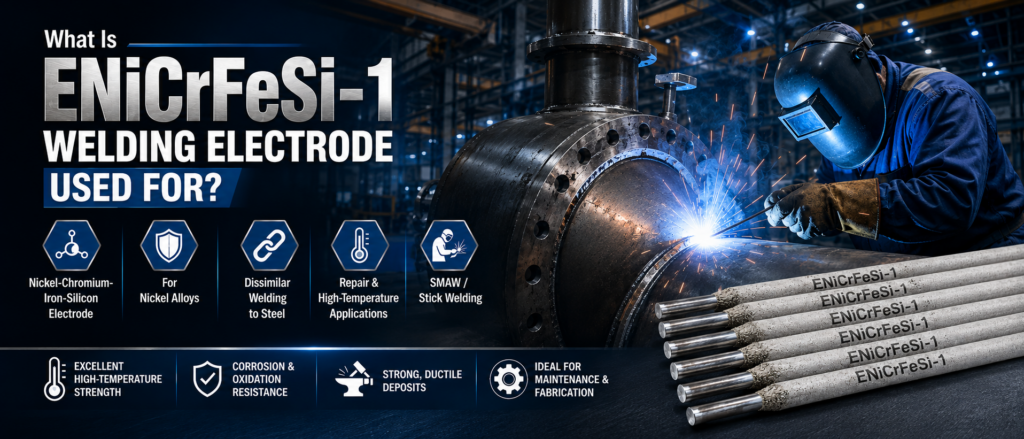
What Is ENiCrFeSi-1 Welding Electrode Used For?
ENiCrFeSi-1 is a nickel-chromium-iron-silicon covered electrode designed for shielded metal arc welding, commonly known as SMAW or stick welding. It is mainly selected for joining nickel-chromium-iron alloy UNS N06045, welding this alloy to steel, and connecting it with other nickel-base alloys. (ASSIST-QuickSearch)
Because ENiCrFeSi-1 produces a specialized nickel-alloy weld deposit, it is not normally treated as a general-purpose electrode. Its use should be based on the base-metal grade, operating temperature, service environment, joint design, and applicable welding procedure.
What Is ENiCrFeSi-1?
The designation ENiCrFeSi-1 describes the main alloying elements in the deposited weld metal:
E indicates a covered welding electrode.
Ni represents nickel.
Cr represents chromium.
Fe represents iron.
Si represents silicon.
1 identifies the specific classification within this alloy family.
ENiCrFeSi-1 is classified as a nickel-alloy electrode for shielded metal arc welding. The nominal weld-metal composition is approximately:
| Element | Nominal Content |
|---|---|
| Nickel | 46% |
| Chromium | 28% |
| Iron | 23% |
| Silicon | 2.75% |
The exact chemical limits should always be confirmed through the product technical data sheet, batch certificate, and applicable project specification. (Scribd)
What Is ENiCrFeSi-1 Welding Electrode Used For?
The primary uses of ENiCrFeSi-1 include:
Welding UNS N06045 nickel-chromium-iron alloy to itself
Joining UNS N06045 to steel
Welding UNS N06045 to other nickel-base alloys
Repairing compatible nickel-alloy components
Fabricating or maintaining equipment requiring a chemically compatible nickel-chromium-iron-silicon weld deposit
These applications make ENiCrFeSi-1 useful in specialized fabrication, maintenance, and repair work where ordinary stainless-steel or low-alloy electrodes may not provide the required weld-metal chemistry. (pdfcoffee.com)
1. Welding UNS N06045 Alloy
The most direct application of ENiCrFeSi-1 is welding components made from UNS N06045.
When the base material is UNS N06045, the welding consumable should provide suitable metallurgical compatibility with the parent metal. ENiCrFeSi-1 is formulated to deposit weld metal with a nickel-chromium-iron-silicon composition associated with this alloy system.
Possible welded components may include:
Pipes and tubes
Plates and sheets
Bars and fabricated sections
Fittings
Furnace components
Heat-processing equipment
High-temperature structural parts
UNS N06045 is included in specifications covering nickel-chromium-iron pipe, tube, rod, bar, wire, plate, sheet, strip, fittings, and other wrought product forms. (ASTM Store)
2. Joining Nickel-Chromium-Iron Alloy to Steel
ENiCrFeSi-1 can also be used for dissimilar-metal welding between nickel-chromium-iron alloy and steel.
Dissimilar welding requires careful consumable selection because the two base metals may have different:
Thermal expansion rates
Chemical compositions
Melting behavior
Strength levels
Heat-treatment requirements
Service-temperature limits
A nickel-alloy electrode can help create a transition weld between the nickel-based component and the steel component. However, the suitability of ENiCrFeSi-1 must be verified for the exact steel grade.
Before welding, the fabricator should identify whether the steel is:
Carbon steel
Low-alloy steel
Heat-resistant steel
Stainless steel
Cast steel
The welding procedure should then control dilution, heat input, preheat, interpass temperature, and postweld treatment.
3. Joining UNS N06045 to Other Nickel-Base Alloys
Another important ENiCrFeSi-1 application is joining UNS N06045 to compatible nickel-base alloys.
This may be required when equipment contains several nickel-alloy grades selected for different operating zones. For example, one section may require a specific oxidation-resistant alloy, while another may use a different nickel alloy for strength, fabrication, or availability.
In these situations, ENiCrFeSi-1 may be considered when its deposited weld-metal chemistry is suitable for both sides of the joint. The final selection should be based on:
Base-metal compositions
Required weld strength
Operating temperature
Corrosion conditions
Thermal cycling
Joint restraint
Code requirements
A qualified welding engineer should approve the filler metal for critical dissimilar joints.
4. High-Temperature Equipment Fabrication
UNS N06045 is a high-chromium, austenitic nickel-chromium-iron alloy associated with heat-resistant and oxidation-resistant service. Because ENiCrFeSi-1 is intended for welding this alloy system, it may be used in the fabrication or repair of compatible high-temperature equipment. (Metalcor)
Potential applications may include:
Industrial furnace components
Heat-treatment fixtures
Thermal-processing equipment
High-temperature ducts
Burner-related assemblies
Furnace supports
Waste-incineration equipment
Components exposed to hot oxidizing atmospheres
The electrode should not be selected only because an application operates at high temperature. The actual service temperature, load, atmosphere, thermal cycling, and expected equipment life must be evaluated.
5. Repair and Maintenance Welding
ENiCrFeSi-1 may be used for the maintenance of existing components originally fabricated from UNS N06045 or a compatible alloy combination.
Typical repair situations may involve:
Localized cracking
Damaged weld seams
Worn attachment points
Replacement of a damaged section
Repair of furnace hardware
Restoration of nickel-alloy-to-steel joints
Modification of existing equipment
Before repair welding, the base material should be positively identified. Surface contamination, oxidation, sulfur-bearing deposits, oil, paint, and damaged metal must be removed.
Repairing an unidentified high-temperature alloy with the wrong electrode can lead to cracking, reduced service life, or unacceptable weld-metal chemistry.
Why Is ENiCrFeSi-1 Selected?
ENiCrFeSi-1 is mainly selected because of its specialized weld-metal composition.
Nickel Content
Nickel provides the main alloy base of the deposited weld metal and supports compatibility with nickel-alloy components.
Chromium Content
The relatively high chromium content is associated with the alloy system used for elevated-temperature and oxidation-related service.
Iron Content
Iron helps match the nickel-chromium-iron base-metal family and contributes to the intended weld deposit chemistry.
Silicon Content
Silicon is an important feature of the ENiCrFeSi-1 classification. Its controlled level distinguishes this electrode from common ENiCrFe classifications that contain much less silicon.
The combined chemistry is designed for a specific group of base metals and should not be replaced casually with another nickel electrode.
Is ENiCrFeSi-1 Suitable for Corrosion-Resistant Welding?
ENiCrFeSi-1 may be used in equipment operating under corrosive or high-temperature conditions, but its classification alone does not guarantee performance in every environment.
Standard electrode classification tests may not fully evaluate:
Corrosion resistance
Scaling resistance
Sulfidation resistance
Carburization resistance
Strength at elevated temperature
Strength at cryogenic temperature
Supplementary testing may therefore be required when these properties are essential to the application.
The service environment should be reviewed for:
Chlorides
Acids
Alkalis
Sulfur compounds
Combustion gases
Molten salts
Reducing atmospheres
Oxidizing atmospheres
Repeated heating and cooling
ENiCrFeSi-1 Welding Process
ENiCrFeSi-1 is a covered electrode used with the shielded metal arc welding process.
This process is suitable for:
Shop fabrication
Field installation
Equipment repair
Short production runs
Restricted-access locations
Maintenance welding
Many nickel-alloy covered electrodes are designed primarily for direct-current electrode-positive operation, although the exact polarity should always be confirmed from the electrode data sheet. (pdfcoffee.com)
Recommended Welding Preparation
Proper preparation is essential when welding nickel alloys.
Clean the Joint Thoroughly
Remove:
Oil
Grease
Paint
Moisture
Oxide scale
Sulfur-containing contamination
Cutting residues
Embedded carbon-steel particles
Use clean tools dedicated to nickel-alloy fabrication whenever possible.
Use the Correct Joint Design
Nickel-alloy weld metal may not flow exactly like carbon-steel weld metal. Joint openings and groove angles should provide sufficient access for electrode manipulation and complete fusion.
Control Heat Input
Excessive heat input can increase:
Distortion
Dilution
Grain growth
Hot-cracking risk
Time spent at elevated temperature
Use controlled bead size and follow the approved welding procedure.
Maintain a Short Arc
A short, stable arc helps reduce atmospheric contamination, excessive spatter, and poor bead control.
Clean Between Passes
Remove slag completely before depositing the next pass. Slag trapped between weld layers can produce inclusions and reduce weld quality.
Can ENiCrFeSi-1 Be Used for All Welding Positions?
Welding-position capability can depend on electrode diameter, coating design, manufacturer instructions, and the approved procedure.
Smaller-diameter electrodes are generally easier to control in vertical and overhead positions. Larger electrodes may be limited to flat or horizontal welding.
The user should verify:
Approved welding position
Electrode diameter
Current range
Polarity
Recommended travel speed
Maximum weave width
Interpass temperature
ENiCrFeSi-1 vs. Other Nickel-Alloy Electrodes
ENiCrFeSi-1 should not be confused with common nickel-alloy classifications such as:
ENiCrFe electrodes
ENiCrMo electrodes
ENiCu electrodes
ENi electrodes
Stainless-steel electrodes
These consumables can differ substantially in:
Nickel content
Chromium content
Molybdenum content
Iron content
Silicon content
Intended base metals
Corrosion behavior
High-temperature performance
The correct electrode is not simply the one with the highest alloy content. It is the electrode whose weld-metal chemistry and mechanical properties meet the engineering requirements.
How to Select ENiCrFeSi-1 Welding Electrodes
Before purchasing ENiCrFeSi-1, confirm the following information.
Classification
The package and certificate should clearly identify the electrode as ENiCrFeSi-1.
Applicable Standard
Confirm the required classification standard and project edition.
Chemical Composition
Request a chemical composition certificate for the deposited weld metal or manufactured batch.
Mechanical Properties
Review tensile strength and other required mechanical test results.
Electrode Diameter
Choose the diameter according to:
Base-metal thickness
Welding position
Joint access
Deposition requirement
Power-source capacity
Certification
Depending on the project, required documents may include:
Technical data sheet
Safety data sheet
Certificate of analysis
Batch test certificate
Certificate of conformity
Inspection report
Third-party approval
Manufacturing traceability
Packaging and Storage
Nickel-alloy electrodes should be supplied in sealed, moisture-resistant packaging. Storage and reconditioning instructions should be followed carefully.
Common Mistakes to Avoid
Using ENiCrFeSi-1 as a General-Purpose Electrode
This classification is designed for specialized alloy welding, not routine structural-steel fabrication.
Selecting It by Trade Description Alone
Always verify the standardized classification and batch documentation.
Ignoring Base-Metal Identification
Similar-looking heat-resistant alloys may have very different compositions.
Excessive Dilution
High dilution from steel can change the weld deposit and reduce its intended alloy content.
Welding Over Contamination
Nickel alloys are sensitive to contaminants that can contribute to porosity or cracking.
Skipping Procedure Qualification
Critical welds should be made under an approved and qualified welding procedure.
Conclusion
ENiCrFeSi-1 welding electrode is mainly used for welding UNS N06045 nickel-chromium-iron alloy, joining this alloy to steel, and connecting it with other nickel-base alloys.
Its specialized nickel-chromium-iron-silicon weld deposit makes it relevant to selected high-temperature fabrication, furnace equipment, thermal-processing systems, dissimilar joints, and maintenance repairs.
Successful use depends on more than the electrode classification. The fabricator should verify the base material, product certification, chemical composition, welding position, current range, heat input, service environment, and qualified welding procedure before production begins.