
ENiCrMo-4 Electrode Applications in Chemical Processing Equipment
Chemical processing equipment frequently operates under demanding conditions involving aggressive acids, chlorides, elevated temperatures, pressure, and continuous exposure to corrosive media. In these environments, weld integrity is just as important as the corrosion resistance of the base material.ENiCrMo-4
ENiCrMo-4 is a nickel-chromium-molybdenum covered electrode developed for shielded metal arc welding of corrosion-resistant nickel alloys. Its balanced alloy system provides strong resistance to localized corrosion and makes it suitable for manufacturing, maintaining, and repairing critical chemical processing equipment.
This article explains the primary ENiCrMo-4 electrode applications, its performance advantages, typical equipment uses, and the welding practices required to produce reliable joints.
What Is an ENiCrMo-4 Electrode?
ENiCrMo-4 is classified under AWS A5.11 for nickel and nickel-alloy covered welding electrodes. It is commonly used to deposit weld metal compatible with low-carbon nickel-chromium-molybdenum alloys such as UNS N10276.
The weld deposit typically contains nickel as the balance, along with substantial amounts of chromium, molybdenum, tungsten, and controlled iron. Carbon and silicon are kept relatively low to help reduce the formation of undesirable phases that may affect corrosion performance in welded areas.
The main functions of ENiCrMo-4 electrodes include:
Joining nickel-chromium-molybdenum alloys of similar composition
Welding corrosion-resistant alloy cladding
Joining nickel alloys to compatible steels or other nickel-based alloys
Repairing worn or corroded chemical processing components
Applying corrosion-resistant weld overlays
Restoring damaged welds in pressure-containing equipment
Because ENiCrMo-4 is a covered electrode, it is primarily used with the shielded metal arc welding process, also known as SMAW.
Why ENiCrMo-4 Is Used in Chemical Processing Equipment
Chemical plants handle media that can attack ordinary steels and even some stainless steels. Acids, halides, wet chlorine compounds, contaminated process streams, and changing operating conditions may cause rapid corrosion when the wrong welding material is selected.
ENiCrMo-4 weld metal is valued for its resistance to several forms of corrosion.
ENiCrMo-4 Resistance to Pitting Corrosion
Pitting is a highly localized form of corrosion that creates small but deep cavities in a metal surface. It can be especially dangerous because equipment may appear visually sound while the remaining wall thickness has already been reduced.
The molybdenum content in ENiCrMo-4 helps improve resistance to pitting in chloride-containing process environments.
Resistance to Crevice Corrosion
Crevice corrosion can develop beneath gaskets, deposits, fasteners, lap joints, and other shielded areas where process fluids become trapped. These locations may develop a chemical composition that is more aggressive than the main process stream.
ENiCrMo-4 is often selected for welded assemblies where resistance to this type of localized attack is required.
ENiCrMo-4 Performance in Oxidizing and Reducing Media
Chemical processing systems may encounter both oxidizing and reducing conditions. Chromium contributes to performance in oxidizing environments, while molybdenum supports resistance in reducing acids.
The combination allows ENiCrMo-4 weld deposits to perform across a wider range of chemical conditions than many conventional welding materials.
Resistance to Stress Corrosion Cracking
Stress corrosion cracking occurs when tensile stress and a specific corrosive environment act together. Welded equipment may be vulnerable because residual stresses can remain after fabrication.
Nickel-rich ENiCrMo-4 weld metal provides useful resistance to stress corrosion cracking in many chloride-bearing environments, although actual performance must always be evaluated against the precise operating conditions.
ENiCrMo-4 Electrode Applications in Reactors
Reactors are among the most important applications for ENiCrMo-4 electrodes in chemical processing facilities. These vessels may combine corrosive chemicals, elevated temperatures, pressure, agitation, and repeated production cycles.
ENiCrMo-4 may be used for:
Reactor shell fabrication
Internal attachment welding
Nozzle-to-shell connections
Agitator support components
Corrosion-resistant lining repairs
Weld overlay restoration
Maintenance of internal alloy surfaces
The electrode is particularly useful when the reactor is constructed from, or clad with, a compatible nickel-chromium-molybdenum alloy.
Careful joint preparation and contamination control are essential. Iron particles, sulfur-containing residues, oil, moisture, and marking compounds can negatively affect weld quality or corrosion resistance.
ENiCrMo-4 Heat Exchanger Fabrication and Repair
Heat exchangers are exposed to process media on one side and a heating or cooling medium on the other. A small weld defect can create leakage, product contamination, reduced thermal performance, or an unplanned shutdown.
Typical ENiCrMo-4 electrode applications in heat exchangers include:
Channel and shell repairs
Tube-sheet overlay welding
Nozzle connections
Divider plate welding
Corrosion-resistant lining repairs
Maintenance of welded external components
SMAW electrodes are usually not the first choice for thin tube-to-tube-sheet welds, where a more precise process may be preferred. However, ENiCrMo-4 electrodes are highly useful for thicker sections, accessible repairs, structural attachments, and field maintenance.
ENiCrMo-4 Pressure Vessels and Process Columns
Chemical pressure vessels and process columns may contain acids, solvents, intermediates, contaminated liquids, or corrosive vapors. Their welded joints must maintain both mechanical strength and corrosion resistance throughout the intended service life.
ENiCrMo-4 electrodes can be used for:
Longitudinal and circumferential vessel seams
Nozzle and manway connections
Internal tray supports
Column attachments
Alloy-clad steel joints
Local weld repairs
Corrosion-resistant surfacing
When welding clad steel, ENiCrMo-4 may be used on the corrosion-resistant side of the joint. The welding sequence must be designed to limit dilution from the steel backing material because excessive iron pickup can alter the final weld deposit.
Chemical Process Piping
Process piping transfers corrosive liquids and gases between reactors, storage tanks, pumps, separators, heat exchangers, and other plant equipment.
ENiCrMo-4 electrode applications in piping systems include:
Pipe-to-pipe butt joints
Pipe-to-flange connections
Branch connections
Nozzle-to-pipe joints
Field installation welds
Emergency maintenance
Corrosion-resistant root or fill layers in qualified procedures
SMAW is well suited to field piping work because the equipment is portable and the process can be used in multiple welding positions. However, electrode diameter, current, joint geometry, accessibility, and welding position must be considered before production begins.
Pumps, Valves, and Flow-Control Components
Pumps and valves may experience a combination of chemical corrosion, turbulence, erosion, cavitation, and mechanical wear. Damage frequently develops around sealing surfaces, internal passages, impellers, valve bodies, and welded attachments.
ENiCrMo-4 can be used for:
Repairing compatible pump casings
Restoring valve bodies
Rebuilding corroded surfaces
Applying corrosion-resistant overlays
Joining replacement sections
Repairing weld defects in cast or wrought alloy components
Before repairing a component, the base material should be positively identified. Welding an unknown alloy with ENiCrMo-4 without proper evaluation can result in cracking, excessive dilution, or inadequate service performance.
ENiCrMo-4 Storage Tanks and Transfer Systems
Chemical storage tanks may be exposed to concentrated media during normal operation and diluted or contaminated solutions during cleaning, startup, or shutdown. In some cases, these temporary conditions can be more corrosive than the primary process.
ENiCrMo-4 may be used in:
Tank shell and bottom repairs
Nozzle installations
Manway reinforcement
Alloy lining repairs
Transfer pipe connections
Drain and overflow systems
Corrosion-resistant overlay applications
The welding consumable should be selected according to the most severe credible service condition rather than only the normal operating environment.
ENiCrMo-4 Dissimilar Metal Welding
Chemical equipment often combines several materials to balance corrosion resistance, strength, fabrication requirements, and cost. This may create joints between nickel alloys, stainless steels, and carbon or low-alloy steels.
ENiCrMo-4 can be considered for certain dissimilar metal joints because its nickel-rich weld deposit can accommodate differences in alloy composition and thermal expansion. Possible applications include joining a compatible nickel alloy to another nickel-based material or depositing the corrosion-resistant side of a clad steel joint.
Dissimilar welding must be supported by a qualified welding procedure. Dilution, weld bead placement, heat input, filler selection, and service temperature all affect the final result.
Corrosion-Resistant Weld Overlay
Replacing an entire vessel or component with a high-alloy material may not always be economically practical. Weld overlay provides another option by applying a corrosion-resistant layer over a less expensive structural substrate.
ENiCrMo-4 electrodes can be used for localized overlay work on:
Vessel interiors
Nozzles
Flanges
Valve bodies
Pipe sections
Worn sealing areas
Previously repaired surfaces
Multiple layers may be required to obtain the desired weld chemistry because the first layer can be diluted by the base metal. The completed overlay should be inspected for surface defects, incomplete fusion, excessive dilution, and insufficient thickness.
Welding Practices for ENiCrMo-4 Electrodes
The performance of ENiCrMo-4 depends on more than its chemical composition. Poor welding practices can produce defects or reduce the corrosion resistance of the completed joint.
Keep the Joint Clean
Remove grease, oil, paint, oxide, moisture, sulfur-bearing contaminants, and embedded iron before welding. Use cleaning tools dedicated to nickel alloys whenever possible.
Control Heat Input
Excessive heat input can increase distortion, enlarge the heat-affected zone, and affect the microstructure of the weld. Use controlled travel speed, appropriate amperage, and stringer beads unless the qualified procedure specifies otherwise.
Maintain a Short Arc
A short, stable arc helps reduce spatter, oxidation, and excessive heat input. ENiCrMo-4 electrodes are generally operated using direct current electrode positive, but the approved product data and welding procedure should always be followed.
Remove Slag Between Passes
Every weld pass should be thoroughly cleaned before the next pass is deposited. Trapped slag can reduce mechanical integrity and create locations where corrosive media may concentrate.
Control Interpass Temperature
Allow the joint to cool as required by the welding procedure. High interpass temperatures can increase heat accumulation and may negatively influence weld quality.
Store Electrodes Correctly
Covered electrodes should remain dry and be stored according to the recommended conditions. Electrodes exposed to moisture should not be used until they have been handled in accordance with the approved storage and reconditioning procedure.
How to Select ENiCrMo-4 for Chemical Service
ENiCrMo-4 should not be selected solely because the equipment operates in a chemical plant. The actual service conditions must be reviewed.
Important factors include:
Base material composition
Chemical type and concentration
Operating temperature
Process pressure
Chloride or halide content
Oxidizing and reducing conditions
Contamination during operation
Startup and shutdown conditions
Required design code
Joint type and welding position
Need for post-weld inspection
Expected equipment service life
Corrosion data for the base alloy and weld metal should be considered together. Testing may be necessary when the process contains multiple chemicals or when operating conditions vary significantly.
ENiCrMo-4 Inspection and Quality Control
Chemical processing equipment often requires strict inspection because weld failure can lead to leakage, contamination, environmental damage, or production losses.
Depending on the equipment and governing code, inspection may include:
Visual examination
Liquid penetrant testing
Radiographic testing
Ultrasonic testing
Positive material identification
Ferrite or chemistry checks where applicable
Pressure or leak testing
Corrosion testing for critical service
A qualified welding procedure and trained welding personnel are essential for consistent results.
ENiCrMo-4 Conclusion
ENiCrMo-4 electrodes are an important welding solution for chemical processing equipment exposed to aggressive corrosion. Their nickel-chromium-molybdenum-tungsten weld deposit provides valuable resistance to pitting, crevice corrosion, stress corrosion cracking, and a broad range of oxidizing and reducing environments.
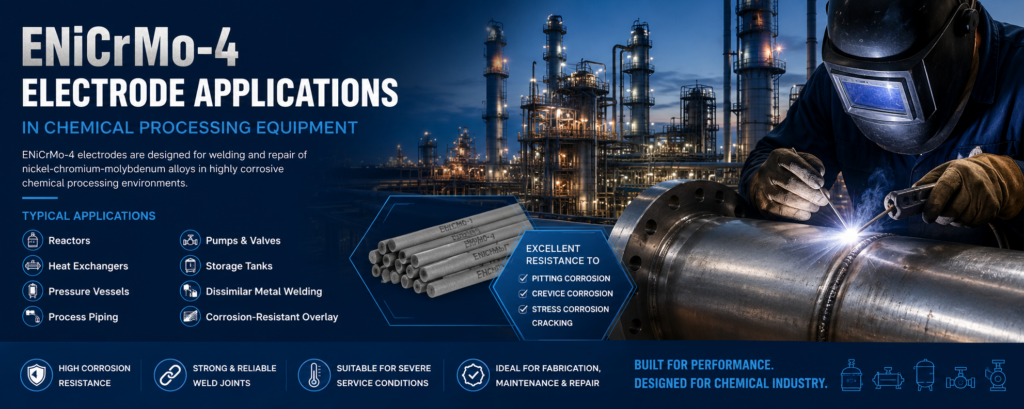
Typical ENiCrMo-4 electrode applications include reactors, heat exchangers, pressure vessels, columns, piping systems, pumps, valves, storage tanks, alloy-clad joints, and corrosion-resistant overlays.
Reliable performance depends on correct material identification, qualified welding procedures, low contamination, controlled heat input, complete slag removal, and appropriate inspection. When these factors are properly managed, ENiCrMo-4 can help extend equipment life, reduce maintenance frequency, and improve the reliability of critical chemical processing systems.
Technical basis: ENiCrMo-4 is listed as an AWS A5.11/SFA-5.11 covered-electrode classification for UNS N10276-type material. Published technical data identify reactors, heat exchangers, columns, pipelines, pressure vessels, cladding, and similar-alloy or dissimilar-alloy joints as relevant applications, while noting strong resistance to pitting and crevice corrosion.