

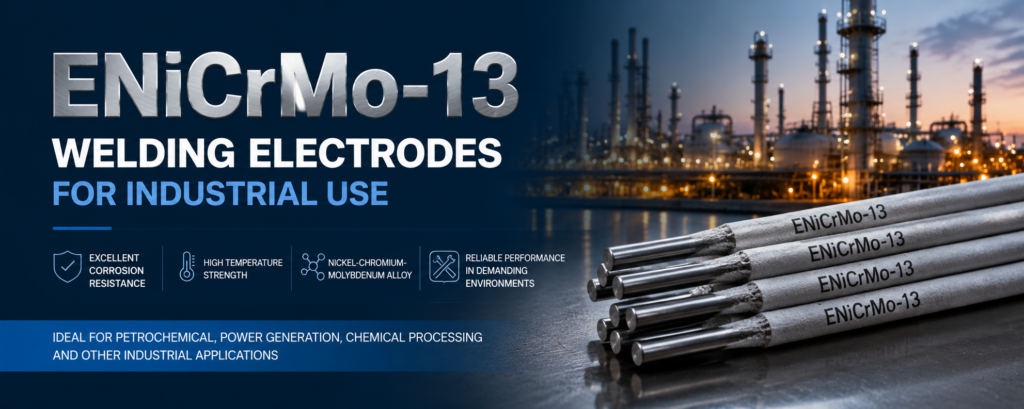
ENiCrMo-13 Welding Electrodes for Industrial Use
Industrial welding applications often involve corrosive chemicals, high temperatures, chloride exposure, and demanding operating conditions. Standard welding consumables may not provide the corrosion resistance or metallurgical stability required in these environments. ENiCrMo-13 welding electrodes for industrial use are designed to produce nickel-chromium-molybdenum weld deposits with reliable performance in severe service conditions.
These covered electrodes are commonly selected for joining corrosion-resistant nickel alloys, welding dissimilar metals, repairing industrial equipment, and applying protective weld overlays. Their balanced alloy system helps completed welds resist localized corrosion while maintaining strength and structural integrity.
What Is an ENiCrMo-13 Welding Electrode?
ENiCrMo-13 is a nickel-based covered electrode used for shielded metal arc welding. Its weld deposit is primarily alloyed with nickel, chromium, and molybdenum.
Each major alloying element supports a different performance requirement:
Nickel provides a stable weld-metal structure and broad corrosion resistance.
Chromium improves resistance to oxidizing chemicals and surface corrosion.
Molybdenum strengthens resistance to reducing environments, pitting, and crevice corrosion.
The low-carbon alloy design also helps limit undesirable phase formation during welding. This makes ENiCrMo-13 suitable for fabrication and maintenance projects where both corrosion resistance and weld quality are important.
Key Benefits of ENiCrMo-13 Welding Electrodes
Excellent Corrosion Resistance
One of the main reasons to use ENiCrMo-13 welding electrodes is their performance in aggressive chemical environments. The deposited weld metal can provide resistance to both oxidizing and reducing media.
This is valuable for equipment exposed to acids, chlorides, contaminated process fluids, seawater, and corrosive industrial gases.
Resistance to Pitting and Crevice Corrosion
Localized corrosion can cause rapid failure even when the surrounding metal appears undamaged. The high chromium and molybdenum content of ENiCrMo-13 weld metal helps improve resistance to pitting and crevice corrosion.
This characteristic is especially important for welded joints operating in chloride-containing environments.
Reliable Performance at Elevated Temperatures
Many chemical processing, power generation, and pollution-control systems operate at elevated temperatures. ENiCrMo-13 electrodes produce weld deposits designed to maintain dependable mechanical and corrosion-resistant properties under demanding thermal conditions.
Actual service suitability must still be confirmed according to the base material, operating temperature, pressure, and process medium.
Suitable for Dissimilar Metal Welding
Industrial equipment may contain combinations of nickel alloys, stainless steels, and carbon or low-alloy steels. ENiCrMo-13 can be considered for selected dissimilar-metal joints where a corrosion-resistant nickel-alloy weld deposit is required.
A qualified welding procedure is essential because dilution from the base metals can change the final weld-metal composition and performance.
Effective for Corrosion-Resistant Overlay
ENiCrMo-13 electrodes may also be used to apply corrosion-resistant weld metal over a less corrosion-resistant substrate. This method can protect equipment surfaces without manufacturing the entire component from a high-alloy material.
Overlay welding is commonly considered for vessels, piping systems, valves, flanges, and process equipment exposed to aggressive media.
Industrial Applications
ENiCrMo-13 welding electrodes are suitable for many demanding fabrication, repair, and maintenance operations.
Chemical Processing Equipment
Chemical plants require welded components that can tolerate acids, chlorides, solvents, and mixed process streams. ENiCrMo-13 may be used for reactors, storage vessels, heat exchangers, piping, and other corrosion-resistant equipment.
Petrochemical Facilities
Refineries and petrochemical plants contain equipment exposed to corrosive compounds, high temperatures, and changing process conditions. ENiCrMo-13 electrodes can support the fabrication and repair of selected nickel-alloy components used in these environments.
Pollution-Control Systems
Flue-gas cleaning and emission-control equipment may experience acidic condensates and chloride contamination. Corrosion-resistant weld deposits are important for maintaining the durability of scrubbers, ducts, absorbers, and related components.
Marine and Offshore Structures
Marine environments expose welded equipment to moisture, salt, and chloride-rich conditions. ENiCrMo-13 may be selected for suitable corrosion-resistant alloy components used in offshore processing, marine systems, and seawater-related applications.
Pulp and Paper Production
Pulp and paper facilities use chemicals that can attack conventional steels. Nickel-alloy weld deposits may be required in digesters, bleaching equipment, tanks, piping, and other process systems.
Industrial Repair and Maintenance
ENiCrMo-13 electrodes can be useful when repairing corrosion-resistant equipment, restoring damaged welds, or rebuilding surfaces exposed to aggressive service conditions. The repair procedure should identify the original base metal and evaluate contamination, cracking, and previous weld repairs.
Base-Material Preparation
Good preparation is essential when welding with ENiCrMo-13 electrodes. The joint area should be clean and free from oil, grease, paint, moisture, scale, sulfur-containing contaminants, and embedded iron particles.
Mechanical cleaning tools should be suitable for nickel-alloy work. Tools previously used on carbon steel may introduce contamination that reduces corrosion resistance.
The joint design should provide adequate access, penetration, and control of the weld pool. Tack welds must be sound and should be inspected before final welding begins.
ENiCrMo-13 Welding Practice and Heat Control
Nickel-alloy weld metal behaves differently from carbon-steel weld metal. The weld pool may be more viscous and require careful electrode manipulation.
For consistent results:
Maintain a short and stable arc.
Use the recommended current range for the electrode diameter.
Avoid excessive weaving.
Control heat input and interpass temperature.
Remove slag completely between passes.
Grind out defects rather than welding over them.
Follow a qualified welding procedure.
Excessive heat input can increase distortion, promote dilution, and affect weld-metal properties. Controlled stringer beads are often preferred where the joint design permits.
ENiCrMo-13 Electrode Storage and Handling
Covered electrodes can absorb moisture during storage or after opening. Moisture may affect arc stability, slag behavior, weld appearance, and deposited-metal quality.
Store ENiCrMo-13 welding electrodes in a clean, dry environment and keep opened packages protected from humidity. Any drying or reconditioning procedure should follow the electrode supplier’s technical instructions. Excessive or repeated heating may damage the coating.
How to Select the Right ENiCrMo-13 Electrode
Product selection should not be based only on the classification name. Before purchasing, confirm:
Base-metal grades and thicknesses
Required welding position
Electrode diameter
Welding current and polarity
Service temperature
Corrosive process medium
Mechanical-property requirements
Required certificates and inspection documents
Packaging and moisture protection
Applicable welding procedure specifications
For critical pressure equipment or corrosion service, the selected electrode should be reviewed by a qualified welding or materials engineer.
ENiCrMo-13 Conclusion
ENiCrMo-13 welding electrodes for industrial use provide a practical solution for joining, repairing, and overlaying corrosion-resistant components. Their nickel-chromium-molybdenum weld deposit supports resistance to aggressive chemicals, chloride-containing media, pitting, crevice corrosion, and demanding industrial conditions.
Successful application depends on more than electrode classification. Correct base-metal identification, surface preparation, heat-input control, electrode storage, and welding-procedure qualification are all essential. When these factors are properly managed, ENiCrMo-13 electrodes can help deliver durable welds for chemical processing, petrochemical, marine, pollution-control, power, and other heavy-industry applications.
The technical scope and core application descriptions were checked against current nickel-alloy covered-electrode specifications and published classification guidance.