

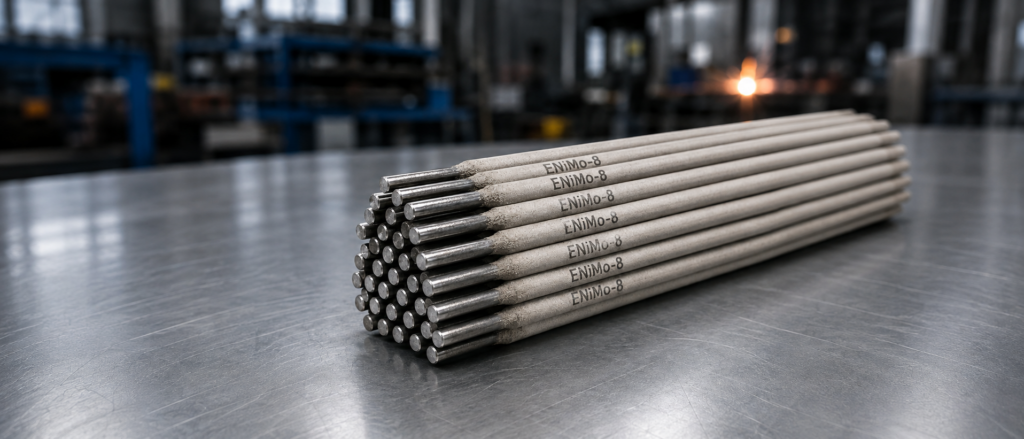
ENiMo-8 Welding Electrode Applications and Advantages
What Is an ENiMo-8 Welding Electrode?
ENiMo-8 is a nickel-molybdenum alloy covered electrode primarily developed for shielded metal arc welding, also known as SMAW or stick welding. It is widely used for welding 9% nickel steel and other components that must maintain strength and toughness at extremely low temperatures.
The weld deposit typically contains high levels of nickel and molybdenum, with controlled additions of iron, tungsten, and chromium. This alloy system produces a ductile and reliable weld metal suitable for demanding cryogenic equipment.
Because of its low-temperature performance, the ENiMo-8 welding electrode is commonly selected for LNG storage tanks, liquefied gas equipment, cryogenic vessels, pipelines, and repair welding of 9% nickel steel.
ENiMo-8 Welding Electrode Classification
ENiMo-8 is generally classified under AWS A5.11 for nickel and nickel-alloy covered welding electrodes. It is designed for the SMAW process and produces a nickel-molybdenum-tungsten weld deposit.
A nominal ENiMo-8 weld metal composition may include approximately:
70% nickel
18% molybdenum
7% iron
3% tungsten
2% chromium
The exact chemical composition and mechanical properties may vary within the limits of the applicable specification. Users should always confirm the product certificate, welding procedure specification, and project requirements before use.
Main ENiMo-8 Welding Electrode Applications
Welding 9% Nickel Steel
The most important application of the ENiMo-8 welding electrode is welding 9% nickel steel. This steel is frequently used in equipment that stores or transports liquefied gases at very low temperatures.
ENiMo-8 creates a nickel-rich weld deposit that remains ductile under cryogenic conditions. It can therefore help reduce the risk of brittle weld failure when equipment is exposed to extremely low service temperatures.
Typical welding work includes:
Butt welding of 9% nickel steel plates
Fillet welding of cryogenic structures
Tack welding during tank fabrication
Repair welding of damaged joints
Maintenance welding on cryogenic equipment
LNG Storage Tank Welding
ENiMo-8 electrodes are frequently used in the construction and maintenance of liquefied natural gas storage tanks. The inner tank of an LNG storage system may operate at temperatures near minus 162 degrees Celsius.
At these temperatures, ordinary welding consumables may lose toughness. ENiMo-8 is designed to produce weld metal with the ductility and low-temperature toughness required for cryogenic tank applications.
Common LNG tank applications include:
Inner tank shell welding
Bottom plate welding
Roof structure welding
Nozzle and attachment welding
Tack and repair welding
Maintenance of existing tank joints
Liquefied Gas Equipment
In addition to LNG systems, ENiMo-8 welding electrodes may be used for equipment handling other liquefied gases.
Potential applications include:
Liquefied nitrogen storage tanks
Cryogenic process vessels
Low-temperature piping systems
Gas transportation equipment
Cryogenic heat exchange equipment
Liquefied gas terminals
Electrode selection should always be based on the base material, operating temperature, joint design, welding position, and applicable construction code.
Cryogenic Pressure Vessels
Pressure vessels operating at low temperatures require welds with reliable strength, ductility, and impact resistance. ENiMo-8 can be used for certain cryogenic pressure vessel joints fabricated from compatible 9% nickel steel.
Its nickel-rich weld deposit helps maintain mechanical performance during cooling, operation, shutdown, and repeated thermal cycles.
Tack and Repair Welding
ENiMo-8 is particularly useful for tack welding and repair welding of 9% nickel steel structures. Tack welds must provide sufficient strength while avoiding cracking before the final weld is completed.
For repair applications, ENiMo-8 can be used to remove and replace defective weld sections, restore damaged joints, or repair localized areas during tank fabrication and maintenance.
Repair procedures should be carefully qualified because joint restraint, base metal condition, heat input, and previous welding history can affect the final result.
Key Advantages of ENiMo-8 Welding Electrodes
Excellent Cryogenic Toughness
One of the main advantages of ENiMo-8 is its ability to maintain toughness at extremely low temperatures. This makes it suitable for LNG tanks, cryogenic vessels, and liquefied gas systems.
A tough weld deposit can absorb deformation and impact energy without sudden brittle fracture. This characteristic is especially important for large storage tanks and pressure-containing equipment.
High Weld Metal Strength
ENiMo-8 weld metal combines high tensile strength with useful ductility. Under the applicable classification, the weld deposit is generally required to meet a minimum tensile strength of approximately 650 MPa and a minimum elongation of approximately 25%.
Actual results depend on the electrode formulation, welding procedure, joint design, heat input, dilution, and testing conditions.
ENiMo-8 Good Ductility
The nickel-rich weld deposit provides good ductility, allowing the welded joint to accommodate contraction and thermal movement during cooling.
This is important because cryogenic equipment experiences significant dimensional changes when temperatures decrease from ambient conditions to operating temperatures.
ENiMo-8 Reliable Performance on 9% Nickel Steel
ENiMo-8 is specifically associated with welding 9% nickel steel. Its weld metal chemistry and mechanical characteristics are designed to provide a reliable transition between the welded joint and the cryogenic base material.
This compatibility helps improve joint integrity in storage tanks, pressure vessels, and low-temperature piping systems.
ENiMo-8 Reduced Risk of Brittle Failure
The weld deposit remains relatively ductile under cryogenic service conditions. When the correct welding procedure is followed, this can help reduce the risk of sudden brittle weld failure.
However, electrode classification alone does not guarantee joint performance. Procedure qualification, welder qualification, inspection, and impact testing may still be required.
Suitable for Multiple Welding Positions
ENiMo-8 electrodes with diameters up to approximately 4.0 mm may be suitable for all-position welding, depending on the specific product and qualified welding procedure.
Larger electrodes are generally more suitable for flat and horizontal welding because of their higher deposition rate and larger weld pool.
Stable Arc Characteristics
Some ENiMo-8 electrodes are designed for alternating-current operation. AC welding can be beneficial when magnetic arc blow is a concern, particularly in large steel structures or highly restrained joints.
A stable arc can improve bead control, fusion, weld appearance, and operator comfort.
No External Shielding Gas Required
As a covered electrode for SMAW, ENiMo-8 does not normally require an external shielding gas. The electrode coating generates shielding and slag during welding.
This makes the process practical for:
Site fabrication
Outdoor maintenance
Confined work areas
Tank construction
Localized repair welding
Locations where gas cylinders are inconvenient
ENiMo-8 Recommended Welding Practices
Clean the Joint Thoroughly
Before welding, remove oil, grease, moisture, rust, paint, scale, marking materials, and previous slag. Nickel-alloy weld deposits can be sensitive to contamination.
Both the joint surfaces and the surrounding area should be clean before tack welding and final welding begin.
Keep a Short Arc Length
A short and stable arc helps control heat input, reduce oxidation, limit spatter, and improve weld pool protection.
Excessive arc length may produce an unstable weld pool, poor slag coverage, increased porosity, or an irregular bead profile.
ENiMo-8 Control Welding Current
Use the lowest practical current that still provides stable arc operation and complete fusion. Excessive current may increase heat input, electrode overheating, dilution, and weld pool fluidity.
The correct current range depends on electrode diameter, welding position, joint type, and manufacturer recommendations.
ENiMo-8 Control Interpass Temperature
Interpass temperature should be controlled according to the approved welding procedure. Excessive interpass temperature may affect the base metal heat-affected zone and the final mechanical properties of the joint.
Temperature crayons, contact thermometers, or calibrated digital devices can be used for monitoring.
ENiMo-8 Store Electrodes in Dry Conditions
ENiMo-8 electrodes should be protected from moisture during transportation, storage, and use. Open packages should be stored in a controlled holding oven when required by the electrode instructions or project specification.
Electrodes exposed to excessive moisture may require redrying. The correct redrying temperature and time must be based on the product instructions rather than a general assumption.
ENiMo-8 Remove Slag Between Passes
All slag must be completely removed before depositing the next weld pass. Special attention should be given to joint sidewalls, weld toes, narrow grooves, and restart areas.
Remaining slag can cause inclusions, incomplete fusion, or other internal weld defects.
ENiMo-8 Welding Quality Control
Critical cryogenic welds normally require strict inspection and testing. Depending on the project, quality control may include:
Visual inspection
Liquid penetrant testing
Radiographic testing
Ultrasonic testing
Tensile testing
Bend testing
Low-temperature impact testing
Chemical composition analysis
Procedure qualification testing
The final inspection plan should follow the applicable construction code, engineering specification, and service conditions.
How to Select an ENiMo-8 Welding Electrode
When selecting an ENiMo-8 electrode, consider the following factors:
Applicable AWS or ASME classification
Base metal grade
Minimum service temperature
Required tensile strength
Required impact toughness
Welding position
Electrode diameter
Available welding current
Joint thickness and groove design
Inspection requirements
Product certification
Packaging and moisture protection
For cryogenic equipment, purchasing decisions should not be based only on price. Consistent chemical composition, stable arc performance, traceable certification, and dependable low-temperature properties are also important.
ENiMo-8 Compared with General Nickel Alloy Electrodes
Not every nickel alloy electrode is designed for welding 9% nickel steel. Different electrode classifications contain different combinations of nickel, chromium, molybdenum, iron, tungsten, and other alloying elements.
ENiMo-8 is distinguished by its high nickel and molybdenum content and its established use in cryogenic 9% nickel steel applications.
Substituting another nickel alloy electrode without engineering approval may change:
Weld metal strength
Low-temperature toughness
Thermal expansion behavior
Dilution characteristics
Crack resistance
Welding position capability
Code compliance
The filler metal classification should therefore match the qualified welding procedure and project specification.
ENiMo-8 Conclusion
ENiMo-8 is a specialized nickel-molybdenum welding electrode designed for critical low-temperature applications. Its combination of strength, ductility, and cryogenic toughness makes it an important consumable for welding 9% nickel steel.
Typical applications include LNG storage tanks, liquefied nitrogen equipment, cryogenic pressure vessels, low-temperature pipelines, tack welding, and repair welding.
For reliable results, ENiMo-8 should be used with a qualified welding procedure, controlled heat input, clean joint surfaces, correct electrode storage, and appropriate inspection. Proper selection and application can help produce durable welds capable of performing safely under severe cryogenic service conditions.