
ENiMoCr-1 Electrode for Heat and Corrosion Resistance
What Is an ENiMoCr-1 Electrode?
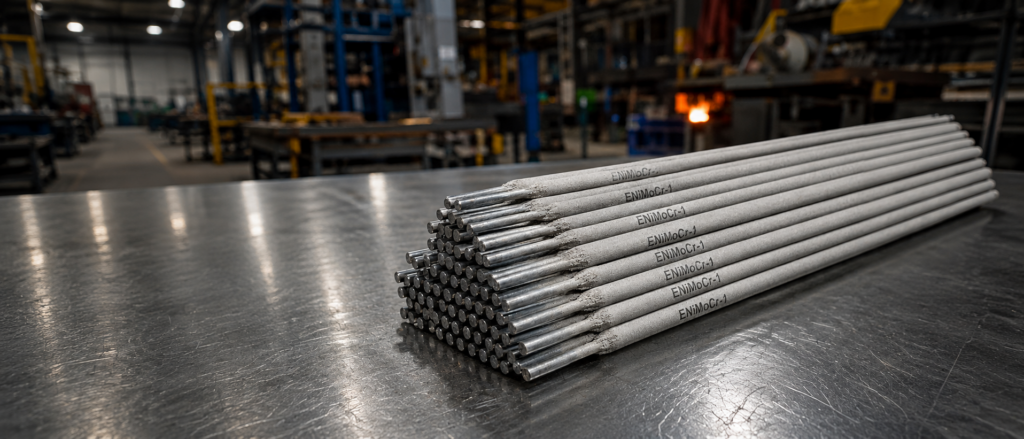
ENiMoCr-1 is a nickel-molybdenum-chromium covered welding electrode developed for shielded metal arc welding, commonly known as SMAW or stick welding. It is designed for fabricating and repairing corrosion-resistant nickel alloy components used in aggressive chemical and elevated-temperature environments.
The ENiMoCr-1 electrode produces a nickel-rich weld deposit containing significant amounts of molybdenum and chromium. This alloy balance provides strong resistance to reducing acids while maintaining protection when oxidizing contaminants are present.
Because of its combined heat and corrosion resistance, ENiMoCr-1 is commonly considered for chemical processing equipment, heat exchangers, reaction vessels, piping, storage tanks, pumps, valves, and other components exposed to hot corrosive media.
ENiMoCr-1 Electrode Classification
ENiMoCr-1 is classified under AWS A5.11, the specification covering nickel and nickel-alloy electrodes for shielded metal arc welding.
The classification name helps identify its basic alloy system:
E indicates a covered welding electrode.
Ni represents nickel as the primary alloy base.
Mo indicates a high molybdenum content.
Cr represents chromium.
1 identifies the specific alloy classification.
ENiMoCr-1 is associated with the UNS N10362 alloy system. Actual chemical composition, mechanical properties, electrode diameter, current range, and welding position should always be confirmed through the relevant product certificate and approved welding procedure.
Typical ENiMoCr-1 Chemical Composition
The ENiMoCr-1 alloy system is based on nickel with high levels of molybdenum and chromium. A typical nominal composition may include:
Nickel: balance
Molybdenum: approximately 22%
Chromium: approximately 15%
Iron: controlled at a low level
Cobalt: controlled at a low level
Manganese: minor addition
Carbon: very low content
Silicon: very low content
The high molybdenum content supports resistance to reducing acids, while chromium improves performance in environments containing oxidizing species. Low carbon and silicon levels help maintain corrosion resistance and weld metal stability.
Exact deposited weld metal chemistry may vary within the limits of the applicable classification.
Why ENiMoCr-1 Offers Strong Corrosion Resistance
The main advantage of ENiMoCr-1 is its ability to perform in chemical environments that may contain both reducing acids and oxidizing contaminants.
Many industrial processes are not chemically pure. A system may contain hydrochloric acid or sulfuric acid together with dissolved oxygen, ferric ions, cupric ions, chlorides, or other contaminants. These mixed conditions can be more difficult for ordinary welding consumables than a single controlled chemical environment.
ENiMoCr-1 provides a balanced nickel-molybdenum-chromium weld deposit for these demanding conditions.
Resistance to Hydrochloric Acid
Molybdenum is one of the most important alloying elements for resistance to hydrochloric acid. Its high level in ENiMoCr-1 helps the weld metal resist general corrosion in reducing chloride-containing environments.
This makes the electrode relevant to equipment handling:
Hydrochloric acid solutions
Acid mixtures containing chlorides
Chemical process streams
Acid recovery systems
Pickling solutions
Contaminated reducing acids
Actual corrosion performance depends on acid concentration, temperature, impurities, flow rate, aeration, and process conditions.
Resistance to Sulfuric Acid
ENiMoCr-1 may also provide strong performance in many sulfuric acid environments. Its alloy balance is particularly useful where sulfuric acid contains oxygen or other oxidizing residuals.
Potential applications include acid processing equipment, storage systems, transfer piping, reaction vessels, and heat exchangers.
Material selection should be based on detailed process data because corrosion rates can change significantly with temperature and acid concentration.
Resistance to Pitting Corrosion
Pitting is a localized form of corrosion that creates small but deep cavities in a metal surface. It can be especially dangerous because severe penetration may occur while most of the surface still appears undamaged.
The combination of molybdenum and chromium helps ENiMoCr-1 weld metal resist chloride-induced pitting. This is valuable in equipment exposed to halides, acidic chlorides, contaminated process solutions, and stagnant liquid zones.
Resistance to Crevice Corrosion
Crevice corrosion can develop beneath gaskets, deposits, washers, flanges, lap joints, and other shielded areas where aggressive chemicals become concentrated.
ENiMoCr-1 is designed to provide strong resistance to this type of localized attack. This characteristic is important for welded components containing narrow gaps or low-flow regions.
Resistance to Oxidizing Contaminants
Pure nickel-molybdenum alloy systems can perform well in reducing acids but may be sensitive to oxidizing contaminants. The chromium content in ENiMoCr-1 improves tolerance to dissolved oxygen, ferric ions, cupric ions, and other oxidizing species.
This gives ENiMoCr-1 an important advantage in real industrial systems where complete control of impurities is difficult.
ENiMoCr-1 Heat Resistance
ENiMoCr-1 is intended primarily for corrosion-resistant service, but it can also maintain useful mechanical and corrosion performance at elevated temperatures.
The associated alloy system may be suitable for service temperatures up to approximately 427°C, depending on the equipment design, applicable code, process environment, and material form.
This does not mean ENiMoCr-1 should automatically be selected for every high-temperature application. It is best suited to environments where heat and chemical corrosion occur together.
Typical examples include:
Heated acid tanks
Hot chemical pipelines
Process reaction vessels
Heat exchanger components
Acid recovery equipment
Heated filtration systems
Chemical evaporation equipment
For furnace components, combustion equipment, or extremely high-temperature oxidation service, a different high-temperature welding alloy may be required.
Main ENiMoCr-1 Electrode Applications
Chemical Processing Equipment
Chemical processing plants frequently handle hot acids, halides, mixed contaminants, and changing process conditions. ENiMoCr-1 can be used for welding compatible corrosion-resistant alloy components in these systems.
Typical equipment includes:
Reactors
Agitator components
Process vessels
Transfer piping
Columns
Scrubbers
Acid handling systems
Chemical storage equipment
Heat Exchangers
Heat exchangers may experience both elevated temperatures and highly corrosive fluids. Welded joints can become vulnerable if the filler metal does not provide corrosion resistance similar to the base material.
ENiMoCr-1 can be used for compatible heat exchanger components such as:
Tube sheets
Headers
Shell connections
Nozzles
Channel covers
Repair areas
Weld overlays
Correct filler metal selection helps reduce the risk of preferential weld corrosion.
Reaction Vessels
Reaction vessels often contain mixed acids, oxidizing impurities, chlorides, and elevated operating temperatures. ENiMoCr-1 provides a corrosion-resistant weld deposit for joining compatible nickel alloy vessel components.
It may also be considered for repairing localized weld defects or damaged corrosion-resistant surfaces, subject to an approved repair procedure.
Corrosion-Resistant Piping
Piping systems used for acid transfer require dependable welds that can resist both general and localized corrosion.
ENiMoCr-1 applications may include:
Process piping
Acid transfer lines
Chemical injection systems
Drain lines
Recirculation piping
High-purity chemical systems
Corrosion-resistant pipe repairs
Joint preparation, root protection, cleaning, and heat control are important for achieving reliable results.
Pumps and Valves
Pumps and valves contain complex shapes, restricted areas, and components exposed to high fluid velocity. These conditions may increase the risk of erosion-corrosion, crevice attack, or localized damage.
ENiMoCr-1 may be used for compatible pump and valve components, including:
Valve bodies
Pump casings
Impellers
Seats
Internal surfaces
Repair welds
Corrosion-resistant overlays
Storage Tanks
Storage tanks may contain acids or mixed chemical solutions for long periods. Areas around nozzles, bottom plates, attachments, and internal structures can be especially vulnerable to corrosion.
ENiMoCr-1 may be suitable for welding compatible tank materials used in aggressive chemical storage service.
Pharmaceutical and Food Processing Equipment
Some pharmaceutical and food processing systems use aggressive cleaning chemicals, acids, or specialized process solutions. ENiMoCr-1 may be considered where compatible nickel alloy equipment requires high corrosion resistance.
Suitability must be confirmed according to hygiene, contamination, surface-finish, and regulatory requirements.
Petrochemical and Power Applications
Petrochemical and power facilities may contain equipment exposed to hot acidic streams, contaminated process liquids, and corrosive condensates.
Potential ENiMoCr-1 applications include:
Process vessels
Chemical treatment systems
Heat exchangers
Pumps
Valves
Piping
Scrubbing equipment
Corrosion-resistant repairs
Key Advantages of ENiMoCr-1 Electrodes
Balanced Resistance to Reducing and Oxidizing Conditions
ENiMoCr-1 combines high molybdenum with chromium. This helps the weld metal resist reducing acids while tolerating certain oxidizing contaminants.
This balanced performance is useful when process chemistry changes during operation.
Excellent Localized Corrosion Resistance
The alloy system offers strong resistance to pitting and crevice corrosion. These forms of attack are common in chloride-containing and stagnant chemical environments.
Suitable for Hot Corrosive Service
ENiMoCr-1 can support applications involving elevated temperatures and aggressive chemicals. It is especially useful where corrosion resistance must be maintained during heating.
Good Weld Metal Strength and Ductility
A nickel-rich weld deposit provides useful ductility and mechanical strength. This helps welded joints accommodate thermal expansion, vibration, and service stresses.
Actual properties depend on electrode quality, welding procedure, base metal dilution, joint geometry, and testing conditions.
Useful for Repair Welding
The SMAW process is portable and practical for maintenance. ENiMoCr-1 can be used for localized repair work where access is limited or gas-shielded welding equipment is inconvenient.
No External Shielding Gas Required
As a covered electrode, ENiMoCr-1 generates its own shielding and slag during welding. An external shielding gas is normally unnecessary.
This makes it suitable for:
Field maintenance
Confined areas
Outdoor repairs
Tank fabrication
Piping repairs
Small production quantities
Suitable for Corrosion-Resistant Overlay
ENiMoCr-1 may be considered for depositing a corrosion-resistant surface on compatible substrates. Overlay welding can protect equipment from aggressive chemicals while reducing the amount of expensive alloy required.
Overlay procedures must carefully control dilution to achieve the required final weld chemistry.
ENiMoCr-1 Welding Recommendations
Clean the Joint Completely
Before welding, remove all oil, grease, moisture, paint, scale, sulfur-containing compounds, marking materials, and previous slag.
Nickel alloy weld deposits can be sensitive to contamination. Use clean tools dedicated to corrosion-resistant materials where possible.
Control Heat Input
Excessive heat input can increase dilution, enlarge the heat-affected zone, and reduce control of the weld pool.
Use a stable arc and an appropriate current for the electrode diameter and welding position. Avoid unnecessarily wide weaving.
Maintain a Short Arc
A short arc helps improve shielding, reduce oxidation, stabilize the weld pool, and limit spatter.
A long arc may create an irregular bead, porosity, excessive oxidation, or incomplete slag protection.
Use Stringer Beads
Stringer beads are often preferred for nickel alloy welding because they help control heat input and bead shape.
Wide weaving should only be used when permitted by the qualified welding procedure.
Remove Slag Between Passes
Completely remove slag after every pass. Pay close attention to:
Weld toes
Groove sidewalls
Restart points
Narrow joint areas
Irregular bead surfaces
Remaining slag may cause inclusions or incomplete fusion.
Control Interpass Temperature
Maintain the interpass temperature specified by the approved welding procedure. Excessive interpass temperature may affect corrosion performance and joint properties.
Allow the weld area to cool when necessary before depositing the next pass.
Keep Electrodes Dry
Store ENiMoCr-1 electrodes in clean, dry conditions. Moisture exposure can increase the risk of porosity, unstable arc behavior, and weld defects.
Follow the applicable storage, holding, and redrying instructions for the specific electrode batch.
Control Dilution
Dilution from the base metal can change the corrosion resistance of the final weld deposit. This is especially important during dissimilar welding and overlay applications.
The number of layers, welding current, bead placement, and joint design should be controlled through procedure qualification.
ENiMoCr-1 Welding Quality Control
Critical corrosion-resistant welds should be inspected according to the applicable project requirements.
Common inspection and testing methods include:
Visual inspection
Liquid penetrant testing
Radiographic testing
Ultrasonic testing
Tensile testing
Bend testing
Chemical analysis
Ferrite or composition checks when required
Corrosion testing
Procedure qualification testing
For severe chemical service, corrosion testing under representative process conditions may be necessary before full-scale use.
How to Select the Right ENiMoCr-1 Electrode
Before purchasing or specifying an ENiMoCr-1 electrode, evaluate:
Base metal classification
Chemical composition
Service temperature
Acid type and concentration
Chloride or halide content
Presence of oxidizing contaminants
Required mechanical properties
Electrode diameter
Welding position
Joint design
Current range
Product certification
Batch traceability
Inspection requirements
Packaging and moisture protection
The lowest purchase price does not always provide the lowest operating cost. Reliable chemistry, stable welding performance, traceable certification, and consistent corrosion resistance are essential for critical process equipment.
ENiMoCr-1 vs. ENiCrMo-1
ENiMoCr-1 and ENiCrMo-1 are different welding electrode classifications. The order of the alloy symbols is significant and should not be treated as interchangeable.
ENiMoCr-1 is associated with a nickel-molybdenum-chromium alloy system containing a particularly high level of molybdenum. It is designed for strong resistance to reducing acids while retaining tolerance to oxidizing contaminants.
ENiCrMo-1 belongs to a different nickel-chromium-molybdenum alloy system with different chemistry and service characteristics.
Always confirm the complete classification before ordering, approving, or using the electrode.
Frequently Asked Questions
What is an ENiMoCr-1 electrode used for?
ENiMoCr-1 is used for welding compatible corrosion-resistant nickel alloys in chemical processing equipment, piping, reaction vessels, heat exchangers, pumps, valves, and storage tanks.
Is ENiMoCr-1 resistant to hydrochloric acid?
Its high molybdenum content provides strong resistance to many hydrochloric acid environments. Actual suitability depends on acid concentration, temperature, contaminants, and operating conditions.
Can ENiMoCr-1 resist sulfuric acid?
ENiMoCr-1 can provide excellent resistance in many sulfuric acid conditions, including some environments containing oxidizing impurities. Process-specific evaluation is still required.
Is ENiMoCr-1 suitable for high-temperature welding?
It is suitable for certain elevated-temperature corrosion applications, with the associated alloy system used at temperatures up to approximately 427°C when permitted by the design and applicable code.
It is not intended to replace specialized furnace or extreme-temperature oxidation electrodes.
Does ENiMoCr-1 require shielding gas?
No external shielding gas is normally required because ENiMoCr-1 is a covered electrode for the SMAW process.
Can ENiMoCr-1 be used for overlay welding?
Yes, it may be considered for corrosion-resistant overlay on compatible materials. Dilution must be controlled to obtain the required final weld deposit chemistry.
What is the difference between ENiMoCr-1 and ERNiMoCr-1?
ENiMoCr-1 is a covered electrode for SMAW. ERNiMoCr-1 is a bare welding wire or rod used with processes such as GTAW and GMAW.
How should ENiMoCr-1 electrodes be stored?
They should be kept in dry, controlled storage and protected from moisture. Follow the product-specific instructions for holding and redrying.
Conclusion
ENiMoCr-1 is a specialized nickel-molybdenum-chromium welding electrode for equipment exposed to aggressive acids, chloride-containing solutions, oxidizing contaminants, and elevated process temperatures.
Its main advantages include strong resistance to hydrochloric and sulfuric acids, excellent protection against pitting and crevice corrosion, useful elevated-temperature performance, and convenient SMAW operation without external shielding gas.
Typical ENiMoCr-1 electrode applications include chemical processing equipment, reaction vessels, heat exchangers, piping systems, pumps, valves, storage tanks, and corrosion-resistant overlays.
Reliable performance depends on correct filler metal selection, qualified welding procedures, clean joint preparation, controlled heat input, dry electrode storage, low dilution, and appropriate inspection. When these factors are properly managed, ENiMoCr-1 can provide durable welds for demanding heat and corrosion-resistant service.