

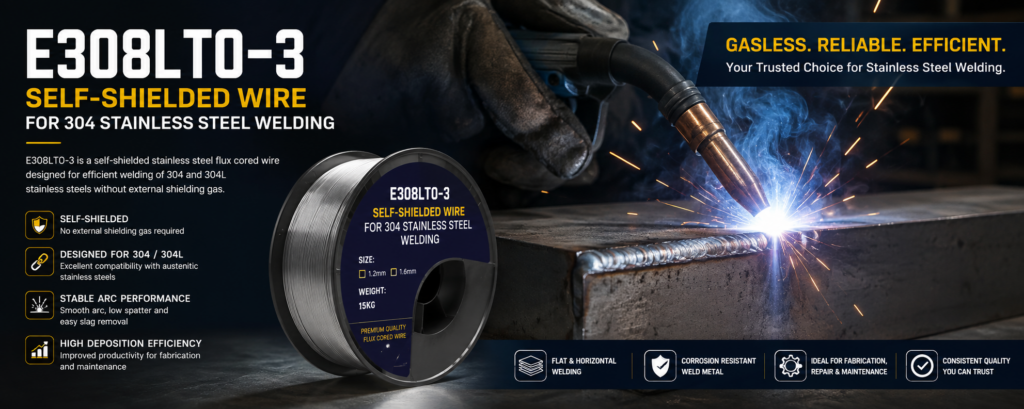
E308LT0-3 Self-Shielded Wire for 304 Stainless Steel Welding
When welding 304 stainless steel, selecting the correct filler metal is essential for weld quality, productivity, and corrosion resistance. E308LT0-3 self-shielded wire is designed for flux cored arc welding of austenitic stainless steels and provides a practical solution for applications where external shielding gas is not preferred or available.
As a self-shielded stainless steel flux cored wire, E308LT0-3 generates the shielding needed to protect the molten weld pool through its internal flux system. This makes it particularly useful for field welding, repair work, fabrication, maintenance, and other environments where transporting or managing shielding gas can be inconvenient.
This article explains the features, applications, advantages, welding characteristics, and selection considerations of E308LT0-3 wire for 304 stainless steel welding.
What Is E308LT0-3 Self-Shielded Wire?
E308LT0-3 is a stainless steel flux cored welding wire intended for welding applications involving 18Cr-8Ni type austenitic stainless steels, including commonly used 304 and 304L stainless steel.
Unlike gas-shielded flux cored wires, a self-shielded E308LT0-3 wire does not require an external shielding gas cylinder during welding. The flux ingredients inside the tubular wire create protective gases and slag when exposed to arc heat, helping protect the weld metal from atmospheric contamination.
This self-shielding capability gives the wire an important practical advantage in welding environments where conventional gas shielding may be difficult to maintain.
Why Use E308LT0-3 for 304 Stainless Steel Welding?
304 stainless steel is widely used because of its combination of corrosion resistance, formability, appearance, and mechanical properties. However, maintaining these characteristics during welding requires a suitable filler metal.
E308LT0-3 self-shielded wire for 304 stainless steel is formulated to produce weld metal compatible with this common austenitic stainless steel family.
Its main advantages include:
No external shielding gas required
Suitable for 304 and 304L stainless steel welding
Convenient flux cored welding process
Stable welding characteristics under suitable parameters
Good productivity compared with many manual welding methods
Reduced dependence on gas cylinders and regulators
Suitable for workshop and field welding applications
Efficient deposition for stainless steel fabrication
For welding projects where mobility and operational simplicity are important, these characteristics can make E308LT0-3 a practical filler metal choice.
How Does Self-Shielded E308LT0-3 Wire Work?
The structure of E308LT0-3 flux cored wire differs from that of conventional solid stainless steel wire. Instead of being completely solid, the wire contains a carefully formulated flux core surrounded by a metallic sheath.
When the welding arc melts the wire, the flux performs several important functions.
First, it generates protective gases around the arc and molten weld pool. This reduces direct exposure to oxygen and nitrogen in the atmosphere.
Second, the flux forms a slag layer over the deposited weld metal. The slag helps protect the weld bead while it cools and can influence bead shape and welding characteristics.
Third, the flux formulation helps control arc behavior and weld metal chemistry.
Because these functions are incorporated into the wire itself, self-shielded stainless steel welding wire can operate without an externally supplied shielding gas.
E308LT0-3 for 304 and 304L Stainless Steel
One of the primary applications of E308LT0-3 is the joining of 304 stainless steel.
304 stainless steel typically contains chromium and nickel as its principal alloying elements. These elements contribute to the material’s characteristic corrosion resistance and austenitic structure.
E308-type stainless filler metals are designed around a compatible chromium-nickel composition, making them suitable for many welding applications involving 304-type base metals.
The wire may also be used for 304L stainless steel, depending on the applicable welding procedure and engineering requirements.
The low-carbon characteristics associated with the 308L weld metal family help minimize excessive carbide precipitation during welding, which is particularly useful when corrosion performance is important.
Key Features of E308LT0-3 Stainless Steel Flux Cored Wire
1. Self-Shielded Welding
The most distinctive feature of E308LT0-3 self-shielded wire is that external shielding gas is not normally required.
This eliminates the need to continuously transport and manage:
Gas cylinders
Regulators
Flow meters
Gas hoses
For field fabrication and maintenance welding, this can simplify the welding setup considerably.
2. Designed for Stainless Steel
E308LT0-3 is specifically intended for stainless steel welding rather than general carbon steel applications.
Its weld metal composition is designed to provide compatibility with common austenitic stainless steels such as 304 and 304L.
3. Flux Cored Productivity
Flux cored arc welding can provide relatively high deposition rates compared with processes that rely on individually replaced electrodes.
Continuous wire feeding allows the welder to maintain longer welding periods and can improve productivity in repetitive fabrication.
4. Convenient Field Operation
Shielding gas can be affected by environmental conditions, particularly air movement around the welding area. Because E308LT0-3 generates its own shielding system, it can offer greater operational flexibility for appropriate field applications.
Proper protection from excessive wind and unsuitable environmental conditions is still necessary to maintain weld quality.
5. Consistent Wire Feeding
When used with correctly adjusted FCAW equipment, quality E308LT0-3 welding wire can provide consistent feeding and stable arc performance.
Correct drive rolls, contact tips, wire tension, polarity, voltage, and wire feed speed are important for achieving reliable results.
Typical Applications of E308LT0-3 Wire
E308LT0-3 self-shielded stainless steel wire can be used across a range of fabrication and maintenance applications involving compatible stainless steel grades.
Common applications may include:
Stainless steel tanks
Stainless steel containers
Industrial equipment
Process equipment
Stainless steel structures
General stainless steel fabrication
Repair and maintenance welding
Metal enclosures
Food-processing equipment fabrication
Chemical processing equipment
Stainless steel piping components
Field repair projects
The exact suitability of the wire should always be confirmed against the base material, service environment, joint design, welding procedure, and applicable fabrication standard.
E308LT0-3 vs Gas-Shielded Stainless Steel Flux Cored Wire
One important decision when selecting stainless steel welding consumables is whether to use self-shielded or gas-shielded flux cored wire.
E308LT0-3 Self-Shielded Wire
E308LT0-3 carries its own shielding system within the flux core.
Typical benefits include:
No separate shielding gas supply
Simpler field setup
Fewer gas-related accessories
Greater mobility
Convenient maintenance welding
Gas-Shielded Flux Cored Wire
Gas-shielded stainless steel flux cored wires require an external shielding gas.
Depending on the application, they may offer different arc characteristics, bead appearance, welding position capability, and deposition performance.
The correct choice depends on production requirements rather than simply determining which type of wire is universally better.
For projects emphasizing portability and eliminating external gas, E308LT0-3 gasless stainless steel welding wire can be particularly attractive.
Welding Positions for E308LT0-3
The classification designation provides useful information regarding intended welding characteristics.
The T0 designation is generally associated with flat and horizontal welding applications under the relevant classification system.
Therefore, E308LT0-3 should not automatically be treated as an all-position stainless steel wire.
Before starting production welding, users should verify:
Approved welding position
Wire diameter
Welding current range
Arc voltage
Wire feed speed
Travel speed
Electrical polarity
Joint configuration
Following the recommended welding procedure is essential for consistent results.
Recommended Welding Practices
Even a high-quality stainless steel flux cored wire will not perform correctly if preparation and welding parameters are unsuitable.
Several practices are particularly important when welding 304 stainless steel with E308LT0-3.
Keep the Joint Clean
Remove contamination such as:
Oil
Grease
Moisture
Paint
Heavy oxide
Dirt
Carbon steel particles
Stainless steel should be cleaned using tools dedicated to stainless steel whenever possible. Cross-contamination from carbon steel tools can compromise surface corrosion resistance.
Control Heat Input
Excessive heat input can increase distortion and negatively affect the properties of stainless steel.
The welder should use appropriate current, voltage, travel speed, and technique to achieve adequate fusion without unnecessarily overheating the joint.
Maintain Proper Stick-Out
Electrode extension can significantly influence self-shielded flux cored welding performance.
An inappropriate stick-out may affect:
Arc stability
Current
Penetration
Deposition rate
Slag behavior
Follow the recommended operating range for the specific wire diameter.
Remove Slag Between Passes
Flux cored welding produces slag. In multipass welds, slag should be thoroughly removed before depositing the next pass.
Incomplete slag removal can increase the risk of slag inclusions and weld discontinuities.
Store Welding Wire Correctly
Stainless steel welding consumables should be stored in a clean and dry environment.
Protect the wire from:
Moisture
Dust
Oil
Chemical contamination
Physical damage
Proper storage supports stable welding performance and reduces contamination risks.
Choosing the Right E308LT0-3 Wire Diameter
The appropriate wire diameter depends on material thickness, welding equipment, joint design, and desired deposition rate.
Smaller diameters may provide better control when welding relatively thin sections or when lower current is required.
Larger diameters may provide higher deposition rates for heavier fabrication.
When selecting E308LT0-3 stainless steel welding wire, consider:
Base metal thickness
Joint type
Welding position
Required deposition rate
Available power source
Wire feeder capability
Required penetration
Production efficiency
The welding procedure should then be optimized for the selected diameter.
Benefits of Gasless Stainless Steel Welding Wire
The term gasless stainless steel welding wire is commonly used to describe self-shielded flux cored wires because no external shielding gas is required.
This provides several practical benefits.
Easier Equipment Setup
Removing the external gas system reduces the number of components required at the welding station.
Better Portability
Welders working on repair, installation, or fabrication projects can move equipment more easily without transporting shielding gas cylinders.
Reduced Gas Management
There is no need to monitor shielding gas flow or replace empty cylinders during welding.
Suitable for Field Welding
Where external gas shielding is inconvenient, self-shielded wire can provide a useful alternative for compatible applications.
These factors help explain why E308LT0-3 self-shielded stainless steel wire is attractive for many industrial welding environments.
Factors That Affect Weld Quality
Successful 304 stainless steel welding depends on more than filler metal classification.
Important factors include:
Base metal condition
Joint preparation
Welding parameters
Wire feed consistency
Operator technique
Travel angle
Electrode extension
Interpass cleaning
Heat input
Welding position
Equipment condition
Incorrect parameters may result in excessive spatter, poor bead shape, incomplete fusion, slag inclusions, or other welding defects.
A qualified welding procedure should therefore be established before critical production welding.
How to Select E308LT0-3 Self-Shielded Wire
Before purchasing or using E308LT0-3, evaluate the actual welding application carefully.
Confirm the Base Material
Verify that the base material is compatible with an E308-type filler metal, such as appropriate 304 or 304L stainless steel applications.
Check the Required Welding Position
E308LT0-3 is primarily associated with specific welding positions. Make sure its position capability matches the fabrication requirement.
Select the Correct Diameter
Choose a wire diameter appropriate for material thickness, welding current, equipment capacity, and production requirements.
Review Mechanical Requirements
For structural or critical applications, confirm that the weld metal properties satisfy the relevant design and fabrication requirements.
Consider the Service Environment
Corrosion resistance requirements can vary considerably between indoor structures, chemical equipment, marine environments, food-processing applications, and other service conditions.
Filler metal selection should consider the complete service environment.
E308LT0-3 for Efficient Stainless Steel Fabrication
For manufacturers, fabricators, and maintenance teams working with 304-type stainless steel, productivity and weld quality must be balanced carefully.
E308LT0-3 self-shielded wire combines the continuous feeding benefits of flux cored arc welding with an internal shielding system that eliminates the need for external shielding gas.
This can reduce setup complexity while maintaining a welding process specifically designed for stainless steel applications.
Its advantages are especially relevant when:
Welding equipment must remain portable
Gas cylinders are inconvenient
Stainless steel fabrication is performed outside a fixed production line
Continuous wire feeding is preferred
304 or 304L stainless steel is being welded
Flat or horizontal welding is required
Conclusion
E308LT0-3 self-shielded wire for 304 stainless steel welding provides a practical combination of stainless steel compatibility, flux cored productivity, and gasless operation.
Its internal flux system eliminates the need for an external shielding gas supply, making the welding setup more portable and convenient for suitable fabrication and maintenance applications. For 304 and 304L stainless steel projects requiring flat or horizontal welding, E308LT0-3 can provide an efficient FCAW solution when used with the correct welding parameters and procedures.
Selecting the right wire diameter, preparing the joint correctly, controlling heat input, removing slag between passes, and following qualified welding procedures are essential for achieving consistent weld quality.
For industrial users seeking a self-shielded stainless steel flux cored wire for 304 stainless steel, E308LT0-3 offers a practical solution for efficient, portable, and reliable stainless steel welding.