

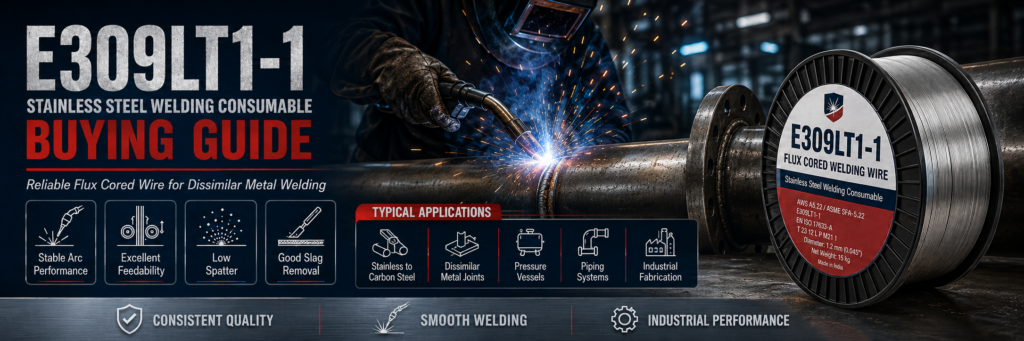
E309LT1-1 Stainless Steel Welding Consumable Buying Guide
Choosing the right stainless steel welding consumable directly affects weld quality, productivity, corrosion resistance, and long-term joint reliability. For applications involving stainless steel, carbon steel, and dissimilar metal joints, E309LT1-1 stainless steel flux cored wire is a commonly considered welding consumable.
E309LT1-1 is designed to provide an alloy-rich weld deposit, low carbon content, stable welding performance, and good compatibility with many dissimilar steel combinations. It is particularly useful when joining stainless steel to carbon steel or when welding structures that require a 309L-type stainless weld deposit.
However, not every E309LT1-1 welding wire provides the same practical performance. Wire consistency, arc stability, slag removal, spatter level, feeding behavior, packaging, shielding gas compatibility, and manufacturing quality can all affect welding results.
This E309LT1-1 stainless steel welding consumable buying guide explains the main factors buyers, distributors, welding engineers, and fabrication companies should evaluate before selecting a suitable product.
What Is E309LT1-1 Welding Wire?
E309LT1-1 is a stainless steel flux cored welding consumable used with the flux cored arc welding process.
The classification generally identifies a tubular stainless steel electrode designed to deposit 309L-type weld metal. Its relatively high chromium and nickel alloy content makes it suitable for applications where dilution from carbon steel or low-alloy steel must be considered.
The low-carbon design is particularly important in stainless steel welding because it helps reduce the possibility of chromium carbide precipitation and supports corrosion resistance in the finished weld.
Typical uses include:
Stainless steel to carbon steel welding
Dissimilar metal joints
Stainless steel fabrication
Buffer layers before stainless cladding
Pressure vessel fabrication
Industrial piping
Petrochemical equipment
Storage tanks
Heat-resistant structures
Repair and maintenance welding
The exact suitability should always be confirmed according to the base metal, service temperature, corrosion environment, design requirements, and qualified welding procedure.
Why Buyers Choose E309LT1-1
E309LT1-1 offers a useful balance between welding productivity and metallurgical performance.
Suitable for Dissimilar Metal Welding
One of the main reasons to buy E309LT1-1 welding wire is its ability to join stainless steel to carbon steel.
When two different steels are welded together, the molten filler metal mixes with both base materials. This dilution changes the chemistry of the final weld deposit.
The relatively high chromium and nickel content associated with 309L-type filler metals helps compensate for this dilution and supports a favorable weld structure.
E309LT1-1 Low Carbon Weld Deposit
The “L” indicates a low-carbon grade.
Low carbon content helps minimize sensitization and maintain corrosion resistance, especially in welded stainless steel structures exposed to corrosive environments.
High Welding Productivity
Flux cored wire uses continuous wire feeding, which can provide higher deposition rates than many manual electrode processes.
For fabrication shops with significant welding volume, this can improve productivity by reducing electrode changes and increasing arc-on time.
Stable Arc Performance
A high-quality E309LT1-1 flux cored wire should provide consistent arc characteristics throughout the spool.
Stable arc performance contributes to:
Smooth metal transfer
Consistent penetration
Reduced spatter
Better bead appearance
More predictable welding results
Improved operator efficiency
E309LT1-1 Good Slag Removal
Slag detachability is an important purchasing consideration for flux cored wire.
Easy slag removal can significantly reduce cleaning time between passes, especially in multi-pass welding applications.
Common Applications of E309LT1-1
Before purchasing E309LT1-1 welding wire, buyers should first determine whether it matches the intended welding application.
Stainless Steel to Carbon Steel Welding
This is one of the most important applications for E309LT1-1.
Typical examples include stainless steel attachments welded to carbon steel structures, transition joints, process equipment, piping systems, tanks, and industrial machinery.
Dissimilar Stainless Steel Joints
E309LT1-1 may also be selected for certain combinations of dissimilar stainless steels where a highly alloyed 309L-type weld deposit is appropriate.
E309LT1-1 Buffer Layers
A 309L-type filler metal is frequently considered as a buffer or intermediate layer before applying another stainless steel weld layer.
The higher alloy content helps compensate for dilution from a carbon steel or low-alloy steel substrate.
Stainless Steel Cladding
E309LT1-1 can be used in certain cladding and overlay procedures where a corrosion-resistant stainless layer is deposited onto a lower-alloy substrate.
Dilution control is particularly important in this application.
E309LT1-1 Industrial Repair Welding
Maintenance operations frequently involve unknown or mixed steel structures. E309LT1-1 may be useful in selected repair situations where stainless steel needs to be joined to another ferrous material.
The actual material composition should still be identified whenever possible before selecting the consumable.
How to Choose E309LT1-1 Welding Consumables
Purchasing welding wire should involve more than comparing price per kilogram.
The following factors can significantly affect real production costs and weld quality.
1. Confirm the Welding Classification
The first step is verifying that the product is clearly identified as E309LT1-1 and supplied with appropriate technical documentation.
Check information such as:
Product classification
Typical chemical composition
Mechanical properties
Recommended shielding gas
Welding current range
Voltage range
Welding positions
Wire diameter
Polarity
Packaging weight
Storage recommendations
For critical applications, product documentation should be reviewed against the requirements of the welding procedure and project specification.
2. Check Base Metal Compatibility
Do not select welding wire based only on the name of the filler metal.
Identify both base materials first.
Important information includes:
Stainless steel grade
Carbon steel grade
Low-alloy steel grade
Plate thickness
Joint design
Service temperature
Corrosion conditions
Post-weld heat treatment requirements
E309LT1-1 is particularly associated with dissimilar joints, but engineering review may be required for critical pressure, high-temperature, cryogenic, or highly corrosive service.
3. Evaluate Wire Diameter
E309LT1-1 flux cored wire is available in different diameters depending on production requirements and welding equipment.
Wire diameter influences:
Current range
Deposition rate
Heat input
Penetration
Welding position
Productivity
Smaller diameters can provide greater control for lower-current applications, thinner materials, or positional welding.
Larger diameters may be preferred for higher deposition rates and heavy fabrication.
The correct choice depends on the material thickness, joint configuration, welding position, and available power source.
4. Review Shielding Gas Requirements
Shielding gas plays a major role in flux cored arc welding performance.
It affects:
Arc stability
Penetration
Spatter
Metal transfer
Bead profile
Oxidation
Mechanical properties
Buyers should confirm that the shielding gas required by the wire is compatible with the gas system already used in production.
Using an unsuitable shielding gas may alter weld performance and may prevent the deposited weld metal from meeting the intended classification requirements.
5. Compare Arc Stability
Arc stability is one of the best practical indicators of flux cored wire quality.
An unstable wire may cause:
Irregular metal transfer
Excessive spatter
Arc interruptions
Uneven penetration
Poor bead appearance
Increased operator fatigue
Before making a large-volume purchase, conducting a welding trial is often useful.
Evaluate the wire at different settings within the intended operating range rather than testing only one ideal parameter.
6. Evaluate Wire Feeding Performance
Consistent feeding is essential for production welding.
Poorly manufactured wire can cause:
Feed interruptions
Slipping
Irregular arc length
Burnback
Excessive contact tip wear
Downtime
The wire should have consistent diameter, surface condition, stiffness, and winding quality.
The spool should also unwind smoothly without tangling or sudden changes in feeding resistance.
7. Check Spatter Levels
Excessive spatter increases production costs.
It creates additional work involving:
Surface cleaning
Grinding
Equipment maintenance
Nozzle cleaning
Rework
A well-performing E309LT1-1 wire should maintain controlled metal transfer and relatively low spatter when used within the correct parameter range.
Buyers should therefore evaluate total cleanup requirements rather than comparing only the purchase price of the wire.
8. Assess Slag Detachability
Flux cored welding produces slag that must normally be removed from the weld surface.
Good slag detachability is especially important in:
Multi-pass welds
Fillet welds
Positional welding
Production welding
Complex joint geometries
Poor slag removal increases labor cost and can contribute to slag inclusions if cleaning between passes is inadequate.
During product trials, check whether slag lifts easily from the weld bead or requires extensive mechanical cleaning.
9. Examine Bead Appearance
A smooth and consistent weld bead can indicate good compatibility between the wire, welding parameters, and shielding gas.
Important characteristics include:
Smooth bead profile
Uniform bead width
Controlled reinforcement
Good toe wetting
Limited undercut
Consistent ripple pattern
Appearance alone does not guarantee weld integrity, but poor bead consistency may indicate unstable welding conditions.
10. Consider Deposition Efficiency
Deposition performance is an important economic factor for industrial users.
A low-cost wire does not necessarily produce the lowest welding cost.
Total cost should include:
Wire consumption
Deposition rate
Welder time
Slag removal
Spatter cleanup
Rework
Grinding
Downtime
Contact tip consumption
A more consistent wire may reduce total fabrication cost even if its initial purchase price is higher.
E309LT1-1 for Dissimilar Metal Welding
Dissimilar metal welding requires careful filler metal selection because the final weld chemistry depends on dilution from both base metals.
When stainless steel is welded to carbon steel, iron and carbon from the carbon steel side enter the weld pool.
If the filler metal does not contain sufficient alloying elements, the resulting weld composition may not provide the required microstructure or corrosion resistance.
E309LT1-1 provides a relatively highly alloyed 309L-type weld deposit that helps tolerate dilution in many stainless-to-carbon-steel applications.
Good welding practice should still control:
Heat input
Penetration
Travel speed
Joint geometry
Interpass temperature
Number of passes
For critical joints, dilution and weld metal chemistry may need to be evaluated during welding procedure qualification.
Typical Welding Characteristics Buyers Should Expect
A quality E309LT1-1 consumable should provide a balanced set of welding characteristics.
Buyers should look for:
Smooth arc starting
Stable arc throughout welding
Consistent wire feeding
Controlled spatter
Good slag coverage
Easy slag removal
Smooth bead profile
Reliable fusion
Good positional control
Consistent performance between spools
Consistency is particularly important for automated and high-volume fabrication.
Welding Parameter Considerations
There is no single welding parameter suitable for every E309LT1-1 application.
Parameters depend on:
Wire diameter
Welding position
Joint type
Material thickness
Shielding gas
Welding machine
Required penetration
Travel speed
Important variables include welding current, arc voltage, wire feed speed, travel speed, electrode extension, torch angle, and gas flow.
The recommended operating range supplied for the particular welding consumable should be used as the starting point.
Production parameters should then be validated using the qualified welding procedure.
Welding Position Requirements
Buyers should consider whether the intended work involves:
Flat welding
Horizontal welding
Vertical welding
Overhead welding
Pipe welding
A wire that performs well in flat-position production may not provide the same level of control when used vertically or overhead.
If all-position welding is important, conduct practical tests using the actual joint configuration before purchasing large quantities.
Corrosion Resistance Considerations
Corrosion performance depends on more than the filler metal classification.
Factors that affect the final welded joint include:
Weld metal chemistry
Base metal chemistry
Dilution
Heat input
Surface contamination
Oxidation
Cleaning method
Service temperature
Chemical exposure
Chloride concentration
E309LT1-1 is often selected for dissimilar welding, but it should not automatically be assumed suitable for every highly corrosive environment.
Where localized corrosion resistance is a major requirement, the complete material system should be reviewed.
Surface Preparation Before Welding
Even high-quality welding wire cannot compensate for badly contaminated base metal.
Before welding, remove:
Oil
Grease
Paint
Rust
Dirt
Moisture
Heavy scale
Cutting contamination
Separate cleaning tools should preferably be used for stainless steel to reduce the risk of iron contamination.
Clean joint surfaces help minimize porosity and improve weld consistency.
Packaging Quality Matters
Packaging protects welding wire during transportation and storage.
Buyers should inspect packaging for:
Moisture protection
Strong spool construction
Secure sealing
Clear labeling
Batch identification
Wire diameter
Classification
Net weight
Storage instructions
Damaged packaging can allow moisture, dust, or contaminants to reach the welding wire.
This may negatively affect welding performance.
Storage and Handling
Stainless steel flux cored wire should be stored in a dry, clean environment.
Avoid:
High humidity
Water exposure
Condensation
Chemical contamination
Dust
Excessive heat
Physical damage
Once the package is opened, unused wire should remain protected whenever possible.
Correct inventory management can also help ensure that older stock is used before recently received material.
Quality Consistency Between Batches
For industrial customers, batch-to-batch consistency is often more important than isolated laboratory performance.
A welding wire should provide comparable performance between production lots.
Important consistency indicators include:
Wire diameter
Feedability
Arc stability
Chemical composition
Slag behavior
Bead appearance
Mechanical properties
Spatter level
For large-volume procurement, buyers may consider qualifying a consumable using production welding trials before establishing long-term supply.
E309LT1-1 Technical Documentation to Request
Professional buyers should evaluate technical documentation before ordering.
Useful documentation may include:
Product data sheet
Typical chemical composition
Mechanical properties
Recommended welding parameters
Shielding gas information
Storage recommendations
Classification information
Batch or lot identification
Quality inspection documentation where required
Documentation requirements may vary according to industry and project specifications.
Questions to Ask Before Buying E309LT1-1
A practical purchasing checklist can prevent incorrect consumable selection.
Ask:
Is the wire clearly classified as E309LT1-1?
What base metals will be welded?
Is the application a dissimilar metal joint?
What wire diameter is required?
Which shielding gas is recommended?
Which welding positions are required?
What current and voltage ranges are recommended?
Is the wire suitable for the existing welding equipment?
How stable is wire feeding?
What is the typical spatter level?
Is slag removal easy?
What packaging sizes are available?
How should the wire be stored?
Is technical documentation available?
Can welding samples be evaluated before bulk purchasing?
These questions help buyers compare welding consumables based on production value rather than price alone.
E309LT1-1 vs. Solid Stainless Steel Welding Wire
Flux cored and solid stainless steel wires each have different advantages.
E309LT1-1 flux cored wire may offer:
Higher deposition rates
Strong positional capability
Good bead profile
Easy operation
Stable arc characteristics
Efficient industrial production
Solid wire may be suitable for other applications depending on equipment, shielding gas, productivity requirements, and weld appearance.
The better option depends on the fabrication process rather than one consumable being universally superior.
E309LT1-1 vs. E309LMoT1-1
Buyers may also compare E309LT1-1 with E309LMoT1-1.
The important difference is the addition of molybdenum in the Mo-containing classification.
E309LT1-1 is commonly selected for general dissimilar welding and stainless-to-carbon-steel joining.
E309LMoT1-1 may be considered when additional molybdenum in the weld deposit is desired for specific corrosion-related service requirements.
Selection should be based on the base metals, corrosion environment, service conditions, and engineering specification.
E309LT1-1 Common Purchasing Mistakes
Choosing Only by Price
The cheapest wire may create higher total welding costs through excessive spatter, poor feeding, difficult slag removal, or rework.
Ignoring Shielding Gas Compatibility
Using an unsuitable shielding gas can change welding behavior and weld properties.
Buying Without a Welding Trial
For large orders, welding trials can identify compatibility problems before production begins.
Ignoring Batch Consistency
Excellent performance from one sample spool does not guarantee reliable long-term production unless manufacturing consistency is controlled.
E309LT1-1 Using One Wire for Every Stainless Steel Application
No single stainless steel welding consumable is ideal for every base metal and service environment.
Filler metal selection should follow the actual engineering requirements.
E309LT1-1 Conclusion
Choosing the right E309LT1-1 stainless steel welding consumable requires more than simply finding a wire with the correct classification.
Buyers should evaluate base metal compatibility, wire diameter, shielding gas, welding position, arc stability, feeding consistency, slag removal, spatter, deposition performance, packaging, technical documentation, and batch-to-batch quality.
For stainless steel to carbon steel and other dissimilar metal welding applications, E309LT1-1 can provide a practical combination of alloy compatibility, low-carbon weld metal, stable welding characteristics, and high flux cored welding productivity.
For industrial procurement, the most effective approach is to compare total welding performance rather than purchase price alone. A welding consumable that provides consistent feeding, stable arc behavior, easy slag removal, low rework rates, and reliable weld quality can deliver better long-term value in fabrication and production environments.