

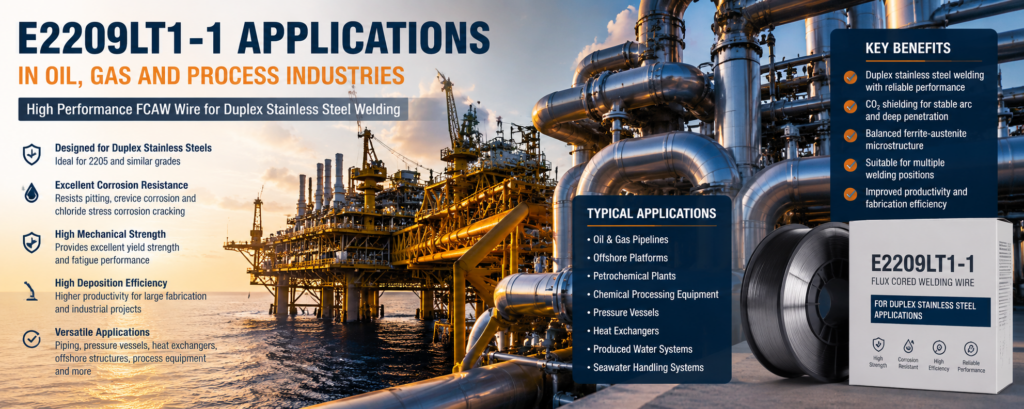
E2209LT1-1 Applications in Oil, Gas and Process Industries
Oil, gas, petrochemical, and process industries operate under some of the most demanding service conditions encountered in industrial fabrication. Equipment may be exposed to chlorides, corrosive chemicals, elevated pressure, fluctuating temperatures, sour environments, and continuous mechanical loading.E2209LT1-1
For these applications, duplex stainless steels are widely used because they combine high mechanical strength with excellent resistance to several forms of corrosion. When welding common duplex stainless steels such as 2205 duplex stainless steel, selecting the correct welding consumable is critical.
E2209LT1-1 flux-cored welding wire is designed for welding duplex stainless steels and is particularly useful in applications where productivity, weld quality, corrosion resistance, and mechanical performance must be carefully balanced.
This article explains the major E2209LT1-1 applications in oil, gas and process industries, why this flux-cored wire is selected, and what fabricators should consider when using it in critical industrial systems.
What Is E2209LT1-1?
E2209LT1-1 is a duplex stainless steel flux-cored electrode used primarily for gas-shielded flux-cored arc welding, commonly known as FCAW-G.
The deposited weld metal is designed to provide an appropriate balance between austenite and ferrite, which is essential for achieving the corrosion resistance and mechanical properties expected from duplex stainless steel welds.
E2209-type weld metal generally contains significant levels of:
Chromium
Nickel
Molybdenum
Nitrogen
Iron
The alloy design helps provide resistance to localized corrosion while maintaining high tensile and yield strength.
E2209LT1-1 is commonly associated with welding duplex stainless steels such as:
2205 duplex stainless steel
UNS S31803
UNS S32205
Similar duplex stainless steel grades
Duplex stainless steel to compatible stainless steel combinations
Because duplex stainless steels are widely used in corrosive industrial systems, E2209LT1-1 has become relevant to many oil, gas, chemical, petrochemical, marine, and process equipment applications.
E2209LT1-1 Why Duplex Stainless Steel Is Used in Oil and Gas Industries
Traditional carbon steels provide excellent strength and relatively low cost, but they can suffer significant corrosion in aggressive environments.
Austenitic stainless steels offer better corrosion resistance, but some applications require greater resistance to chloride-induced stress corrosion cracking and higher mechanical strength.
Duplex stainless steels provide a combination of both properties.
Their microstructure contains approximately two major phases:
Austenite
Ferrite
This duplex structure can provide several practical advantages.
E2209LT1-1 High Mechanical Strength
Duplex stainless steels generally offer substantially higher yield strength than many conventional austenitic stainless steels.
Higher strength can allow engineers to reduce wall thickness in certain designs while maintaining required pressure capability.
E2209LT1-1 Good Resistance to Pitting and Crevice Corrosion
Oil, gas, offshore, and chemical environments often contain chlorides.
Duplex stainless steels containing chromium, molybdenum, and nitrogen provide good resistance to localized corrosion under appropriate service conditions.
Resistance to Chloride Stress Corrosion Cracking
Chloride stress corrosion cracking can become a serious concern in stainless steel equipment operating under tensile stress and corrosive conditions.
Duplex stainless steels generally provide improved resistance compared with many conventional austenitic stainless steels.
Good Fatigue Performance
Pipelines, offshore structures, pressure systems, and rotating equipment may experience repeated mechanical loading.
The high strength and favorable mechanical properties of duplex stainless steels make them attractive for these applications.
Why Use E2209LT1-1 for Duplex Stainless Steel Welding?
A successful duplex stainless steel weld requires more than simply joining two pieces of metal.
The weld must retain suitable mechanical properties and corrosion resistance while maintaining an acceptable phase balance.
E2209LT1-1 is designed to support these requirements.
E2209LT1-1 Suitable Alloy Composition
The weld metal chemistry is formulated to match the performance requirements of duplex stainless steel.
Nickel content in the filler metal helps promote sufficient austenite formation during cooling, while chromium, molybdenum, and nitrogen contribute to corrosion resistance.
High Deposition Efficiency
Flux-cored arc welding generally provides higher deposition rates than many manual welding processes.
This can be important when fabricating:
Large pressure vessels
Process piping
Storage tanks
Offshore structures
Heavy industrial equipment
Higher productivity can reduce welding time and improve fabrication efficiency.
Good Positional Welding Capability
Industrial systems rarely consist entirely of flat welds.
Piping, vessel connections, field joints, and structural components may require vertical and overhead welding.
E2209LT1-1 flux-cored wire can provide practical positional welding capability when used with suitable parameters and procedures.
Consistent Bead Formation
Flux-cored electrodes are designed to provide stable arc characteristics, effective slag coverage, and controlled weld pool behavior.
These characteristics can help produce consistent weld profiles in industrial fabrication.
E2209LT1-1 Applications in Oil and Gas Pipelines
One of the most important application areas for duplex stainless steel is oil and gas piping.
Pipelines and process piping systems may transport fluids containing:
Chlorides
Carbon dioxide
Hydrogen sulfide
Hydrocarbons
Produced water
Process chemicals
Depending on temperature, pressure, chemical composition, and design requirements, corrosion can become a major concern.
Duplex stainless steel piping may be selected where carbon steel would require extensive corrosion protection or where conventional stainless steels may not provide sufficient performance.
E2209LT1-1 may be used for welding:
Duplex process piping
Offshore piping systems
Produced water lines
Utility piping
Corrosive fluid transportation systems
Refinery piping
Chemical injection lines
Process plant piping
The combination of high deposition rate and corrosion-resistant weld metal makes flux-cored welding attractive for shop fabrication of many duplex piping components.
E2209LT1-1 Offshore Oil and Gas Applications
Offshore environments are particularly aggressive because equipment is continuously exposed to seawater, salt spray, humidity, and chloride contamination.
At the same time, offshore structures must provide high reliability because repair and maintenance can be extremely expensive.
Duplex stainless steel is therefore used in various offshore components.
E2209LT1-1 may be suitable for welding duplex stainless steel components used in:
Offshore platforms
Process modules
Seawater handling systems
Firewater systems
Cooling water piping
Produced water treatment systems
Offshore pressure equipment
Subsea-related fabrication
Marine process equipment
In these applications, resistance to chloride-induced corrosion is one of the main reasons duplex stainless steel is selected.
E2209LT1-1 in Refineries
Refineries contain complex networks of piping, pressure vessels, columns, heat exchangers, tanks, and processing equipment.
Many systems operate under elevated temperature and pressure while handling corrosive process streams.
Duplex stainless steels can be selected for refinery equipment where both strength and corrosion resistance are required.
Typical E2209LT1-1 applications may include:
Process piping
Separator vessels
Scrubber systems
Heat exchanger components
Chemical handling systems
Corrosion-resistant pressure equipment
Pump and valve assemblies
Process skids
Flux-cored welding can be particularly advantageous during shop fabrication where high productivity is required.
E2209LT1-1 Petrochemical Industry Applications
Petrochemical facilities convert hydrocarbons into chemicals, polymers, solvents, and other industrial products.
Many processing units contain aggressive chemical environments.
Duplex stainless steels may be used where equipment requires resistance to:
Chloride corrosion
Organic acids
Process contaminants
Pitting
Crevice corrosion
Stress corrosion cracking
E2209LT1-1 can be applied to duplex stainless steel fabrication for equipment such as:
Reactors
Process vessels
Storage systems
Piping
Separators
Columns
Heat exchangers
Chemical transfer equipment
The precise material and welding procedure must always be selected according to actual process conditions.
Chemical Processing Applications
Chemical plants often present even more complex corrosion challenges than oil and gas installations.
Equipment may handle acids, alkalis, salts, solvents, and highly concentrated process chemicals.
The selection of duplex stainless steel depends on the chemical environment, temperature, pressure, and required corrosion resistance.
When 2205 or similar duplex stainless steel is specified, E2209LT1-1 may be used in fabrication of:
Chemical storage tanks
Reactor vessels
Processing vessels
Mixing equipment
Piping systems
Heat exchangers
Scrubbers
Filters
Separation equipment
The corrosion resistance of the final weld depends not only on filler metal selection but also on correct welding heat input, interpass temperature, shielding gas, joint preparation, and post-weld cleaning.
Heat Exchanger Applications
Heat exchangers are widely used throughout oil, gas, refinery, petrochemical, and chemical facilities.
These systems may expose metal surfaces to aggressive process fluids on one side and cooling water on the other.
Chloride-containing cooling water can create serious corrosion problems for conventional stainless steels.
Duplex stainless steel may therefore be selected for:
Heat exchanger shells
Tube sheets
Headers
Piping connections
Channels
Associated pressure components
E2209LT1-1 can be useful when welding suitable duplex components where FCAW is permitted by the fabrication procedure.
Maintaining correct heat input is particularly important because excessive or insufficient thermal cycles can influence the final weld microstructure.
Pressure Vessel Fabrication
Pressure vessels used in process industries must meet strict requirements for mechanical strength, toughness, weld integrity, and corrosion resistance.
Duplex stainless steel pressure vessels may be used when aggressive service conditions make conventional materials unsuitable.
E2209LT1-1 may be applied to:
Longitudinal seams
Circumferential seams
Nozzle attachments
Reinforcement components
Internal structures
Vessel support components
For code-regulated pressure equipment, welding must follow a qualified welding procedure specification.
Shielding gas, electrical parameters, interpass temperature, filler classification, and other essential variables must be controlled according to the approved procedure.
Pump and Valve Applications
Pumps and valves are critical components in process systems because they directly control fluid movement.
They may experience:
Corrosion
Erosion
Cavitation
High pressure
Mechanical stress
Repeated operating cycles
Duplex stainless steel can provide useful performance in demanding pumping and flow-control applications.
E2209LT1-1 may be used during fabrication or repair of suitable duplex components, including:
Pump housings
Valve bodies
Piping connections
Flanges
Structural attachments
Process equipment assemblies
Material compatibility should always be verified before repair welding because casting compositions and heat treatment conditions can differ from wrought duplex stainless steels.
Produced Water Systems
Produced water is the water that accompanies oil and gas during extraction.
It can contain high concentrations of:
Chlorides
Dissolved gases
Hydrocarbons
Salts
Solids
Process chemicals
These conditions can create aggressive corrosion environments.
Duplex stainless steel piping and equipment may therefore be selected for produced water treatment and transportation.
Typical applications can include:
Produced water piping
Separators
Treatment vessels
Filters
Pump systems
Injection systems
When these components are fabricated from 2205 duplex stainless steel, E2209LT1-1 may provide a suitable weld metal solution when approved by the welding specification.
Seawater Handling Systems
Seawater systems are common on offshore platforms, ships, coastal processing plants, and industrial cooling installations.
Seawater contains significant chloride concentrations, making corrosion resistance a central material-selection consideration.
Duplex stainless steels may be used in:
Cooling water systems
Firewater systems
Seawater piping
Pump assemblies
Filtration systems
Desalination-related equipment
Offshore utility systems
E2209LT1-1 offers a productive FCAW option for suitable duplex stainless steel fabrication in these systems.
Advantages of E2209LT1-1 in Process Industry Fabrication
Higher Welding Productivity
Flux-cored wire can provide high deposition rates.
For large fabrication projects, this can reduce welding time compared with lower-deposition manual welding processes.
Good Operator Control
Modern flux-cored wire can provide stable arc characteristics and manageable weld pool behavior.
This can improve control during positional welding.
Suitable Mechanical Performance
When correctly applied, E2209LT1-1 deposited weld metal can provide mechanical properties suitable for duplex stainless steel applications.
Corrosion-Resistant Weld Metal
Its alloy design supports corrosion resistance compatible with common duplex stainless steel base materials under appropriate service conditions.
Reduced Post-Weld Cleaning Compared With Heavy Spatter Processes
Properly optimized FCAW parameters can provide relatively clean weld profiles and controlled spatter.
Slag still requires removal between weld passes where applicable.
The Importance of Ferrite-Austenite Balance
One of the most important considerations in duplex stainless steel welding is the balance between ferrite and austenite.
The base material obtains many of its desirable properties from the presence of both phases.
During welding, the weld pool initially solidifies mainly as ferrite. Austenite then forms as the weld cools.
If the cooling rate is too fast, excessive ferrite may remain.
If the material experiences unsuitable thermal exposure, other undesirable microstructural changes can occur.
This is why duplex welding procedures carefully control:
Heat input
Interpass temperature
Travel speed
Welding current
Arc voltage
Joint thickness
Shielding gas
Filler metal composition
The filler metal itself is normally designed with increased nickel compared with the base metal to encourage adequate austenite formation.
Heat Input Control When Welding with E2209LT1-1
Heat input must be controlled carefully during duplex stainless steel welding.
Excessively low heat input may cause rapid cooling and leave excessive ferrite.
Excessively high heat input or prolonged exposure to certain temperature ranges may increase the risk of undesirable phase formation and deterioration of corrosion or toughness properties.
There is therefore no universal welding parameter that is correct for every E2209LT1-1 application.
The appropriate parameter range depends on:
Material grade
Material thickness
Joint design
Welding position
Wire diameter
Shielding gas
Welding procedure qualification
Required mechanical properties
Service environment
Qualified welding procedures should always take priority over generic recommendations.
Shielding Gas for E2209LT1-1
The “-1” designation is associated with CO2 shielding under the applicable electrode classification system.
However, some flux-cored wires may carry more than one classification and may be suitable for different shielding gas combinations.
The selected gas can affect:
Arc stability
Weld penetration
Spatter
Bead shape
Metal transfer
Weld chemistry
Mechanical properties
For critical oil, gas, or process applications, shielding gas should not be changed casually.
Use the gas specified by the consumable classification and the qualified welding procedure.
Welding Positions
E2209LT1-1 flux-cored electrodes are designed for practical fabrication and may be used in multiple welding positions depending on the specific consumable and approved procedure.
Typical industrial welding situations include:
Flat
Horizontal
Vertical
Overhead
Positional capability is particularly useful for:
Piping systems
Vessel nozzles
Structural attachments
Large modules
Field fabrication
Correct wire feed speed, voltage, travel speed, and electrode manipulation remain critical.
E2209LT1-1 vs ER2209
Both E2209LT1-1 and ER2209 are designed for duplex stainless steel welding, but they are associated with different welding processes.
E2209LT1-1 is a flux-cored electrode primarily intended for FCAW.
ER2209 is a solid wire or rod commonly associated with processes such as GMAW and GTAW.
E2209LT1-1 may offer advantages when:
High deposition rate is required
Large weld volumes are involved
Positional welding is necessary
Production efficiency is important
ER2209 may be preferred when:
Precise control is required
GTAW root passes are specified
Thin materials are being welded
Slag-free welding is desirable
Many industrial welding procedures combine different processes for different sections of the same joint.
For example, a GTAW root using ER2209 may be followed by FCAW fill and cap passes using an appropriate E2209 flux-cored electrode.
E2209LT1-1 vs Austenitic Stainless Steel Filler Metals
Using a conventional austenitic stainless steel filler for duplex stainless steel may not provide the desired combination of strength, phase balance, and corrosion resistance.
E2209-type weld metal is specifically alloyed for duplex applications.
The filler metal selection should therefore be based on:
Base metal grade
Required corrosion resistance
Mechanical property requirements
Service temperature
Joint configuration
Applicable welding code
Qualified WPS
Substituting a filler metal without engineering evaluation can compromise weld performance.
Quality Control for Critical E2209LT1-1 Welds
Oil, gas, and process applications often require strict inspection.
Depending on the component and applicable specification, testing may include:
Visual inspection
Liquid penetrant testing
Radiographic testing
Ultrasonic testing
Tensile testing
Bend testing
Impact testing
Ferrite measurement
Corrosion testing
Macro examination
For particularly demanding duplex applications, corrosion testing or microstructural evaluation may be required to verify that welding has not significantly degraded material performance.
Common Welding Problems and Their Causes
Excessive Spatter
Possible causes include:
Incorrect voltage
Improper wire feed speed
Excessive electrode extension
Incorrect shielding gas
Poor torch technique
Porosity
Possible causes include:
Insufficient shielding gas
Gas leaks
Contaminated joint surfaces
Excessive wind
Moisture
Incorrect torch position
Slag Inclusion
Possible causes include:
Poor cleaning between passes
Incorrect travel angle
Excessively low welding current
Poor joint preparation
Incomplete Fusion
Possible causes include:
Low heat input
High travel speed
Incorrect torch angle
Insufficient access to the joint sidewall
Undesirable Duplex Microstructure
Possible causes can include:
Improper heat input
Excessive interpass temperature
Incorrect filler metal
Incorrect shielding conditions
Poor welding sequence
These issues demonstrate why qualified procedures are particularly important for duplex stainless steel fabrication.
How to Select E2209LT1-1 for Industrial Applications
Before selecting E2209LT1-1, evaluate the complete welding application.
Important questions include:
What is the exact duplex stainless steel grade?
What service environment will the equipment experience?
Is the application exposed to chlorides?
What corrosion resistance is required?
What mechanical properties are required?
Which welding position will be used?
What is the joint thickness?
What shielding gas is specified?
Which welding code applies?
Has the welding procedure been qualified?
The correct welding consumable should always be selected as part of the overall engineering and welding procedure rather than as an isolated purchasing decision.
E2209LT1-1 Conclusion
E2209LT1-1 flux-cored welding wire plays an important role in the fabrication of duplex stainless steel equipment used throughout the oil, gas, petrochemical, and process industries.
Its combination of productive FCAW performance, duplex-compatible weld metal chemistry, high mechanical strength, and corrosion resistance makes it suitable for applications such as:
Oil and gas piping
Offshore process systems
Pressure vessels
Heat exchangers
Produced water equipment
Chemical processing systems
Refinery equipment
Petrochemical installations
Seawater handling systems
However, duplex stainless steel welding requires careful control.
Successful welding depends on more than simply selecting E2209LT1-1. Heat input, interpass temperature, shielding gas, welding parameters, joint preparation, filler metal classification, and inspection requirements must all be managed as part of a qualified welding procedure.
When these factors are properly controlled, E2209LT1-1 can provide an efficient and technically reliable solution for demanding duplex stainless steel fabrication in modern oil, gas, and process industries.