

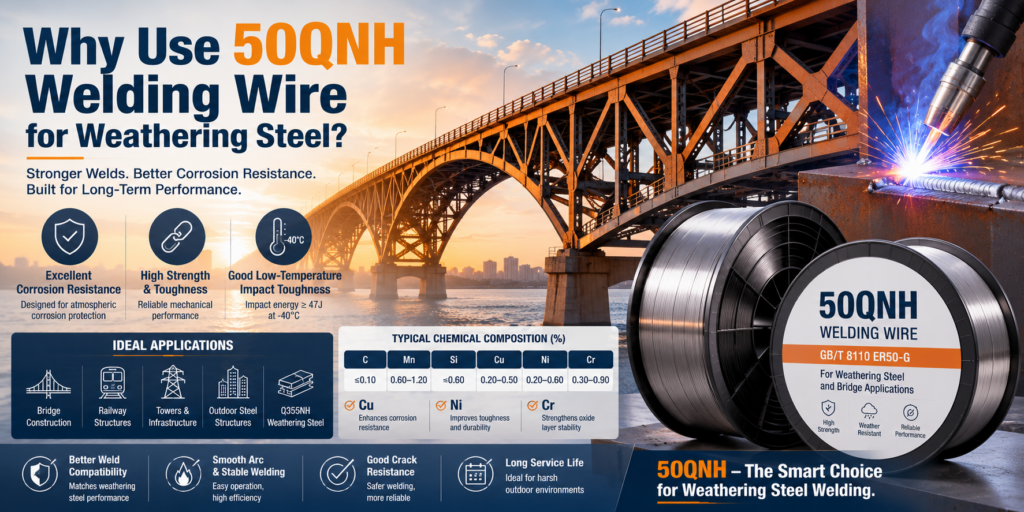
Why Use 50QNH Welding Wire for Weathering Steel?
Weathering steel is widely used in bridges, railway structures, towers, buildings, transportation equipment, and other outdoor steel structures exposed to the atmosphere for long periods.50QNH
Unlike conventional structural steel, weathering steel is designed to develop a stable protective oxide layer under suitable environmental conditions. This helps slow further atmospheric corrosion and can reduce the need for conventional protective coatings in appropriate applications.
However, using weathering steel alone is not enough.
The weld metal must also provide suitable mechanical properties and corrosion behavior. If an unsuitable welding wire is selected, the welded joint may become the weak point of an otherwise corrosion-resistant structure.
This is where 50QNH welding wire becomes important.
50QNH is a low-alloy gas-shielded solid welding wire developed for weather-resistant structural steel. Its alloy system typically includes copper, nickel, and chromium, helping the deposited weld metal achieve atmospheric corrosion resistance while maintaining strength, toughness, and welding performance.
So why use 50QNH welding wire for weathering steel?
The answer lies in the combination of corrosion resistance, mechanical strength, low-temperature toughness, crack resistance, weld compatibility, and suitability for important weathering steel structures such as bridges.
What Is 50QNH Welding Wire?
50QNH is a low-alloy gas-shielded solid welding wire commonly classified as:
GB/T 8110 ER50-G
GB/T 8110 covers welding electrodes and rods for gas-shielded arc welding of carbon and low-alloy steels.
50QNH is specifically formulated to produce weld metal with good atmospheric corrosion resistance.
A typical 50QNH chemical composition may contain alloying elements such as:
Copper
Nickel
Chromium
Manganese
Silicon
Typical published composition ranges include approximately:
| Element | Typical Range |
|---|---|
| C | Around 0.10% max |
| Mn | 0.60–1.20% |
| Si | Around 0.60% |
| Cu | 0.20–0.50% |
| Ni | 0.20–0.60% |
| Cr | 0.30–0.90% |
The addition of Cu, Ni, and Cr distinguishes this type of welding wire from many conventional carbon steel welding wires and helps support weather-resistant weld performance.
50QNH What Is Weathering Steel?
Weathering steel is a family of low-alloy structural steels designed to provide improved resistance to atmospheric corrosion.
Typical weathering steel grades contain controlled amounts of alloying elements such as:
Copper
Chromium
Nickel
Phosphorus
Manganese
Silicon
When exposed to suitable alternating wet and dry atmospheric conditions, the steel surface can gradually form a relatively stable oxide layer.
This protective layer slows the progression of corrosion compared with ordinary carbon steel under suitable service conditions.
Q355NH, for example, is an atmospheric corrosion-resistant structural steel used for bridges, railways, vehicles, towers, and other structures exposed to outdoor environments.
50QNH Why Does Welding Wire Matter for Weathering Steel?
A weathering steel structure may contain hundreds or even thousands of meters of welds.
Every welded joint changes the local metallurgy.
The weld metal is created from:
The filler wire
Diluted base metal
Shielding conditions
Welding parameters
Thermal cycles
If conventional carbon steel welding wire is used without proper engineering evaluation, the deposited weld metal may not provide the same atmospheric corrosion behavior as the surrounding weathering steel.
That can create differences in:
Corrosion behavior
Surface appearance
Mechanical strength
Toughness
Service life
For exposed weathering steel structures, filler metal selection therefore becomes part of the overall corrosion-performance strategy.
1. 50QNH Provides Atmospheric Corrosion Resistance
The primary reason to use 50QNH for weathering steel is its atmospheric corrosion resistance.
50QNH weld metal is designed with alloying additions that help its corrosion behavior better match weather-resistant base metals.
Typical 50QNH chemistry includes controlled quantities of Cu, Ni, and Cr.
These elements are commonly associated with weather-resistant steel metallurgy.
50QNH Role of Copper
Copper is an important alloying element in many weathering steels.
It contributes to the development and stability of the protective corrosion product layer that forms during atmospheric exposure.
Role of Chromium
Chromium helps improve corrosion resistance and contributes to the characteristics of the protective oxide layer.
50QNH Role of Nickel
Nickel can contribute to corrosion resistance while also supporting toughness and mechanical performance.
The combined alloy design helps create weld metal better suited to long-term atmospheric exposure than ordinary unalloyed weld metal.
2. Better Compatibility with Q355NH Weathering Steel
One of the most important applications for 50QNH is welding Q355NH weathering steel.
Q355NH is a commonly used Chinese weather-resistant structural steel grade.
It is used in structures such as:
Bridges
Railway structures
Vehicles
Towers
Outdoor steel structures
Published technical information identifies 50QNH specifically for welding important corrosion-resistant bridge steels such as Q355NH.
This makes 50QNH particularly relevant when the welded joint must provide both structural performance and atmospheric corrosion resistance.
3. Suitable Strength for Structural Welding
Weathering steel structures are not selected only for corrosion resistance.
They are structural components and must carry loads safely throughout their service life.
The weld metal therefore requires sufficient:
Tensile strength
Yield strength
Elongation
Impact toughness
Typical published mechanical requirements for 50QNH weld metal include:
Tensile strength: ≥500 MPa
Yield strength: ≥400 MPa
Elongation: ≥22%
Impact energy: ≥47 J at -40°C
Actual product values and project requirements should always be confirmed against the applicable specification and welding procedure.
These mechanical properties make 50QNH suitable for demanding structural applications where both strength and toughness are important.
4. Good Low-Temperature Toughness
Bridges and outdoor steel structures may operate in cold climates.
Low temperatures can reduce the toughness of some steels and weld metals, increasing sensitivity to brittle fracture.
For critical structural applications, impact toughness can therefore be as important as tensile strength.
50QNH weld metal can be designed to provide useful low-temperature impact performance.
Published technical data for one typical 50QNH specification gives a minimum impact requirement of 47 J at -40°C, demonstrating why this type of welding wire is considered for outdoor structural applications exposed to cold service environments.
5. Good Crack Resistance
Welding creates localized thermal expansion and contraction.
As the weld cools, residual stresses develop.
In thick sections, restrained joints, bridge structures, and high-strength steels, these stresses can increase cracking risk if:
The filler metal is unsuitable
Hydrogen levels are excessive
Preheat is inadequate
Heat input is poorly controlled
Joint restraint is high
Base metal cleanliness is poor
50QNH is designed to provide good mechanical properties and crack resistance for weathering steel fabrication.
However, filler selection alone cannot prevent cracking.
Proper control of welding procedure variables remains essential.
6. Ideal for Weathering Steel Bridges
Bridge construction is one of the strongest application areas for 50QNH.
Weathering steel bridges may benefit from reduced reliance on paint systems in suitable environments, while maintaining high structural strength.
Common bridge components can include:
Main girders
Cross girders
Stiffeners
Diaphragms
Box sections
Reinforcement plates
Structural attachments
Connection components
50QNH is specifically associated with the welding of corrosion-resistant bridge steel such as Q355NH.
For bridge fabrication, filler metal compatibility is particularly important because welded joints must maintain strength, toughness, fatigue performance, and corrosion resistance for extended service periods.
7. Suitable for Railway Structures
Railway infrastructure operates outdoors throughout the year.
Steel components can experience:
Rain
Humidity
Temperature cycling
Industrial pollution
Mechanical vibration
Repeated loading
Weathering steel may be selected for certain railway structures because of its atmospheric corrosion resistance and structural properties.
Where compatible weather-resistant steels are specified, 50QNH welding wire can be considered as part of a qualified welding procedure.
Potential applications include:
Railway bridges
Structural supports
Outdoor frames
Steel platforms
Transportation infrastructure
8. Useful for Outdoor Steel Structures
50QNH is not limited to bridges.
Weather-resistant steel is used in a wide range of outdoor structures.
Potential applications include:
Transmission towers
Structural frames
Outdoor equipment
Architectural steel structures
Industrial structures
Transportation equipment
Infrastructure projects
Steel supports
The main advantage is maintaining a weld metal composition and performance more appropriate for atmospheric exposure than ordinary filler metal.
9. Supports Long-Term Structural Durability
The durability of a weathering steel structure depends on the complete system.
That includes:
Base metal
Weld metal
Joint design
Drainage
Environmental exposure
Surface condition
Fabrication quality
A corrosion-resistant base material joined using unsuitable weld metal can create areas of inconsistent performance.
Using an appropriately selected weathering steel welding wire helps reduce this mismatch.
50QNH is therefore best viewed as part of a complete durability strategy rather than simply as a means of depositing metal into a joint.
10. Better Appearance for Exposed Weathering Steel Welds
Weathering steel is often used without conventional paint coatings in appropriate environments.
The appearance of the exposed steel surface therefore matters.
Over time, weathering steel develops its characteristic oxide appearance.
If the weld chemistry differs greatly from the base metal, the weld and surrounding steel may weather differently.
Using a compatible weather-resistant filler metal can help reduce excessive differences between the appearance and corrosion behavior of the weld and base metal.
This can be particularly useful for:
Architectural structures
Exposed bridges
Public infrastructure
Landscape structures
Decorative structural steel
50QNH vs Conventional ER50-6 Welding Wire
50QNH and conventional ER50-6 solid wire may both be used for structural steel welding, but they are designed for different priorities.
| Feature | 50QNH | Conventional ER50-6 |
|---|---|---|
| Main application | Weathering steel | Carbon and low-alloy steel |
| Atmospheric corrosion matching | Designed for weather-resistant applications | Not primarily designed for weathering compatibility |
| Cu, Ni, Cr additions | Typically controlled for weather resistance | Different alloy design |
| Q355NH welding | Common application | Requires engineering evaluation |
| Bridge weathering steel | Particularly suitable | Depends on specification |
| General fabrication | Possible where specified | Very common |
The correct filler wire should always be selected according to the base material, structural design, service environment, and approved welding procedure.
50QNH Why Not Simply Use Ordinary Carbon Steel Welding Wire?
For some weathering steel joints, particularly small or less exposed welds, engineering specifications may permit conventional filler metals.
However, exposed structural welds may require weld metal with weather-resistant chemistry.
The concern is not simply whether an ordinary wire can physically join the steel.
The more important questions are:
Will the weld provide the required strength?
Will it provide sufficient toughness?
Will it weather similarly to the base metal?
Will it satisfy the structural design specification?
Will it satisfy the applicable welding code?
For critical weathering steel fabrication, filler metal selection should therefore be made according to engineering requirements rather than convenience.
50QNH Chemical Composition and Why It Matters
A typical 50QNH alloy system may contain:
C: controlled at a relatively low level
Mn: contributes to strength and deoxidation
Si: supports deoxidation and welding performance
Cu: supports atmospheric corrosion resistance
Ni: contributes to toughness and corrosion performance
Cr: contributes to corrosion resistance
Published 50QNH data shows typical Cu levels of 0.20–0.50%, Ni of 0.20–0.60%, and Cr of 0.30–0.90%.
This balanced chemistry helps explain why 50QNH is more appropriate for weather-resistant structures than a conventional carbon steel wire in applications requiring matching atmospheric corrosion behavior.
50QNH Welding Process
50QNH is a gas-shielded solid welding wire.
It is therefore commonly used with mechanized or semi-automatic gas metal arc welding equipment.
A typical welding system includes:
Constant-voltage welding power source
Wire feeder
Welding torch
Shielding gas system
50QNH welding wire
The actual shielding gas composition, polarity, voltage, current, wire feed speed, travel speed, and preheat requirements should be determined by the approved welding procedure.
Common 50QNH Wire Diameters
Published technical information lists common 50QNH wire diameters including:
0.8 mm
1.0 mm
1.2 mm
Different diameters allow fabricators to select appropriate deposition rates and operating ranges according to material thickness and welding position.
50QNH Typical Welding Current Ranges
Published guidance for a typical 50QNH wire includes approximately:
| Wire Diameter | Flat/Horizontal | Vertical/Overhead |
|---|---|---|
| 0.8 mm | 50–180 A | 50–100 A |
| 1.0 mm | 80–250 A | 70–160 A |
| 1.2 mm | 100–360 A | 80–220 A |
These values should be treated as general reference ranges rather than universal welding parameters.
Actual settings depend on:
Base metal thickness
Joint design
Welding position
Shielding gas
Wire feed speed
Travel speed
Required heat input
Welding equipment
Applicable WPS
Important Factors When Welding Weathering Steel with 50QNH
Clean the Joint Properly
Remove contaminants from the weld area before welding.
These may include:
Oil
Grease
Moisture
Heavy rust
Scale
Dirt
Paint
Poor surface preparation can lead to porosity, lack of fusion, and inconsistent weld quality.
50QNH Control Heat Input
Excessive heat input can create an unnecessarily large heat-affected zone and increase distortion.
Insufficient heat input may result in:
Lack of fusion
Poor penetration
Unstable bead formation
Use the welding parameters established by the qualified procedure.
50QNH Control Interpass Temperature
For multi-pass welding, interpass temperature should be controlled according to the applicable WPS.
Excessive temperature accumulation can affect microstructure and mechanical properties.
Use Correct Electrode Extension
Excessive or insufficient electrode extension can influence:
Welding current
Arc stability
Penetration
Spatter
Deposition rate
Maintain consistent torch technique throughout the joint.
Protect the Shielding Gas
Gas-shielded welding can be sensitive to strong wind.
Outdoor bridge and structural welding may therefore require wind protection to prevent shielding gas disruption.
Common Problems When Welding Weathering Steel
Porosity
Possible causes include:
Contamination
Moisture
Gas leaks
Insufficient shielding gas
Excessive wind
Incorrect torch angle
Excessive Spatter
Possible causes include:
Incorrect voltage
Incorrect wire feed speed
Excessive electrode extension
Poor electrical contact
Incorrect shielding conditions
Lack of Fusion
Possible causes include:
Low heat input
Excessive travel speed
Improper torch angle
Poor joint preparation
Cracking
Potential contributing factors include:
Excessive joint restraint
Hydrogen
Inadequate preheat
Poor filler selection
Improper heat input
High residual stress
For critical bridge welding, these variables should be controlled through a qualified welding procedure.
Is 50QNH Suitable for Q355NH?
Yes, 50QNH is commonly used for welding corrosion-resistant structural steels such as Q355NH, particularly in bridge fabrication.
Q355NH itself is a weather-resistant steel used in bridges, railway structures, vehicles, towers, and other components exposed to the atmosphere.
However, the final filler metal selection must still comply with:
Project specification
Structural design requirements
Welding code
Procedure qualification
Required mechanical properties
Service environment
Is 50QNH Only for Bridges?
No.
Bridge fabrication is one of its most important applications, but 50QNH can also be considered for other compatible weathering steel structures.
Potential applications include:
Railway infrastructure
Outdoor structural steel
Towers
Transportation equipment
Architectural weathering steel
Industrial structures
Corrosion-resistant structural components
The key requirement is that the filler metal matches the engineering requirements of the weather-resistant base steel.
When Should You Choose 50QNH?
Consider 50QNH when:
The base metal is weathering steel
Q355NH or a compatible grade is being welded
Atmospheric corrosion resistance is required
The weld will remain exposed to the environment
The project involves bridge fabrication
Low-temperature impact toughness is important
Suitable mechanical strength is required
The welding procedure specifies a weather-resistant filler metal
When Might Another Welding Wire Be Better?
50QNH is not automatically the best wire for every steel structure.
Another consumable may be more suitable when:
The base metal is ordinary carbon steel
Higher-strength weathering steel is used
Different impact toughness is required
Different alloy chemistry is specified
A different welding process is required
The applicable code requires another filler classification
Filler metal selection should always begin with the base material and project requirements.
Conclusion
The main reason to use 50QNH welding wire for weathering steel is simple: the weld should support the performance of the base material rather than become its weak point.
50QNH combines weather-resistant alloying elements with structural mechanical properties suitable for demanding outdoor steel fabrication.
Its main advantages include:
Atmospheric corrosion resistance
Compatibility with weathering steels such as Q355NH
Good tensile and yield strength
Good low-temperature toughness
Good crack resistance
Suitability for bridge fabrication
Suitability for outdoor structural applications
Controlled Cu, Ni and Cr alloy chemistry
For weathering steel bridges, railway structures, towers, transportation equipment, and other exposed structural projects, selecting an appropriate weather-resistant filler metal is an important part of long-term durability.
50QNH provides a practical welding solution when the project requires both structural performance and atmospheric corrosion resistance.
The final selection should always be based on the exact base metal grade, service environment, engineering specification, applicable welding code, and qualified welding procedure.