

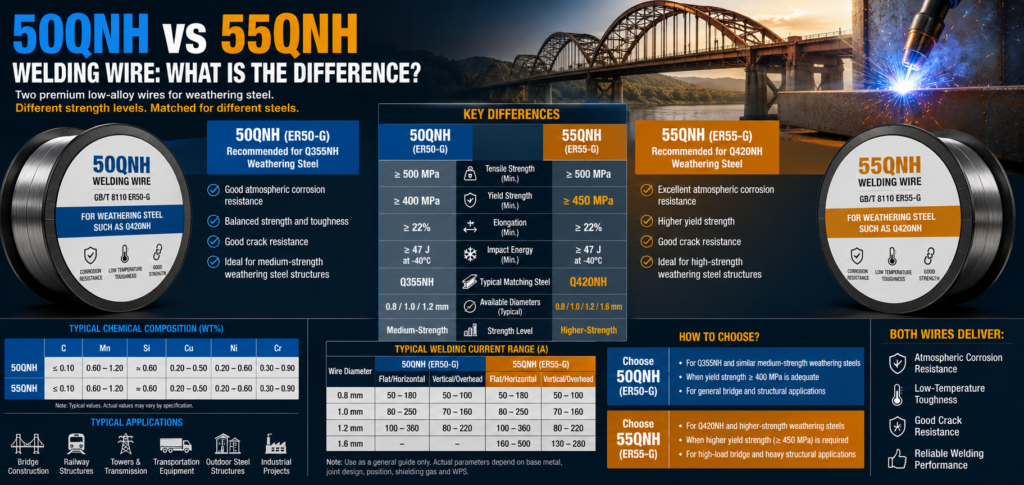
50QNH vs 55QNH Welding Wire: What Is the Difference?
When selecting welding wire for weathering steel, 50QNH and 55QNH are two commonly considered low-alloy gas-shielded solid wires.
Both are designed to provide weld metal with good atmospheric corrosion resistance, mechanical properties, toughness, and crack resistance. They are particularly relevant to bridges, railway structures, transportation equipment, towers, and other steel structures exposed to outdoor environments.
However, 50QNH and 55QNH are not identical.
The most important difference is their strength level and typical matching base metal.
In general:
50QNH is commonly associated with ER50-G and weathering steels such as Q355NH.
55QNH is commonly associated with ER55-G and higher-strength weathering steels such as Q420NH.
Understanding these differences helps fabricators select a filler metal that better matches the mechanical and corrosion-performance requirements of the base steel.
What Is 50QNH Welding Wire?
50QNH is a low-alloy gas-shielded solid welding wire designed for weather-resistant structural steel.
A common classification is:
GB/T 8110 ER50-G
The deposited weld metal contains controlled amounts of alloying elements such as copper, nickel, and chromium. These elements help provide improved resistance to atmospheric corrosion compared with conventional carbon steel weld metal.
50QNH is commonly used for welding:
Q355NH weathering steel
Weathering steel bridges
Railway structures
Outdoor structural steel
Towers
Transportation equipment
Corrosion-resistant steel structures
Its combination of strength, toughness, weather resistance, and weldability makes it suitable for many medium-strength weathering steel applications.
What Is 55QNH Welding Wire?
55QNH is also a low-alloy gas-shielded solid welding wire developed for corrosion-resistant structural steels.
A common classification is:
GB/T 8110 ER55-G
Like 50QNH, its weld metal typically contains Cu, Ni, and Cr to support atmospheric corrosion resistance.
The key difference is that 55QNH is generally intended for a higher-strength structural level.
It is commonly used for:
Q420NH weathering steel
Higher-strength bridge steel
Railway structures
Heavy outdoor structures
Transportation equipment
Corrosion-resistant structural fabrication
For applications where the base material requires higher yield strength, 55QNH may be the more appropriate choice.
50QNH vs 55QNH: Quick Comparison
| Feature | 50QNH | 55QNH |
|---|---|---|
| Typical classification | ER50-G | ER55-G |
| Wire type | Gas-shielded solid wire | Gas-shielded solid wire |
| Typical matching steel | Q355NH | Q420NH |
| Minimum tensile strength | ≥500 MPa | ≥500 MPa |
| Minimum yield strength | ≥400 MPa | ≥450 MPa |
| Minimum elongation | ≥22% | ≥22% |
| Typical impact requirement | ≥47 J at -40°C | ≥47 J at -40°C |
| Atmospheric corrosion resistance | Excellent | Excellent |
| Typical alloying elements | Cu, Ni, Cr | Cu, Ni, Cr |
| Typical application | Medium-strength weathering steel | Higher-strength weathering steel |
| Bridge applications | Yes | Yes |
| Crack resistance | Good | Good |
The most practical distinction is therefore not simply corrosion resistance.
55QNH provides a higher specified yield-strength level and is typically paired with higher-strength weathering steel such as Q420NH.
Difference 1: Strength Level
The first major difference between 50QNH and 55QNH is mechanical strength.
50QNH
Typical minimum properties include:
Tensile strength: ≥500 MPa
Yield strength: ≥400 MPa
Elongation: ≥22%
Impact energy: ≥47 J at -40°C
55QNH
Typical minimum properties include:
Tensile strength: ≥500 MPa
Yield strength: ≥450 MPa
Elongation: ≥22%
Impact energy: ≥47 J at -40°C
The higher minimum yield strength of 55QNH makes it better suited to applications where the structural design requires a higher-strength weld deposit.
This is also why 55QNH is commonly associated with Q420NH rather than Q355NH.
Difference 2: Typical Base Metal
Another major difference is the weathering steel grade each wire is commonly selected to weld.
50QNH for Q355NH
50QNH is commonly used for welding Q355NH weathering steel.
Q355NH is widely used in:
Bridges
Railway structures
Towers
Vehicles
Outdoor structural components
Architectural steelwork
For these applications, 50QNH can provide a practical balance of strength, toughness, corrosion resistance, and welding performance.
55QNH for Q420NH
55QNH is commonly used for welding Q420NH weathering steel.
Q420NH has a higher nominal structural strength level than Q355NH.
Typical applications may include:
Higher-strength bridges
Heavy structural components
Railway infrastructure
Large outdoor structures
Transportation equipment
High-load weathering steel components
When the base metal strength increases, the filler metal must be selected carefully so that the weld does not become the weak section of the joint.
Difference 3: Yield Strength
Yield strength is one of the clearest numerical differences between the two welding wires.
For typical specifications:
50QNH: ≥400 MPa
55QNH: ≥450 MPa
Yield strength indicates the stress level at which permanent plastic deformation begins.
For structural fabrication, this property matters because bridges, frames, towers, and other structures must withstand service loads without permanent deformation.
A higher-strength base steel normally requires a filler metal that provides suitable matching or engineering-approved mechanical properties.
This is one of the main reasons 55QNH is generally selected for higher-strength weathering steel.
Difference 4: Atmospheric Corrosion Resistance
In terms of basic corrosion-resistance philosophy, 50QNH and 55QNH are quite similar.
Both are designed to produce weld metal suitable for weather-resistant steel structures.
Their typical alloy systems contain elements such as:
Copper
Nickel
Chromium
These alloying elements help the weld metal develop atmospheric corrosion resistance appropriate for exposed structural applications.
Typical composition ranges may include:
| Element | 50QNH | 55QNH |
|---|---|---|
| C | ≤0.10% | ≤0.10% |
| Mn | 0.60–1.20% | 0.60–1.20% |
| Si | Around 0.60% | Around 0.60% |
| Cu | 0.20–0.50% | 0.20–0.50% |
| Ni | 0.20–0.60% | 0.20–0.60% |
| Cr | 0.30–0.90% | 0.30–0.90% |
This shows an important point:
The main difference between 50QNH and 55QNH is not necessarily a dramatic change in corrosion-resistant alloy content.
Instead, the key distinction lies mainly in their mechanical performance and intended matching strength level.
Why Do Both Contain Cu, Ni and Cr?
Copper, nickel, and chromium play important roles in weathering steel weld metal.
Copper
Copper contributes to atmospheric corrosion resistance and supports the formation of more protective corrosion products during suitable outdoor exposure.
Nickel
Nickel can improve toughness and contribute to corrosion performance.
It is particularly useful where low-temperature mechanical properties are important.
Chromium
Chromium contributes to corrosion resistance and helps improve the stability of the protective surface oxide layer.
Together, these elements help the weld metal perform more consistently with weather-resistant base steel.
Difference 5: Bridge Applications
Both 50QNH and 55QNH can be used in bridge fabrication, but they are normally selected for different base steel strength levels.
50QNH Bridge Applications
50QNH may be used for:
Q355NH bridge steel
Bridge girders
Cross beams
Stiffeners
Diaphragms
Structural attachments
Medium-strength weathering steel sections
55QNH Bridge Applications
55QNH may be selected for:
Q420NH bridge steel
Higher-strength bridge girders
Heavy structural sections
High-load bridge components
Higher-strength corrosion-resistant structures
The correct filler should always be selected according to the exact bridge steel grade and approved welding procedure.
Difference 6: Low-Temperature Toughness
Interestingly, the typical minimum impact toughness requirements for 50QNH and 55QNH may be similar.
Both can specify:
Impact energy ≥47 J at -40°C
This is important for structures used in cold climates.
Bridges and outdoor structures may experience significant temperature changes throughout the year.
At low temperatures, inadequate weld toughness can increase the risk of brittle fracture.
Therefore, good low-temperature toughness is an important performance feature for both 50QNH and 55QNH.
Difference 7: Wire Diameter Availability
Common 50QNH wire diameters include:
0.8 mm
1.0 mm
1.2 mm
55QNH can commonly be supplied in:
0.8 mm
1.0 mm
1.2 mm
1.6 mm
Larger wire diameters can be useful for high-deposition applications involving thick structural components.
However, available sizes may vary by product specification and production requirements.
50QNH vs 55QNH Welding Parameters
Typical current ranges may be similar for the most common diameters.
| Wire Diameter | Flat/Horizontal | Vertical/Overhead |
|---|---|---|
| 0.8 mm | 50–180 A | 50–100 A |
| 1.0 mm | 80–250 A | 70–160 A |
| 1.2 mm | 100–360 A | 80–220 A |
For 55QNH, 1.6 mm wire may also be available for higher-current applications, with flat or horizontal welding currents reaching significantly higher levels.
These values should only be treated as general reference ranges.
Actual welding parameters depend on:
Base metal grade
Material thickness
Joint type
Wire diameter
Welding position
Shielding gas
Travel speed
Wire feed speed
Required heat input
Welding equipment
Qualified WPS
Which Is Better for Q355NH?
For Q355NH weathering steel, 50QNH is generally the more natural matching choice.
It provides:
Appropriate structural strength
Atmospheric corrosion resistance
Good low-temperature toughness
Good crack resistance
Suitable compatibility with Q355NH
Using 55QNH simply because it has a higher strength level does not automatically improve the welded structure.
Filler metal should match the engineering requirements rather than follow a “higher number is always better” approach.
Which Is Better for Q420NH?
For Q420NH weathering steel, 55QNH is generally the more appropriate option.
Its higher specified yield-strength level makes it better suited to the mechanical requirements associated with Q420NH.
This is especially important in:
Bridge structures
Railway infrastructure
Heavy outdoor steelwork
High-load structural sections
Again, final selection should always follow the project specification and qualified welding procedure.
Is 55QNH Better Than 50QNH?
Not necessarily.
55QNH has a higher strength level, but that does not mean it is universally better.
The correct question is:
Which wire better matches the base metal and design requirements?
Choose 50QNH when the project involves steels such as Q355NH and the required mechanical properties are consistent with ER50-G-type weld metal.
Choose 55QNH when welding higher-strength weathering steels such as Q420NH and a higher yield-strength level is required.
Using a higher-strength filler than necessary can sometimes affect:
Weld metal hardness
Stress distribution
Crack sensitivity
Joint design assumptions
Welding procedure qualification
Therefore, matching performance is usually more important than simply maximizing strength.
50QNH vs 55QNH for Atmospheric Corrosion Resistance
If corrosion resistance is the only consideration, the two wires may appear very similar because their typical Cu, Ni, and Cr ranges can be close.
Both are designed for weathering steel applications.
Their main advantage compared with conventional carbon steel filler wire is that the deposited weld metal is engineered to provide improved atmospheric corrosion behavior.
This can be important when the welded structure will remain exposed without a conventional paint system.
Typical examples include:
Weathering steel bridges
Architectural structures
Railway infrastructure
Outdoor towers
Transportation equipment
Exposed industrial structures
50QNH vs 55QNH for Crack Resistance
Both 50QNH and 55QNH are designed to provide good crack resistance.
However, actual cracking performance depends strongly on the welding procedure.
Important factors include:
Hydrogen control
Base metal thickness
Joint restraint
Preheat
Interpass temperature
Heat input
Welding sequence
Surface cleanliness
Higher-strength steels generally require increasingly careful attention to hydrogen-assisted cracking.
Therefore, Q420NH and 55QNH applications may require tighter control than lower-strength fabrication depending on joint thickness and structural restraint.
50QNH vs 55QNH for Outdoor Structures
For outdoor structures, both wires provide several desirable characteristics:
Atmospheric corrosion resistance
Structural strength
Low-temperature toughness
Crack resistance
Compatibility with weathering steels
Long-term outdoor performance
The choice depends primarily on the weathering steel grade.
A simple selection approach is:
Q355NH → Consider 50QNH
Q420NH → Consider 55QNH
This should be treated as a practical starting point rather than a substitute for an approved engineering specification.
Can 55QNH Be Used on Q355NH?
Technically, a higher-strength filler metal may sometimes be used with a lower-strength base metal, depending on the joint design and applicable welding procedure.
However, this should not be done automatically.
Potential considerations include:
Strength mismatch
Weld hardness
Crack sensitivity
Toughness requirements
Structural code requirements
Procedure qualification
If the project specifies 50QNH for Q355NH, replacing it with 55QNH should require technical evaluation rather than a simple purchasing substitution.
Can 50QNH Be Used on Q420NH?
This requires even more caution.
Because Q420NH represents a higher-strength base steel, 50QNH may not provide the required matching mechanical performance for certain joints.
Using an undermatching filler can affect the load-carrying capability of the welded joint.
Therefore, for Q420NH applications, 55QNH is generally the more appropriate starting choice when specified by the welding procedure.
50QNH vs 55QNH: Which One Is More Economical?
Price alone should not determine the selection.
The total welding cost includes:
Welding wire price
Deposition efficiency
Welding speed
Shielding gas
Labor
Rework
Inspection
Repair costs
Long-term structural performance
Selecting the wrong filler metal to save a small amount on consumables can create much larger costs if the weld fails inspection or does not meet the required mechanical properties.
The most economical wire is therefore the one that satisfies the engineering requirements efficiently and reliably.
How to Choose Between 50QNH and 55QNH
Before selecting either welding wire, consider the following factors.
1. Identify the Base Metal
Determine whether the steel is:
Q355NH
Q420NH
Another weathering steel grade
This is the most important starting point.
2. Check Required Strength
Review the required:
Tensile strength
Yield strength
Elongation
Impact toughness
The filler metal must provide appropriate weld mechanical properties.
3. Consider the Service Environment
Determine whether the structure will be exposed to:
Rain
Snow
Humidity
Coastal atmosphere
Industrial pollution
Low temperatures
Weather-resistant filler metal may be particularly important for exposed structures.
4. Check Low-Temperature Requirements
If the structure operates in cold climates, verify the required Charpy impact test temperature and energy.
5. Review the Welding Procedure
The qualified WPS should define variables such as:
Filler metal
Wire diameter
Welding current
Voltage
Shielding gas
Heat input
Preheat
Interpass temperature
6. Follow the Structural Specification
Bridge, railway, and infrastructure projects may have specific filler metal requirements.
These requirements take priority over general recommendations.
Common Mistakes When Choosing 50QNH or 55QNH
Choosing Only by Price
A cheaper wire is not economical if it fails to meet structural requirements.
Assuming 55QNH Is Always Better
Higher strength does not automatically mean better performance.
Correct matching is more important.
Ignoring Base Metal Grade
Q355NH and Q420NH have different strength requirements.
The welding wire should be selected accordingly.
Ignoring Impact Toughness
Outdoor structures may operate at very low temperatures.
Strength alone is not enough.
Using Ordinary Carbon Steel Wire Without Evaluation
For exposed multi-pass weathering steel welds, a conventional filler may not provide the desired atmospheric corrosion behavior.
Changing Welding Wire Without Updating the WPS
Switching from 50QNH to 55QNH may represent a significant welding procedure change.
Always verify the applicable qualification requirements.
Final Comparison: 50QNH or 55QNH?
Choosing between 50QNH and 55QNH welding wire comes down primarily to matching the welding consumable to the strength level of the weathering steel.
Choose 50QNH when:
Welding Q355NH or similar weathering steel
ER50-G-level weld metal is appropriate
Good atmospheric corrosion resistance is required
Good low-temperature toughness is required
Bridge or outdoor structural fabrication is involved
Choose 55QNH when:
Welding Q420NH or similar higher-strength weathering steel
Higher yield strength is required
The project involves higher-strength bridge components
Atmospheric corrosion resistance remains important
Structural loads demand stronger weld metal
Both wires use a similar weather-resistant alloying philosophy and can provide strong corrosion performance, toughness, and crack resistance.
The essential difference is therefore straightforward:
50QNH is generally suited to Q355NH-level weathering steel, while 55QNH is designed for higher-strength applications such as Q420NH.
Selecting the correct wire based on the base metal, mechanical requirements, service environment, and qualified welding procedure helps ensure that the completed weld provides the strength, toughness, and long-term atmospheric corrosion resistance expected from a weathering steel structure.