

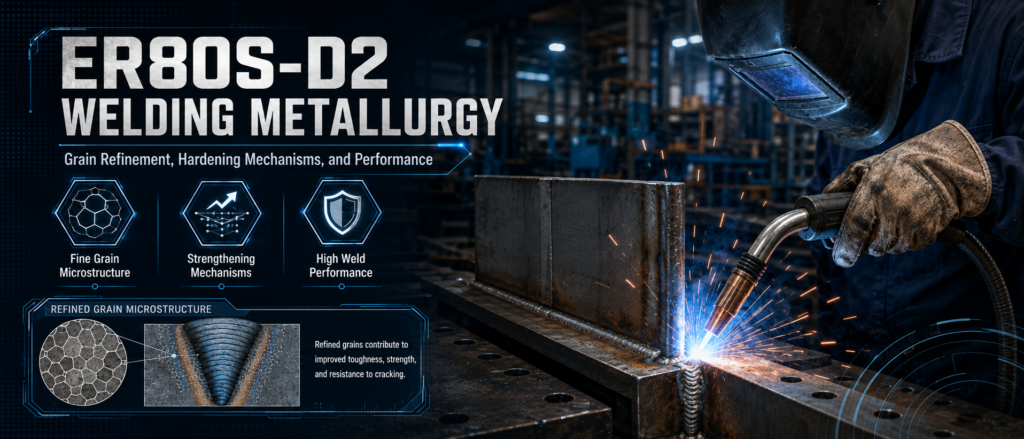
ER80S-D2 Welding Metallurgy: Grain Refinement, Hardening Mechanisms, and Performance
ER80S-D2 is a low-alloy steel welding wire designed for applications where higher strength, improved toughness, and reliable weld performance are required. Unlike conventional carbon steel filler metals, ER80S-D2 achieves its mechanical advantages through carefully controlled alloy chemistry and welding metallurgy.
The performance of ER80S-D2 weld metal is not determined only by its chemical composition. The final properties depend on a combination of:
solidification behavior
grain structure development
alloy strengthening mechanisms
cooling conditions
weld thermal cycles
Understanding the metallurgy behind ER80S-D2 helps engineers optimize welding procedures and achieve stronger, more durable welded joints.
1. Understanding the Metallurgical Design of ER80S-D2
ER80S-D2 belongs to the low-alloy steel filler metal family. Its design focuses on achieving a balance between:
high tensile strength
good toughness
controlled hardness
weld reliability
The alloy system typically contains controlled amounts of carbon, manganese, silicon, and molybdenum. Each element contributes differently to weld metal formation and mechanical performance.
The main metallurgical goals of ER80S-D2 are:
Developing a refined weld microstructure
Increasing resistance to plastic deformation
Improving strength through alloy strengthening
Maintaining adequate toughness after welding
The interaction between composition and thermal history determines the final weld structure.
2. Grain Refinement Mechanism in ER80S-D2 Weld Metal
2.1 Importance of Grain Size Control
Grain refinement is one of the most important strengthening strategies in welding metallurgy.
A finer grain structure provides:
higher yield strength
improved toughness
better resistance to crack propagation
When weld metal solidifies, crystals initially grow as columnar grains from the fusion boundary. If grain growth is not controlled, coarse microstructures may develop, reducing toughness and increasing sensitivity to cracking.
A refined microstructure creates more grain boundaries that act as barriers to dislocation movement, improving mechanical strength. Grain boundary strengthening is a fundamental mechanism used in many high-strength steel systems.
2.2 Factors Affecting Grain Refinement
The grain structure of ER80S-D2 weld metal is influenced by several welding parameters:
Heat Input
Higher heat input increases the time available for grain growth, potentially producing coarser grains.
Lower and controlled heat input can promote:
faster cooling
reduced grain growth
finer weld structures
Cooling Rate
The cooling rate after welding strongly affects phase transformation.
A controlled cooling process can help develop favorable microstructures with improved strength and toughness.
Alloying Elements
Alloying elements influence nucleation behavior and phase transformation during weld solidification.
Elements such as manganese and molybdenum contribute to microstructure control by changing transformation kinetics and strengthening the ferritic matrix.
3. Hardening Mechanisms of ER80S-D2 Weld Metal
The strength of ER80S-D2 comes from multiple strengthening mechanisms working together.
3.1 Solid Solution Strengthening
Alloying elements dissolved within the iron matrix create lattice distortion.
This distortion restricts dislocation movement, increasing resistance to deformation.
Manganese and molybdenum are particularly important because they strengthen the ferritic structure and improve mechanical stability.
The result is:
higher yield strength
improved tensile strength
better load-bearing capability
3.2 Grain Boundary Strengthening
According to the Hall–Petch relationship, smaller grain sizes increase strength because grain boundaries restrict dislocation motion.
In ER80S-D2 weld metal:
Fine grains can provide:
increased hardness
improved toughness balance
enhanced resistance to crack growth
Unlike some strengthening methods that may reduce ductility, grain refinement can improve both strength and toughness simultaneously.
3.3 Transformation Strengthening
During welding, the molten weld pool undergoes rapid cooling and solid-state transformation.
The final microstructure may contain different ferritic structures depending on:
alloy composition
cooling rate
heat input
interpass temperature
Controlled transformation contributes to the development of a strong weld deposit with stable mechanical properties.
3.4 Precipitation and Dispersion Effects
During welding thermal cycles, alloy elements may contribute to the formation of fine secondary phases.
These particles can restrict dislocation movement and improve strength.
Fine precipitates can also influence grain growth behavior by limiting boundary movement during thermal exposure.
4. Role of Alloying Elements in ER80S-D2 Performance
Carbon (C)
Carbon contributes to hardness and strength by increasing matrix strengthening.
However, excessive carbon may reduce weldability and increase cracking sensitivity, so controlled carbon content is essential.
Manganese (Mn)
Manganese plays several important roles:
improves strength
enhances deoxidation
contributes to toughness
stabilizes weld metal structure
It helps produce cleaner weld deposits with improved mechanical consistency.
Silicon (Si)
Silicon mainly functions as a deoxidizing element.
Proper silicon control improves:
weld cleanliness
surface quality
arc stability
Molybdenum (Mo)
Molybdenum is a key alloying element in ER80S-D2.
Its contributions include:
increasing hardenability
improving high-strength performance
enhancing resistance to softening during thermal exposure
Mo strengthens the ferritic matrix and helps maintain mechanical properties after welding.
5. Relationship Between Microstructure and Weld Performance
The final performance of ER80S-D2 depends on the relationship:
Chemical Composition → Solidification → Microstructure → Mechanical Properties
A properly controlled weld structure provides:
Higher Strength
Refined grains and alloy strengthening improve resistance against deformation.
Better Toughness
A refined microstructure reduces the tendency for cracks to propagate through the weld metal.
Improved Weld Reliability
Stable metallurgical characteristics help maintain performance under mechanical loading and service conditions.
6. Welding Process Considerations for ER80S-D2
Although ER80S-D2 provides high-strength weld deposits, proper welding control is necessary to achieve optimal metallurgy.
Important parameters include:
ER80S-D2 Heat Input Control
Excessive heat input may cause:
grain coarsening
reduced toughness
undesirable microstructural changes
ER80S-D2 Interpass Temperature Management
Controlling interpass temperature helps maintain consistent weld properties during multi-pass welding.
ER80S-D2 Shielding Conditions
Proper shielding prevents contamination and improves weld quality.
Poor shielding may introduce defects that reduce mechanical performance.
7. Applications Requiring ER80S-D2 Metallurgical Advantages
Due to its combination of strength and toughness, ER80S-D2 is commonly considered for applications involving:
structural steel fabrication
heavy-duty welded components
machinery manufacturing
transportation equipment
high-strength steel assemblies
These applications require weld metals capable of maintaining mechanical integrity under demanding service conditions.
ER80S-D2 Conclusion
The performance of ER80S-D2 welding wire is the result of carefully controlled welding metallurgy. Its strength and reliability come from the combination of grain refinement, solid solution strengthening, transformation control, and alloy-assisted hardening mechanisms.
By controlling weld composition and thermal history, ER80S-D2 can achieve a balanced combination of:
high strength
toughness
structural reliability
consistent weld performance
Understanding these metallurgical principles allows engineers to optimize welding procedures and select ER80S-D2 for applications requiring dependable high-strength weld joints.