

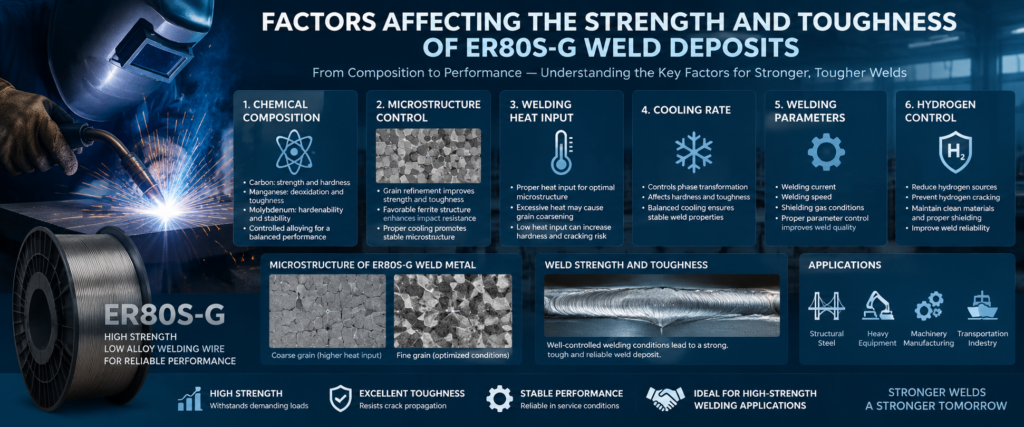
Factors Affecting the Strength and Toughness of ER80S-G Weld Deposits
ER80S-G is a high-strength low-alloy (HSLA) solid welding wire designed for producing weld deposits with a balance of strength, toughness, and weld reliability. The mechanical performance of ER80S-G weld metal is not determined only by the filler metal composition. Instead, it is the result of complex interactions between alloy chemistry, welding thermal cycles, microstructure evolution, and processing conditions.
For high-strength welded structures, achieving both strength and toughness is critical. Excessive hardness may increase crack sensitivity, while insufficient strength can reduce structural reliability. Therefore, controlling metallurgical factors during welding is essential for obtaining stable ER80S-G weld performance.
The major factors influencing ER80S-G weld deposits include:
chemical composition
microstructure development
grain refinement
alloy strengthening mechanisms
heat input and cooling rate
welding parameters
hydrogen control
Understanding these factors helps engineers optimize welding procedures and maximize the performance of ER80S-G weld joints.
1. Influence of Chemical Composition on ER80S-G Weld Strength and Toughness
The chemical composition of ER80S-G plays a fundamental role in determining weld metal properties.
Unlike conventional carbon steel welding wires, ER80S-G utilizes controlled alloying elements to improve mechanical performance. The interaction between alloying elements affects:
weld strength
hardness
toughness
crack resistance
microstructural stability
A carefully designed alloy system allows ER80S-G weld deposits to achieve higher strength while maintaining adequate ductility.
1.1 The Role of Carbon in Weld Hardness and Strength
Carbon is one of the most important strengthening elements in steel weld metal.
Increasing carbon content can improve:
tensile strength
hardness
wear resistance
However, excessive carbon may negatively affect weld toughness by increasing brittleness and reducing resistance to cracking.
Therefore, ER80S-G requires controlled carbon levels to maintain a balance between strength and toughness.
The objective is not simply to maximize hardness, but to develop a stable weld structure with sufficient deformation capability.
1.2 The Effect of Manganese on Weld Performance
Manganese is an important alloying element in ER80S-G weld deposits.
Its main functions include:
improving strength through solid solution strengthening
enhancing deoxidation
refining weld microstructure
improving toughness
Manganese also influences transformation behavior during cooling, helping develop favorable ferritic structures.
A proper manganese level contributes to stronger and more reliable weld deposits.
1.3 The Contribution of Molybdenum to Strength and Stability
Molybdenum is widely used in low-alloy welding materials because of its ability to improve high-strength performance.
Mo contributes through:
increasing hardenability
strengthening the ferritic matrix
improving resistance to thermal softening
enhancing microstructural stability
The presence of molybdenum helps ER80S-G maintain mechanical properties after exposure to welding thermal cycles.
2. Microstructure Control and Its Effect on Weld Properties
The final microstructure of ER80S-G weld deposits directly determines mechanical performance.
The relationship can be summarized as:
Alloy Composition → Cooling Process → Microstructure → Mechanical Properties
During welding, molten metal rapidly solidifies and undergoes phase transformation. The cooling history determines whether the weld develops favorable fine structures or undesirable coarse structures.
Important microstructural features include:
grain size
ferrite morphology
transformation products
distribution of strengthening phases
2.1 Grain Refinement and Strength Improvement
Grain refinement is one of the most effective methods for improving weld strength.
Smaller grains provide:
higher yield strength
improved toughness
better resistance to crack propagation
Fine grains limit dislocation movement and increase resistance to plastic deformation.
For ER80S-G weld deposits, controlling solidification conditions and alloy composition helps promote refined grain structures.
2.2 Ferrite Structure and Toughness Behavior
The morphology of ferrite significantly affects weld toughness.
Fine and well-distributed ferritic structures generally provide:
improved impact resistance
better crack resistance
enhanced ductility
Conversely, coarse or unfavorable ferrite structures may create easier paths for crack propagation.
Therefore, controlling transformation behavior during cooling is essential.
3. Effect of Welding Heat Input on ER80S-G Performance
Heat input is one of the most important welding parameters affecting weld metallurgy.
It influences:
cooling rate
grain growth
phase transformation
residual stress development
3.1 Excessive Heat Input
High heat input may cause:
slower cooling
coarse grain formation
reduced toughness
wider heat-affected zones
Although higher heat input can improve penetration and productivity, excessive thermal exposure may reduce weld mechanical performance.
3.2 Low Heat Input Effects
Insufficient heat input may lead to:
rapid cooling
increased hardness
higher residual stress
increased cracking risk
Therefore, optimal heat input control is necessary to achieve a balanced ER80S-G weld structure.
4. Cooling Rate and Transformation Behavior
Cooling rate strongly affects the final weld microstructure.
A controlled cooling process helps regulate:
ferrite formation
hardness distribution
toughness level
Rapid cooling can increase hard phases and hardness, while extremely slow cooling may result in coarse microstructures.
The ideal cooling condition produces a weld deposit with:
sufficient strength
controlled hardness
good impact toughness
5. Influence of Welding Parameters on ER80S-G Weld Quality
The performance of ER80S-G weld deposits depends not only on material chemistry but also on welding operation.
Important parameters include:
Welding Current
Current affects:
penetration depth
melting rate
heat input
Improper current selection may cause unstable weld formation.
Welding Speed
Welding speed influences:
weld bead geometry
cooling behavior
heat distribution
Too high welding speed may reduce fusion quality, while too low speed may increase excessive heat exposure.
Shielding Gas Conditions
Shielding gas protects the molten weld pool from atmospheric contamination.
Poor shielding conditions may introduce:
porosity
oxidation
reduced mechanical properties
Stable shielding improves weld cleanliness and consistency.
6. Hydrogen Control and Crack Resistance
Hydrogen is one of the critical factors affecting weld cracking.
Excess hydrogen may cause:
hydrogen-assisted cracking
reduced ductility
premature failure
To improve ER80S-G weld reliability, controlling hydrogen sources is important.
Key measures include:
maintaining clean base materials
controlling moisture exposure
using proper shielding conditions
optimizing welding procedures
Reducing hydrogen content improves weld toughness and long-term durability.
7. Relationship Between Strength and Toughness in ER80S-G Weld Deposits
Strength and toughness are often competing properties in high-strength steels.
Increasing hardness and strength may reduce ductility if the microstructure becomes too rigid.
ER80S-G achieves performance balance through:
controlled alloying
grain refinement
optimized transformation behavior
proper welding conditions
A successful weld deposit should provide:
High Strength
Ability to withstand mechanical loading without permanent deformation.
Good Toughness
Ability to absorb energy and resist crack propagation.
Stable Performance
Ability to maintain properties during long-term service.
8. Strategies for Optimizing ER80S-G Weld Performance
To maximize ER80S-G weld strength and toughness, engineers should consider:
Optimize Alloy Composition
Maintain appropriate levels of strengthening elements while avoiding excessive hardening.
ER80S-G Control Welding Heat Input
Balance penetration requirements with microstructure control.
ER80S-G Manage Cooling Conditions
Develop favorable transformation products and avoid excessive hardness.
ER80S-G Maintain Low Hydrogen Practices
Reduce cracking risk and improve weld reliability.
ER80S-G Evaluate Microstructure
Use metallurgical analysis to understand the relationship between processing conditions and final properties.
ER80S-G Conclusion
The strength and toughness of ER80S-G weld deposits are controlled by multiple interconnected metallurgical factors. Chemical composition, microstructure evolution, grain refinement, heat input, cooling rate, and welding parameters all contribute to final weld performance.
The key to achieving reliable ER80S-G weld deposits is not simply increasing strength, but creating a balanced structure that combines:
high mechanical strength
excellent toughness
crack resistance
long-term reliability
Through proper alloy design and optimized welding control, ER80S-G can provide high-performance weld joints for demanding low-alloy steel applications.