

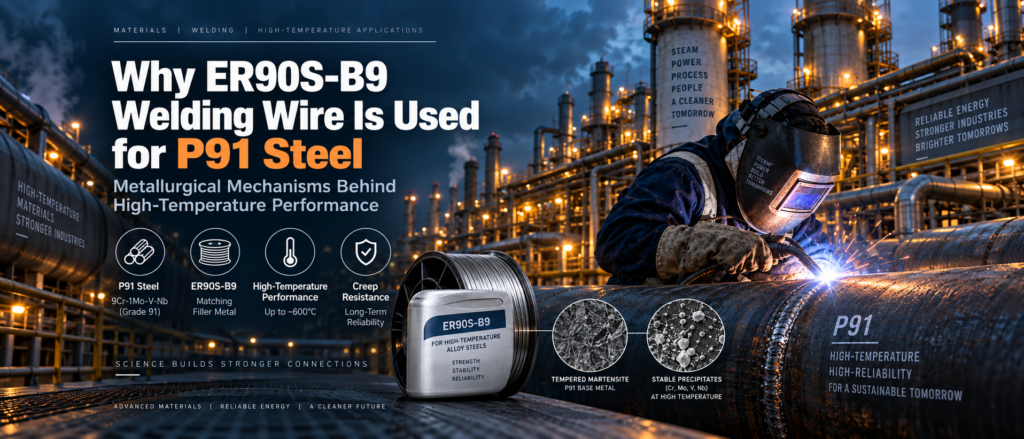
Why ER90S-B9 Welding Wire Is Used for P91 Steel: Metallurgical Mechanisms Behind High Temperature Performance
Introduction: The Challenge of Welding P91 Steel for Extreme Temperature Service
In modern power generation, petrochemical processing, and high-pressure steam systems, materials must maintain mechanical strength under long-term exposure to elevated temperatures. P91 steel, also known as Grade 91 steel, was developed as a high-performance creep-resistant alloy for these demanding environments.ER90S-B9
However, the excellent high-temperature properties of P91 steel also create challenges during welding. The welding consumable must not only provide sufficient strength but also maintain similar metallurgical characteristics to the base metal after welding and post-weld heat treatment.
This is why ER90S-B9 welding wire is widely selected for welding P91, T91, and similar 9Cr alloy steels. Its carefully designed alloy composition enables the weld metal to achieve high-temperature strength, creep resistance, and structural stability.
Understanding why ER90S-B9 performs well requires looking beyond basic welding specifications and examining its metallurgical mechanisms.
1. What Makes P91 Steel Different from Conventional Low Alloy Steels?
P91 steel belongs to the group of 9% chromium creep strength enhanced ferritic steels (CSEF steels). Unlike traditional Cr-Mo steels, P91 achieves high-temperature performance through advanced alloy design and controlled microstructure.
Its main strengthening mechanisms include:
Chromium solid solution strengthening
Molybdenum strengthening
Vanadium and niobium carbide precipitation strengthening
Tempered martensitic microstructure
The combination of these mechanisms allows P91 steel to maintain strength and resistance to creep deformation during long-term high-temperature operation.
However, welding can disturb this carefully controlled microstructure. If the filler metal has significantly different chemical characteristics, the welded joint may become the weakest area during service.
Therefore, the welding wire must be designed to match the metallurgical behavior of P91 steel.
2. ER90S-B9 Alloy Design: Matching the Metallurgy of P91 Steel
The primary reason ER90S-B9 is used for P91 welding is its similar alloy system.
ER90S-B9 typically contains:
Approximately 9% chromium
Molybdenum for high-temperature strengthening
Vanadium for precipitation strengthening
Niobium for carbide stabilization
Controlled carbon content for balancing strength and toughness
This alloy design creates a weld deposit capable of forming a tempered martensitic structure similar to P91 base material.
The objective is not simply to create a strong weld immediately after deposition. The real goal is to achieve a weld metal that remains stable after heat treatment and years of high-temperature operation.
3. Chromium: Improving Oxidation Resistance at High Temperature
Chromium is one of the most important elements in ER90S-B9 welding wire.
At elevated temperatures, steel components are exposed to oxidation, steam corrosion, and aggressive environments. Chromium improves resistance by promoting the formation of protective chromium-rich oxide layers.
In high-temperature applications such as:
Steam pipelines
Boilers
Turbine systems
Petrochemical equipment
chromium helps maintain surface stability and reduces degradation during long-term service.
The approximately 9% chromium content also helps maintain compatibility between the weld metal and P91 base steel.
4. Molybdenum: Enhancing High Temperature Strength
Molybdenum plays a critical role in maintaining mechanical strength at elevated temperatures.
Its main contributions include:
Solid Solution Strengthening
Molybdenum atoms interact with the iron matrix and restrict dislocation movement, improving strength.
Creep Resistance Improvement
During high-temperature service, materials slowly deform under constant stress. This phenomenon is known as creep.
Molybdenum helps slow creep deformation by improving resistance against microstructural changes.
For pressure components operating continuously at high temperature, this creep resistance is essential for long-term reliability.
5. Vanadium and Niobium: The Key to Precipitation Strengthening
One of the most important metallurgical advantages of ER90S-B9 is the presence of vanadium and niobium.
These elements form stable carbide and carbonitride precipitates:
Vanadium-rich precipitates
Niobium carbonitrides
These fine particles strengthen the weld metal by:
Pinning grain boundaries
Restricting dislocation movement
Improving microstructural stability
During high-temperature exposure, these precipitates help prevent rapid softening of the weld structure.
This mechanism is one of the main reasons ER90S-B9 can maintain performance in long-term creep conditions.
6. Martensitic Microstructure and Post-Weld Heat Treatment
During welding, ER90S-B9 weld metal typically transforms into a hard martensitic structure after cooling.
Although martensite provides high strength, the as-welded condition is too hard and contains significant residual stress.
Therefore, post-weld heat treatment (PWHT) is essential.
During PWHT:
Residual stresses are reduced
Martensite is tempered
Toughness is improved
Carbide distribution becomes more stable
The final tempered martensitic structure provides the required combination of:
High strength
Good toughness
Creep resistance
Long-term stability
Proper welding procedures and heat treatment are therefore critical when using ER90S-B9 for P91 steel.
7. Why Ordinary Welding Wires Are Not Suitable for P91 Steel
Using a conventional low alloy welding wire for P91 steel may create several problems:
1. Chemical mismatch
A filler metal with lower chromium or alloy content may have inferior high-temperature properties compared with the base material.
2. Reduced creep strength
The weld zone may experience accelerated creep deformation during service.
3. Microstructural instability
Different transformation behavior can lead to uneven properties between weld metal and base steel.
4. Increased risk during long-term operation
In critical equipment, weld failure can cause serious operational problems.
Therefore, selecting a matching filler metal such as ER90S-B9 is essential for maintaining the overall performance of P91 welded structures.
8. Typical Applications of ER90S-B9 Welding Wire
Because of its high-temperature performance, ER90S-B9 is commonly used in industries requiring long service life under thermal stress.
Typical applications include:
Power Generation
Superheater tubes
Steam pipelines
Boiler components
High-pressure piping systems
ER90S-B9 Petrochemical Industry
High-temperature process equipment
Hydrogen service applications
Pressure-containing components
ER90S-B9 Heavy Industrial Equipment
Heat-resistant steel fabrication
High-temperature pressure vessels
These applications require welding consumables that can maintain mechanical integrity for thousands of operating hours.
9. Key Welding Considerations for ER90S-B9
Although ER90S-B9 provides excellent metallurgical compatibility with P91 steel, welding procedures must be carefully controlled.
Important factors include:
Preheating
Preheating reduces cooling rates and helps prevent hydrogen-assisted cracking.
ER90S-B9 Heat Input Control
Excessive heat input can negatively affect the heat-affected zone and microstructure.
ER90S-B9 Interpass Temperature Management
Maintaining proper interpass temperature helps achieve consistent weld properties.
ER90S-B9 Post-Weld Heat Treatment
PWHT is necessary to obtain the required tempered martensitic structure.
A controlled welding process is as important as selecting the correct filler metal.
Conclusion: The Metallurgical Reason Behind ER90S-B9 Selection
ER90S-B9 welding wire is not selected for P91 steel simply because it provides high tensile strength. Its real advantage comes from metallurgical compatibility.
Through its carefully balanced alloy system:
Chromium improves oxidation resistance
Molybdenum enhances high-temperature strength
Vanadium and niobium provide precipitation strengthening
Controlled composition enables stable tempered martensitic structures
Together, these mechanisms allow ER90S-B9 weld metal to withstand demanding high-temperature environments while maintaining creep resistance and long-term reliability.
For P91 steel welding applications, ER90S-B9 represents a matching filler metal solution designed around the same metallurgical principles that make Grade 91 steels successful in critical high-temperature service.