

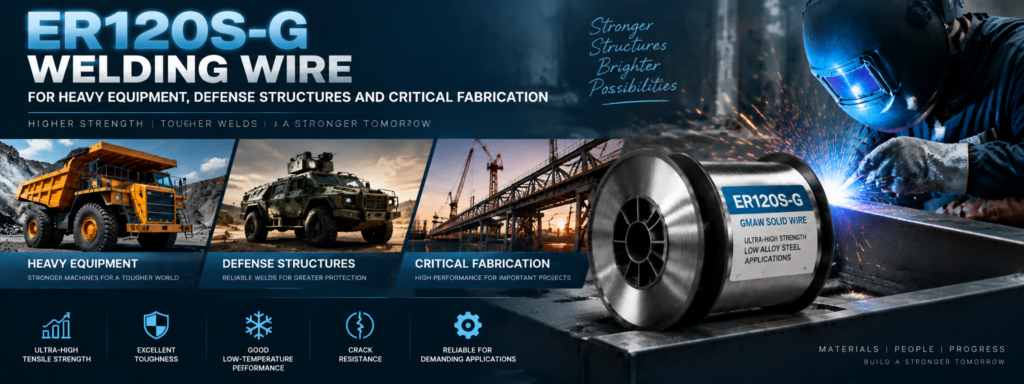
ER120S-G Welding Wire Applications in Heavy Equipment, Defense Structures and Critical Fabrication
Introduction: Why ER120S-G Is Used for High-Demand Welding Applications
Modern industrial structures increasingly require materials that can withstand extreme mechanical loads, impact conditions, and long-term service environments. In these applications, welding consumables must provide not only high strength but also excellent toughness, crack resistance, and consistent performance.ER120S-G
ER120S-G welding wire is developed for ultra-high-strength steel welding applications, where weld metal properties must match advanced structural steels. Its combination of high tensile strength, controlled alloy chemistry, and reliable weldability makes it suitable for demanding fabrication industries requiring durable and safety-critical welded joints.
Unlike conventional welding wires designed for general fabrication, ER120S-G focuses on achieving a superior balance between:
Ultra-high weld strength
Impact toughness
Fatigue resistance
Hydrogen cracking resistance
Structural reliability
These characteristics make It suitable for applications such as heavy equipment manufacturing, defense-related structures, offshore components, and critical steel fabrication.
1. Overview of ER120S-G Welding Wire
1.1 What Is ER120S-G Welding Wire?
It is a high-strength solid welding wire designed for gas metal arc welding (GMAW/MIG) applications. It belongs to the category of low-alloy welding consumables developed for joining high-strength steels.
The wire is engineered to produce weld deposits with approximately 120 ksi tensile strength class, making it suitable for steels requiring superior mechanical performance.
Its alloy system typically includes controlled additions of:
Nickel (Ni)
Chromium (Cr)
Molybdenum (Mo)
Manganese (Mn)
These elements contribute to:
Improved hardenability
Enhanced toughness
Better strength retention
Improved weld metal stability
1.2 Key Performance Characteristics of ER120S-G
The main advantages of ER120S-G include:
High Tensile Strength
It provides weld metal capable of supporting heavy structural loads where standard welding wires may not provide sufficient strength.
Excellent Toughness
High-strength steels often face the challenge of reduced toughness. ER120S-G uses balanced alloy design to maintain impact resistance while achieving high strength.
Crack Resistance
Critical structures require welds that resist:
Hydrogen-assisted cracking
Fatigue damage
Stress concentration failures
Proper welding procedures combined with ER120S-G metallurgy help improve weld reliability.
2. ER120S-G Applications in Heavy Equipment Manufacturing
2.1 Welding of Mining and Construction Machinery
Heavy equipment used in mining, earthmoving, and construction experiences severe operating conditions, including:
High mechanical stress
Repeated impact loading
Abrasion
Variable environmental conditions
Components such as:
Frames
Booms
Structural supports
Load-bearing joints
require weld metals with high strength and fatigue resistance.
It is suitable for these applications because it provides strong welded connections capable of supporting demanding mechanical loads.
2.2 Heavy Lifting Equipment
Cranes and lifting machinery require exceptional weld reliability because structural failure can lead to serious safety risks.
Important welding requirements include:
High yield strength
Stable mechanical properties
Resistance to dynamic loading
Long service life
It helps maintain structural integrity in components exposed to continuous loading cycles.
2.3 Agricultural and Industrial Machinery
Modern agricultural and industrial machines increasingly use high-strength steels to reduce weight while maintaining durability.
ER120S-G supports lightweight structural design by enabling:
Thinner steel sections
Higher load capacity
Improved structural efficiency
This makes it valuable for advanced machinery fabrication.
3. ER120S-G Applications in Defense Structures
3.1 High Strength Military-Grade Structures
Defense-related structures require materials capable of performing under extreme conditions.
Typical requirements include:
High strength-to-weight ratio
Impact resistance
Structural durability
Reliable operation under harsh environments
It welding wire supports fabrication of high-strength steel structures where weld performance is a critical factor.
3.2 Armored and Protective Structures
Protective structures require welded joints that can maintain integrity under severe impact conditions.
The weld metal must demonstrate:
High tensile strength
Good toughness
Resistance to crack propagation
ER120S-G provides a metallurgical foundation for producing durable welded assemblies.
3.3 Mobile Defense Equipment
Mobile defense platforms experience:
Vibration
Shock loading
Repeated mechanical stress
Welding materials must maintain performance throughout extended service conditions.
The high-strength characteristics of ER120S-G make it suitable for applications requiring reliable welded connections.
4. ER120S-G in Critical Fabrication Industries
4.1 Offshore and Marine Structures
Offshore structures operate in challenging environments involving:
Dynamic wave loading
Low temperatures
Corrosion exposure
Continuous mechanical stress
Weld joints must provide both strength and toughness.
ER120S-G helps meet these requirements through controlled alloy design and high-performance weld metal characteristics.
4.2 Pressure and Heavy Structural Fabrication
Critical fabricated structures require strict control of:
Weld quality
Mechanical properties
Defect prevention
ER120S-G is suitable where weld failures could significantly affect equipment safety and reliability.
4.3 Bridge and Infrastructure Components
Modern infrastructure projects increasingly use high-strength steels to achieve:
Longer spans
Reduced structural weight
Improved efficiency
Welded joints must maintain the same performance level as the base materials.
ER120S-G provides a solution for high-load structural connections.
5. Metallurgical Advantages Behind ER120S-G Performance
5.1 Nickel Contribution
Nickel improves:
Low-temperature toughness
Weld ductility
Crack resistance
It helps maintain toughness while supporting high-strength weld development.
5.2 Chromium Contribution
Chromium enhances:
Hardenability
Strength development
Microstructure stability
Controlled chromium content helps produce consistent weld properties.
5.3 Molybdenum Contribution
Molybdenum plays an important role in:
Increasing hardenability
Improving strength
Supporting high-load performance
The Ni-Cr-Mo alloy system allows ER120S-G to achieve high strength without relying on excessive carbon content.
6. Welding Considerations for ER120S-G Applications
6.1 Heat Input Control
Heat input significantly affects weld microstructure.
Excessive heat input may result in:
Grain coarsening
Reduced toughness
Lower mechanical performance
Optimized welding parameters help maintain desirable weld structures.
6.2 Preheating and Temperature Management
High-strength steels require careful thermal control.
Important factors include:
Preheat temperature
Interpass temperature
Cooling rate
Proper control reduces the risk of cracking.
6.3 Shielding Gas Selection
The shielding environment influences:
Arc stability
Weld appearance
Mechanical properties
Selecting appropriate shielding conditions helps maximize ER120S-G weld performance.
7. Advantages of ER120S-G Compared with Conventional Welding Wires
Higher Structural Efficiency
High-strength weld metals allow engineers to design lighter structures without sacrificing performance.
Better Performance Under Extreme Loads
ER120S-G provides improved resistance against:
Fatigue
Impact
Mechanical stress
Improved Reliability for Critical Applications
For industries where weld failure is unacceptable, consistent weld performance is essential.
ER120S-G supports reliable fabrication of high-performance steel structures.
8. Future Trends of ER120S-G in Advanced Manufacturing
As industries continue moving toward lightweight and high-performance structures, demand for ultra-high-strength welding materials continues to increase.
Future applications may expand into:
Automated welding systems
Robotic fabrication
Advanced steel manufacturing
Large-scale additive manufacturing
The combination of high strength and controlled metallurgy makes ER120S-G suitable for next-generation fabrication technologies.
Conclusion
ER120S-G welding wire plays an important role in industries requiring ultra-high-strength welded structures. Its advanced alloy design provides the strength, toughness, and reliability needed for heavy equipment, defense structures, and critical fabrication applications.
By combining controlled metallurgy with optimized welding procedures, ER120S-G enables engineers to build stronger, lighter, and more durable steel structures capable of performing under extreme operating conditions.
For high-performance steel fabrication, ER120S-G represents a welding solution focused on strength, reliability, and long-term structural integrity.