

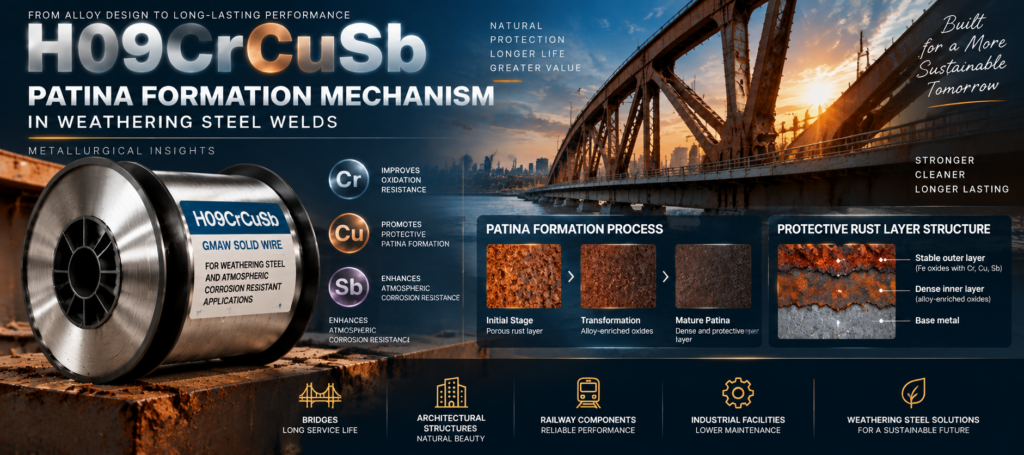
Patina Formation Mechanism in H09CrCuSb Weathering Steel Welds: Metallurgical Insights
Introduction: The Role of Patina Formation in Weathering Steel Welding
Weathering steel represents a unique class of low-alloy steels designed to develop a stable protective rust layer during long-term atmospheric exposure. Unlike conventional steels that require continuous surface protection, weathering steels rely on controlled corrosion processes to form a dense and adherent patina layer that slows further corrosion. H09CrCuSb
For welded structures, achieving similar corrosion behavior between the weld metal and the base metal is a major engineering challenge. The weld region often has different chemical compositions and microstructures, which can influence rust formation, corrosion rate, and long-term durability.
H09CrCuSb welding wire is specifically designed for weather-resistant steel applications. Its performance depends on a carefully optimized Cr-Cu-Sb alloy system, where chromium, copper, and antimony contribute to protective rust layer development, atmospheric corrosion resistance, and weld durability.
Understanding the patina formation mechanism of H09CrCuSb weld metal provides important insights into how alloy design controls corrosion behavior in bridges, architectural structures, railway components, and outdoor steel fabrication.
1. What Is Patina in H09CrCuSb Weathering Steel Welds?
1.1 Definition of Protective Patina Layer
Patina is a stable surface oxide layer formed through controlled atmospheric corrosion.
During exposure to:
Rainwater
Oxygen
Humidity
Industrial environments
the steel surface initially undergoes normal oxidation. However, alloying elements within weathering steel gradually modify the corrosion products, creating a dense and protective layer.
A mature patina typically consists of:
Iron oxides
Iron oxyhydroxides
Alloy-enriched protective phases
This structure reduces oxygen and moisture penetration, significantly slowing corrosion progression.
1.2 Why Patina Formation Matters in Weld Metal
In weathering steel structures, the weld area must develop corrosion resistance comparable to the surrounding steel.
Poorly matched weld metal may cause:
Accelerated local corrosion
Uneven rust appearance
Reduced structural durability
Premature maintenance requirements
Therefore, H09CrCuSb weld metal is designed to reproduce the corrosion-resistant characteristics of weathering steel through controlled alloy chemistry.
2. Metallurgical Design of H09CrCuSb Welding Wire
2.1 Cr-Cu-Sb Alloying Strategy
The corrosion resistance of H09CrCuSb mainly comes from the combined effects of:
Chromium (Cr)
Copper (Cu)
Antimony (Sb)
Each element contributes through different metallurgical mechanisms.
| Alloy Element | Primary Function |
|---|---|
| Chromium | Improves oxidation resistance and rust stability |
| Copper | Promotes protective patina formation |
| Antimony | Enhances atmospheric corrosion resistance |
The effectiveness of H09CrCuSb depends not on individual elements alone, but on their synergistic interaction within the weld microstructure.
3. Role of Copper in Patina Formation
3.1 Copper Enrichment During Corrosion
Copper is one of the most important elements in weathering steel metallurgy.
During atmospheric corrosion, copper gradually enriches near the steel surface.
This enrichment contributes to:
More compact rust layers
Reduced corrosion activity
Improved protective behavior
Copper-containing corrosion products reduce the permeability of the rust layer and limit further electrochemical reactions.
3.2 Copper and Long-Term Atmospheric Stability
The presence of copper helps the patina become more stable during repeated environmental cycles.
These cycles include:
Wetting by rain
Drying under atmospheric conditions
Temperature fluctuations
A stable copper-containing rust layer improves long-term service performance without relying on additional coatings.
4. Role of Chromium in H09CrCuSb Weld Corrosion Resistance
4.1 Chromium and Protective Oxide Formation
Chromium contributes significantly to oxidation resistance.
During corrosion processes, chromium can participate in forming stable oxide-rich regions that improve:
Rust layer compactness
Surface protection
Corrosion resistance
Chromium reduces the rate at which aggressive environmental factors penetrate into the weld metal.
4.2 Chromium Effects on Weld Microstructure
Besides corrosion resistance, chromium influences weld metallurgy through:
Increased hardenability
Improved structural stability
Enhanced oxidation resistance
A controlled chromium content helps maintain a balance between mechanical performance and corrosion protection.
5. Role of Antimony in Weathering Steel Welds
5.1 Antimony as a Corrosion Resistance Element
Antimony is a minor alloying addition but plays an important role in improving atmospheric corrosion behavior.
Its effects include:
Modifying corrosion product composition
Improving rust layer stability
Reducing corrosion propagation
The addition of antimony helps refine the protective characteristics of the patina layer.
5.2 Antimony and Rust Layer Compactness
A key objective of H09CrCuSb alloy design is creating a rust layer that is:
Dense
Adhesive
Less porous
Resistant to cracking
Antimony contributes to improving the long-term stability of corrosion products.
6. Patina Formation Process on H09CrCuSb Weld Metal
6.1 Initial Corrosion Stage
Immediately after exposure, the weld surface experiences rapid oxidation.
The initial products mainly include:
Unstable iron oxides
Hydrated corrosion products
At this stage, the rust layer is relatively porous and does not provide strong protection.
6.2 Transformation Stage
As exposure continues, alloying elements begin influencing corrosion reactions.
Cr, Cu, and Sb gradually participate in modifying the corrosion environment.
The rust layer evolves toward:
Lower porosity
Higher adhesion
Greater chemical stability
6.3 Mature Patina Stage
After long-term atmospheric exposure, H09CrCuSb weld surfaces develop a stable protective patina.
The mature layer provides:
Reduced corrosion rate
Improved environmental resistance
Enhanced structural durability
This transformation is the foundation of weathering steel performance.
7. Relationship Between Weld Microstructure and Patina Performance
7.1 Microstructure Influence on Corrosion Behavior
The weld microstructure affects:
Electrochemical reactions
Corrosion product formation
Surface stability
Factors such as:
Grain structure
Phase distribution
Alloy element distribution
can influence how effectively the patina develops.
7.2 Importance of Alloy Distribution
Uniform distribution of Cr, Cu, and Sb is essential.
Uneven alloy concentration may cause:
Localized corrosion
Unstable rust formation
Reduced protection efficiency
Controlled welding metallurgy ensures consistent corrosion resistance throughout the weld region.
8. H09CrCuSb Weld Applications Requiring Patina Stability
8.1 H09CrCuSb Weathering Steel Bridges
Bridge structures require:
Long service life
Low maintenance requirements
Resistance to atmospheric exposure
H09CrCuSb weld metal helps maintain corrosion-resistant characteristics at welded joints.
8.2 Architectural Steel Structures
Modern architectural designs often use weathering steel because of its natural rust appearance.
The weld metal must provide:
Similar visual appearance
Compatible corrosion behavior
Long-term durability
8.3 Railway and Outdoor Infrastructure
Railway components and outdoor steel structures experience continuous exposure to:
Moisture
Temperature variation
Environmental pollutants
H09CrCuSb supports reliable performance under these demanding conditions.
9. H09CrCuSb Welding Considerations for Maintaining Patina Performance
9.1 Heat Input Control
Welding parameters influence:
Weld microstructure
Alloy distribution
Corrosion behavior
Excessive heat input may cause:
Grain growth
Reduced microstructural stability
Changes in corrosion performance
9.2 Surface Preparation and Welding Quality
Proper welding practices are essential for achieving uniform patina formation.
Important factors include:
Clean weld surfaces
Controlled welding parameters
Proper joint preparation
9.3 Matching Weld Metal Chemistry
The closer the weld chemistry is to the weathering steel design concept, the better the corrosion compatibility.
H09CrCuSb achieves this through its Cr-Cu-Sb alloy strategy.
10. Advantages of H09CrCuSb Patina-Controlled Weld Metal
H09CrCuSb Enhanced Atmospheric Corrosion Resistance
The Cr-Cu-Sb alloy system promotes stable corrosion products that protect the weld surface.
H09CrCuSb Reduced Maintenance Requirements
Stable patina formation reduces dependence on external protective coatings.
H09CrCuSb Improved Structural Longevity
Better corrosion resistance contributes to:
Longer service life
Improved reliability
Lower lifecycle costs
H09CrCuSb Conclusion
The patina formation mechanism of H09CrCuSb weathering steel welds is based on advanced alloy design and controlled corrosion behavior.
Chromium improves oxidation resistance and rust stability, copper promotes protective patina development, and antimony enhances corrosion product stability. Together, these elements create a weld metal capable of maintaining long-term atmospheric corrosion resistance.
Through optimized Cr-Cu-Sb metallurgy, H09CrCuSb provides a reliable welding solution for weathering steel structures requiring durability, corrosion resistance, and long service performance.