

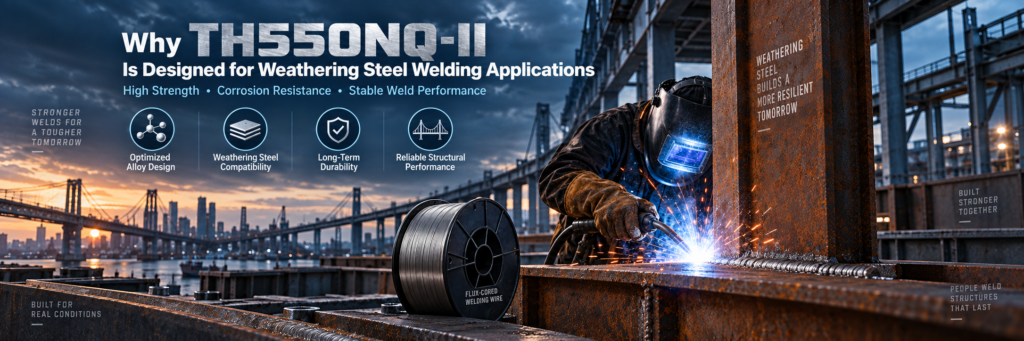
Why TH550NQ-II Is Designed for Weathering Steel Welding Applications
Introduction: The Growing Need for Advanced Weathering Steel Welding Solutions
Weathering steel has become an important material choice for outdoor structures where long-term durability, corrosion resistance, and reduced maintenance requirements are essential. From bridges and heavy structures to industrial facilities exposed to changing environments, weathering steel provides reliable performance through the formation of a stable protective surface layer. TH550NQ-II
However, the performance of a weathering steel structure does not depend only on the base material. The welding process and welding consumable also play a critical role in maintaining structural strength, corrosion resistance, and service life.
This is why TH550NQ-II welding wire is designed specifically for demanding weathering steel welding applications, combining high-strength weld performance with improved durability in challenging environments.
Understanding the Challenges of Weathering Steel Welding
Weathering steel is engineered to withstand atmospheric exposure by developing a protective patina layer that helps slow further corrosion. Alloying elements such as copper, chromium, and nickel contribute to this corrosion-resistant behavior.
During welding, however, the weld zone creates a new metallurgical area with different characteristics from the original steel. If the welding material does not provide compatible performance, several challenges may occur:
Reduced corrosion resistance at the welded area
Lower mechanical strength compared with the base material
Potential differences in surface appearance
Reduced long-term structural reliability
Therefore, selecting a suitable welding wire is essential for achieving consistent performance throughout the entire welded structure.
The Metallurgical Design Behind TH550NQ-II
The performance of TH550NQ-II is based on careful control of chemical composition and weld metal characteristics.
The design focuses on achieving a balance between:
1. High Strength Weld Metal
Weathering steel structures often experience complex mechanical loads, including tension, vibration, and impact forces.
TH550NQ-II is designed to provide:
High tensile strength
Reliable joint performance
Stable mechanical properties after welding
This allows welded structures to maintain their designed load-bearing capability in demanding applications.
2. Enhanced Atmospheric Corrosion Resistance
One of the key requirements for weathering steel welding is maintaining corrosion-resistant performance at the welded joint.
TH550NQ-II is developed with alloy design considerations that support:
Improved resistance against atmospheric exposure
Better compatibility with weathering steel systems
Long-term weld durability
A properly designed weld metal helps the welded area develop performance closer to the surrounding weathering steel structure.
Why Alloy Elements Matter in TH550NQ-II Welding Performance
The effectiveness of weathering steel welding materials depends heavily on alloying strategies.
Different alloy elements contribute specific functions:
Copper (Cu)
Copper can improve atmospheric corrosion resistance by supporting the formation of a more stable protective surface layer.
Chromium (Cr)
Chromium contributes to corrosion resistance and improves environmental durability.
Nickel (Ni)
Nickel helps enhance toughness and supports reliable performance under challenging conditions.
Manganese and Silicon (Mn & Si)
These elements contribute to weld pool control, deoxidation, and overall weld quality.
Through controlled alloy design, TH550NQ-II achieves a balance between strength, toughness, and environmental resistance.
TH550NQ-II and Long-Term Structural Reliability
For large-scale steel structures, welding quality directly affects service life.
Poor weld performance may lead to:
Premature corrosion
Reduced fatigue resistance
Increased maintenance requirements
Lower structural reliability
TH550NQ-II is designed to address these challenges by providing stable welding performance and durable welded joints.
Its characteristics make it suitable for applications requiring:
High-strength steel fabrication
Outdoor structural components
Heavy engineering projects
Long-service-life constructions
Welding Process Considerations for TH550NQ-II
Even with advanced welding wire technology, proper welding procedures remain important.
Key factors affecting weld performance include:
TH550NQ-II Welding Parameters
Appropriate control of:
Welding current
Voltage
Travel speed
Heat input
helps achieve stable weld formation.
TH550NQ-II Surface Preparation
Clean base metal surfaces are essential to reduce weld defects and improve joint quality.
TH550NQ-II Heat Input Management
Proper heat control helps maintain desired microstructure and mechanical properties.
Combining suitable welding procedures with TH550NQ-II allows manufacturers to achieve more consistent weld quality.
Applications of TH550NQ-II in Weathering Steel Fabrication
TH550NQ-II is suitable for industries where strength and environmental durability are critical.
Potential applications include:
Bridge structures
Railway and transportation equipment
Heavy steel fabrication
Outdoor industrial structures
Infrastructure projects
These applications require welding materials that can withstand long-term exposure while maintaining structural performance.
TH550NQ-II The Future of Weathering Steel Welding Technology
As industries continue to demand lighter structures, longer service life, and reduced maintenance costs, welding technology will continue evolving.
Future welding solutions will focus on:
Higher strength weld metals
Improved corrosion resistance
Better process stability
Greater compatibility with advanced steels
TH550NQ-II represents this development direction by combining modern alloy design with practical welding performance.
TH550NQ-II Conclusion
Weathering steel requires more than corrosion-resistant base materials. The welding consumable must also provide compatible strength, durability, and environmental performance.
TH550NQ-II is designed for weathering steel welding applications because it focuses on the key requirements of modern structural fabrication: high-strength weld performance, reliable durability, and long-term resistance to challenging environments.
By combining advanced material design with optimized welding characteristics, TH550NQ-II helps create stronger and more reliable welded structures for the future.