

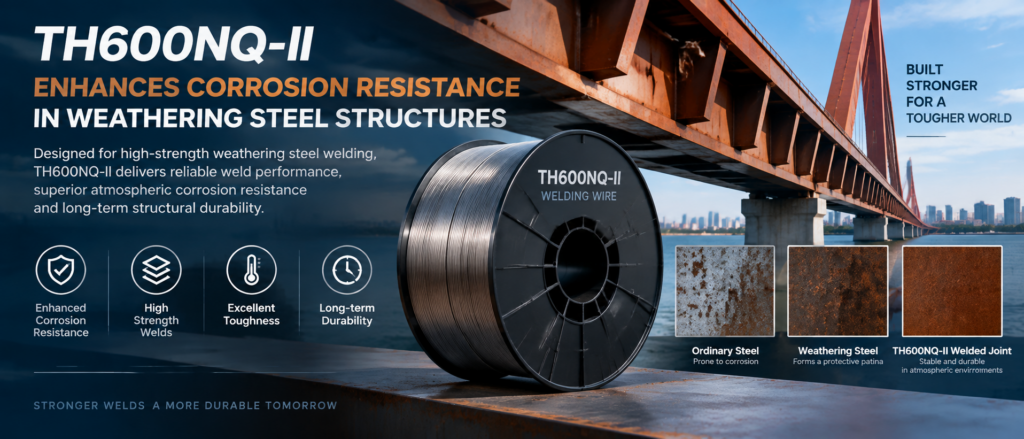
How TH600NQ-II Enhances Corrosion Resistance in Weathering Steel Structures
Introduction: The Challenge of Long-Term Protection in Weathering Steel Structures
Weathering steel is widely recognized for its ability to develop a protective surface layer that improves resistance against atmospheric corrosion. This unique characteristic allows structures exposed to outdoor environments to achieve longer service life with reduced maintenance requirements.TH600NQ-II
However, the corrosion resistance of a weathering steel structure depends not only on the base material. The welded joints are equally important because they represent areas where the original steel properties must be maintained through carefully designed welding materials.
TH600NQ-II is developed for high-strength weathering steel welding applications, focusing on achieving reliable weld performance, atmospheric corrosion resistance, and long-term structural durability. Through optimized alloy design and controlled weld metal properties, TH600NQ-II helps create welded structures capable of performing under demanding environmental conditions. (Akweld)
Why Corrosion Resistance Matters in Weathering Steel Welding
Weathering steel relies on alloying elements and controlled oxidation processes to form a stable protective patina. This surface layer helps slow further corrosion when exposed to moisture, oxygen, and changing weather conditions.
During welding, however, the weld metal introduces a new metallurgical region. If the welding consumable does not provide suitable corrosion resistance, the welded area may become a weak point in the overall structure.
Common challenges include:
Different corrosion behavior between base metal and weld metal
Reduced durability in harsh atmospheric environments
Increased maintenance requirements
Lower long-term structural reliability
Therefore, selecting a welding wire that matches the performance requirements of weathering steel is essential.
The Alloy Design Behind TH600NQ-II Corrosion Resistance
The corrosion resistance of TH600NQ-II comes from carefully balanced alloy composition and weld metal engineering.
Key alloy elements contribute different functions:
Copper (Cu): Supporting Atmospheric Corrosion Resistance
Copper plays an important role in improving the atmospheric corrosion behavior of weathering steel welding materials.
During exposure to outdoor environments, copper helps support the development of a more stable protective surface layer, reducing the progression of corrosion over time.
In welded structures, appropriate copper content contributes to maintaining better environmental resistance in the weld metal.
Chromium (Cr): Improving Environmental Durability
Chromium is commonly used in corrosion-resistant steel systems because it contributes to oxidation resistance and surface stability.
In TH600NQ-II weld metal, chromium helps improve resistance against atmospheric exposure and supports long-term durability.
This is especially valuable for structures operating under:
Rain exposure
Humidity changes
Industrial environments
Outdoor temperature variations
Nickel (Ni): Balancing Toughness and Corrosion Performance
Nickel contributes to both mechanical performance and environmental resistance.
For high-strength weathering steel applications, nickel helps maintain weld reliability by improving toughness and supporting stable performance under challenging service conditions.
This balance between strength, toughness, and corrosion resistance is essential for long-life structural applications.
Maintaining Corrosion Resistance at Welded Joints
A common concern in weathering steel fabrication is whether the welded area can achieve performance similar to the surrounding steel.
A properly designed welding wire should provide:
Compatible Weld Metal Performance
The weld metal needs sufficient alloy content to maintain corrosion-resistant characteristics.
Stable Metallurgical Structure
Controlled chemical composition helps produce consistent weld properties and reduces performance variation.
Reliable Crack Resistance
Good weld integrity prevents defects that could accelerate corrosion or reduce structural performance.
TH600NQ-II is designed with these requirements in mind, helping welded joints maintain strength and durability throughout their service life. (Akweld)
TH600NQ-II for High-Strength Weathering Steel Applications
Modern infrastructure projects increasingly require materials that combine:
High strength
Long service life
Reduced maintenance
Reliable performance in outdoor environments
TH600NQ-II supports these requirements by providing welding performance suitable for high-strength weathering steel structures.
Typical application areas include:
Bridge structures
Railway equipment
Heavy steel fabrication
Outdoor industrial structures
Infrastructure components
These applications require welding solutions that can withstand long-term exposure while maintaining structural reliability.
The Relationship Between Welding Quality and Corrosion Protection
Even with advanced welding materials, proper welding procedures remain critical.
Several factors influence the final corrosion resistance of welded structures:
TH600NQ-II Welding Heat Input
Excessive heat input may affect weld microstructure and mechanical performance.
TH600NQ-II Surface Preparation
Removing moisture, contamination, and surface impurities helps reduce welding defects.
TH600NQ-II Welding Parameters
Proper control of current, voltage, and travel speed improves weld consistency.
TH600NQ-II Post-Weld Quality Control
Inspection and process monitoring help ensure reliable welded joints.
A combination of suitable welding technology and optimized procedures allows TH600NQ-II to achieve better corrosion-resistant performance.
TH600NQ-II Future Trends in Weathering Steel Welding Technology
As industries move toward more sustainable and durable infrastructure, welding materials will continue evolving.
Future development trends include:
Higher-strength weld metals
Improved corrosion resistance
Better low-temperature performance
Enhanced compatibility with advanced steels
More efficient welding processes
TH600NQ-II represents this direction by combining alloy engineering with practical welding performance for demanding weathering steel applications.
TH600NQ-II Conclusion
Corrosion resistance is one of the most important factors determining the service life of weathering steel structures. While the base material provides the foundation, the welding material plays a critical role in maintaining overall structural performance.
TH600NQ-II enhances corrosion resistance in weathering steel structures through optimized alloy design, balanced weld metal properties, and reliable long-term durability.
By improving weld performance and supporting stronger structural integrity, TH600NQ-II helps create weathering steel structures that are built to withstand challenging environments for years to come.