

How TH650NQ-II Welding Wire Solves Challenges in High Strength Steel Welding
Introduction: The Growing Challenges of High Strength Steel Welding
High strength steel has become increasingly important in modern engineering applications where lightweight structures, higher load capacity, and improved durability are required. Industries such as heavy machinery, transportation equipment, structural fabrication, and industrial manufacturing continue to demand materials that can withstand higher mechanical stress while maintaining long-term reliability.TH650NQ-II
However, welding high strength steel presents several technical challenges. Compared with conventional steel welding, high strength steel requires careful control of weld metal strength, toughness, heat input, hydrogen control, and metallurgical compatibility.
An unsuitable welding wire may result in:
Reduced joint strength
Poor impact resistance
Increased risk of cracking
Unstable weld performance
Shortened service life of welded structures
To overcome these challenges, TH650NQ-II Welding Wire is designed as a high-performance welding solution that focuses on achieving a balance between strength, toughness, and weld reliability.
Understanding the Challenges of High Strength Steel Welding
1. Maintaining Matching Weld Strength
One of the primary difficulties in high strength steel welding is ensuring that the deposited weld metal can match the mechanical performance of the base material.
If the weld metal strength is significantly lower than the parent steel, the welded joint may become the weakest area of the structure.
TH650NQ-II Welding Wire addresses this challenge through optimized alloy design, allowing the weld deposit to achieve high strength while maintaining good structural stability.
A well-designed welding wire helps ensure:
Strong load-bearing capability
Improved joint durability
Reliable performance under dynamic stress
2. Balancing Strength and Toughness
Increasing strength alone is not enough for demanding industrial applications.
A weld metal with excessive hardness but insufficient toughness may become more sensitive to impact loading and cracking.
The performance of TH650NQ-II Welding Wire relies on controlling the relationship between:
Tensile strength
Yield strength
Impact toughness
Weld metal ductility
Through precise metallurgical control, the deposited weld structure can maintain both high strength and resistance against mechanical shock.
This balance is especially important for structures exposed to vibration, impact, and changing operating conditions.
3. Controlling Weld Cracking Risks
High strength steels usually have higher alloy content and greater hardenability compared with conventional steels. During welding, rapid cooling may create hard microstructures in the heat-affected zone or weld area, increasing the possibility of cracking.
The selection of appropriate welding wire plays an important role in reducing these risks.
TH650NQ-II Welding Wire helps improve welding reliability through:
Controlled chemical composition
Stable weld metal formation
Reduced sensitivity to welding defects
Improved metallurgical compatibility
Proper welding parameters combined with suitable consumables can significantly improve joint quality.
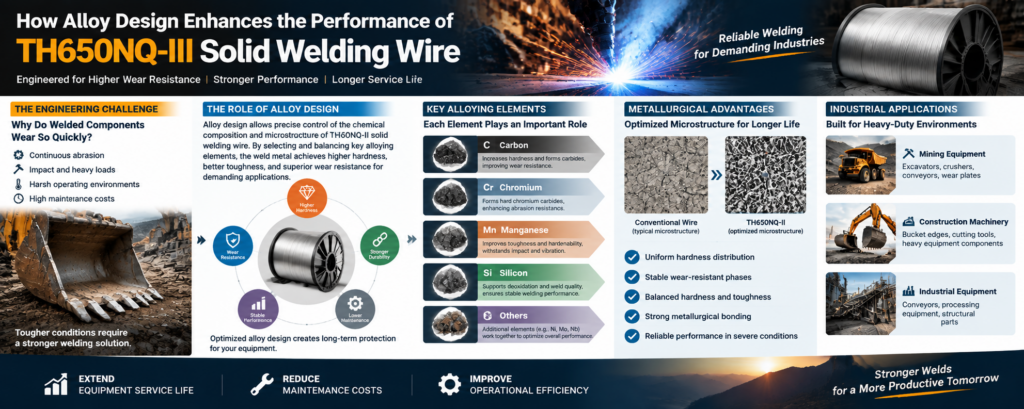
How Alloy Design Improves TH650NQ-II Welding Wire Performance
Optimized Chemical Composition
The performance of high strength welding wire depends heavily on alloy composition.
Elements such as carbon, manganese, silicon, chromium, nickel, and molybdenum can influence:
Weld metal strength
Hardness development
Toughness behavior
Microstructure formation
In TH650NQ-II Welding Wire, alloy elements are carefully controlled to create a weld structure capable of supporting high mechanical loads while maintaining reliability.
Microstructure Control During Solidification
During welding, molten metal rapidly cools and transforms into different microstructures.
The final weld performance depends on:
Grain size
Phase distribution
Alloy element distribution
Cooling behavior
A controlled microstructure helps create a stronger and more stable weld deposit.
For high strength steel applications, microstructure optimization is essential because it directly influences:
Crack resistance
Fatigue performance
Impact toughness
Long-term durability
Improving Welding Efficiency and Weld Quality
Beyond mechanical properties, industrial users also require welding materials that provide stable processing performance.
TH650NQ-II Welding Wire supports improved welding efficiency through:
Stable Arc Performance
A stable welding arc helps achieve:
Consistent weld appearance
Reduced spatter
Better operator control
Higher production efficiency
High Quality Weld Formation
A reliable welding wire contributes to:
Smooth weld beads
Reduced welding defects
Improved surface quality
Consistent mechanical properties
For large-scale industrial fabrication, stable weld quality can reduce rework and improve manufacturing efficiency.
Applications of TH650NQ-II Welding Wire in High Strength Steel Structures
TH650NQ-II Welding Wire is suitable for applications where high strength and reliable welded joints are required.
Typical applications include:
Heavy Equipment Manufacturing
Heavy machinery requires welded structures capable of handling:
High mechanical loads
Continuous operation
Impact forces
High strength welding wire helps improve structural reliability.
Transportation and Structural Components
Modern transportation structures require materials that combine:
Lightweight design
High strength
Long service life
Reliable welding solutions are essential for maintaining structural safety and durability.
Industrial Fabrication Projects
Large welded structures often experience complex stresses during operation.
Using suitable high strength welding wire helps manufacturers achieve:
Better joint performance
Improved production consistency
Reduced maintenance requirements
Why Choose TH650NQ-II Welding Wire for High Strength Steel Welding?
Selecting the correct welding wire is critical for achieving reliable high strength steel joints.
TH650NQ-II Welding Wire provides advantages including:
TH650NQ-II High Strength Weld Metal
Designed to support demanding structural applications requiring strong welded connections.
TH650NQ-II Balanced Mechanical Properties
Combines strength and toughness to improve resistance under complex loading conditions.
TH650NQ-II Reliable Weld Quality
Supports stable welding performance and consistent weld formation.
TH650NQ-II Improved Structural Durability
Helps extend the service life of welded components operating in demanding environments.
TH650NQ-II Conclusion: A Reliable Solution for High Strength Steel Welding Challenges
High strength steel welding requires more than simply achieving strong welds. The welding material must provide a combination of strength, toughness, crack resistance, and processing reliability.
TH650NQ-II Welding Wire addresses these challenges through advanced alloy design, controlled microstructure development, and stable welding performance.
For engineers and manufacturers working with high strength steel structures, selecting an optimized welding wire is a key step toward achieving durable, reliable, and high-performance welded joints.