

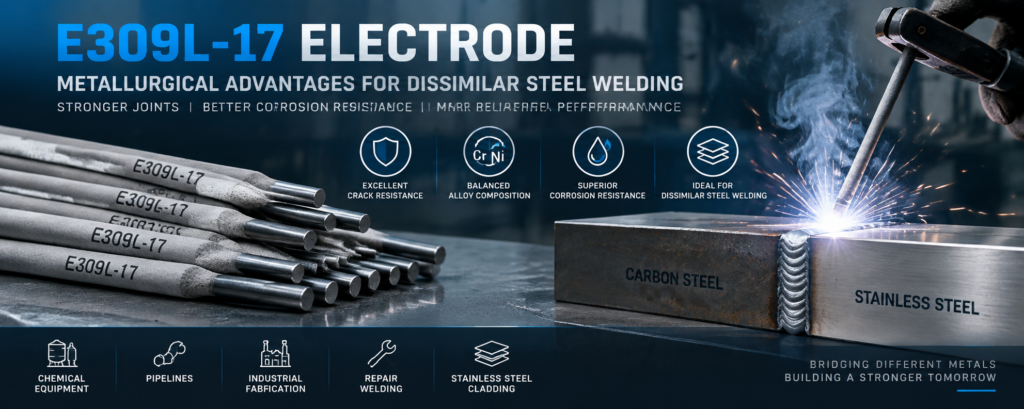
E309L-17 Electrode: Metallurgical Advantages for Dissimilar Steel Welding
Introduction
Dissimilar steel welding presents significant metallurgical challenges because different base metals often have differences in chemical composition, thermal expansion behavior, microstructure, and corrosion resistance. When stainless steel is joined with carbon steel or low-alloy steel, selecting the correct welding electrode is essential to achieve a stable weld structure and prevent cracking during service.E309L-17
The E309L-17 electrode is specifically designed for these challenging welding conditions. With its balanced chromium-nickel composition, low carbon content, and controlled ferrite formation, it provides excellent metallurgical compatibility for stainless steel-to-carbon steel and other dissimilar metal joints.
Understanding the metallurgical advantages of E309L-17 helps engineers select the appropriate welding consumable for applications requiring corrosion resistance, mechanical stability, and long-term joint reliability.
1. Why Dissimilar Steel Welding Requires Special Electrodes
Joining different steel grades is more complex than conventional welding because the weld metal must bridge two different metallurgical systems.
Common challenges include:
Different alloy compositions between base metals
Uneven carbon diffusion during welding
Formation of brittle phases near the fusion zone
Increased risk of hot cracking
Reduced corrosion resistance after welding
Differences in thermal expansion and contraction
For example, when stainless steel is welded directly to carbon steel, excessive dilution from the carbon steel side can reduce the stability of the weld structure. A suitable filler metal must maintain enough alloy content to preserve an austenitic weld matrix while controlling ferrite formation.
E309L-17 electrodes solve this challenge by providing a high-alloy weld deposit that creates a transition layer between dissimilar materials.
2. Balanced Chromium-Nickel Composition for Metallurgical Compatibility
The primary metallurgical advantage of E309L-17 comes from its chromium and nickel alloy system.
Typical E309L-17 weld metal contains approximately:
Chromium (Cr): 22–25%
Nickel (Ni): 12–14%
Carbon (C): ≤0.04%
This Cr-Ni balance promotes the formation of an austenitic stainless weld structure with controlled ferrite content.
Chromium contributes to:
Improved oxidation resistance
Enhanced corrosion resistance
Better high-temperature stability
Nickel contributes to:
Austenite stabilization
Improved toughness
Better resistance against cracking caused by metallurgical stress
During dissimilar welding, this composition provides a buffer between stainless steel and carbon steel, reducing the risk of unstable microstructures in the weld area.
3. Controlled Ferrite Content Improves Crack Resistance
One of the most important metallurgical benefits of E309L-17 is its ability to maintain controlled delta ferrite in the weld metal.
A small amount of ferrite within an austenitic weld structure helps:
Reduce hot cracking sensitivity
Improve weld solidification behavior
Increase resistance to weld metal cracking
During solidification, fully austenitic stainless weld metal can be vulnerable to hot cracking because impurities such as sulfur and phosphorus may concentrate along grain boundaries.
The controlled ferrite phase in E309L-17 interrupts continuous austenitic grain boundaries and improves weld reliability, especially when welding restrained joints or materials with different thermal expansion characteristics.
4. Low Carbon Design Enhances Corrosion Resistance
The “L” designation in E309L-17 represents a low-carbon composition.
Lower carbon content helps reduce chromium carbide precipitation during welding.
Without proper carbon control, chromium can combine with carbon at grain boundaries, creating chromium-depleted regions that are more vulnerable to intergranular corrosion.
The low-carbon design of E309L-17 provides:
Improved resistance to intergranular corrosion
Better performance in corrosive environments
More reliable stainless steel weld protection
This characteristic makes E309L-17 suitable for applications where corrosion performance is a critical requirement.
5. E309L-17 as a Metallurgical Buffer Layer
A major application of E309L-17 is creating a transition layer between stainless steel and carbon or low-alloy steel.
The buffer layer works by:
Increasing alloy content near the carbon steel side
Preventing excessive dilution effects
Maintaining stainless steel characteristics in the weld zone
Reducing cracking risks caused by incompatible structures
This makes E309L-17 widely used for:
Stainless steel to carbon steel joints
Stainless steel cladding applications
Repair welding of mixed-metal components
Industrial equipment requiring corrosion-resistant surfaces
The electrode provides a gradual metallurgical transition rather than an abrupt change between two different steel structures.
6. Improved Weld Stability and Operating Performance
Beyond chemical composition, E309L-17 electrodes provide practical welding advantages through their coating design and arc characteristics.
Key benefits include:
Stable Arc Performance
A stable arc helps maintain consistent penetration and reduces welding defects caused by unstable heat input.
Smooth Weld Bead Formation
The electrode produces smooth weld profiles, reducing the need for excessive post-weld grinding and improving surface quality.
Good Slag Release
Easy slag removal improves productivity and reduces the possibility of slag inclusions.
Flexible Welding Conditions
E309L-17 electrodes are commonly suitable for AC and DC welding conditions, providing flexibility for different fabrication environments.
7. Typical Applications of E309L-17 Electrodes
Due to their metallurgical advantages, E309L-17 electrodes are commonly selected for:
Stainless Steel and Carbon Steel Welding
Used when joining corrosion-resistant stainless steel components with carbon steel structures.
Stainless Steel Cladding
Applied as a transition layer before additional stainless steel layers are deposited.
Chemical and Process Equipment
Suitable for equipment exposed to corrosive environments where weld integrity is important.
Heat-Resistant Components
Used in applications requiring resistance to oxidation and elevated-temperature conditions.
Industrial Fabrication
Commonly applied in tanks, pipelines, structural components, and repair welding operations.
8. Key Welding Considerations When Using E309L-17
To achieve optimal metallurgical performance, welding procedures should consider:
E309L-17 Control Heat Input
Excessive heat input may increase dilution and affect the final weld microstructure.
E309L-17 Proper Electrode Storage
Moisture absorption can influence weld quality and increase defect risks.
E309L-17 Maintain Suitable Interpass Temperature
Temperature control helps preserve corrosion resistance and mechanical properties.
E309L-17 Clean Base Metal Surface
Removing oil, oxide, and contaminants improves weld quality and reduces impurity-related cracking.
E309L-17 Conclusion
E309L-17 electrodes provide a reliable metallurgical solution for dissimilar steel welding by combining a balanced chromium-nickel composition, controlled ferrite formation, and low-carbon design.
Their ability to create a stable transition zone between stainless steel and carbon steel makes them especially valuable for applications where cracking resistance, corrosion protection, and long-term weld performance are required.
For engineers and welding professionals, understanding the metallurgical advantages of E309L-17 is essential for selecting the correct electrode and achieving high-quality dissimilar metal joints.