

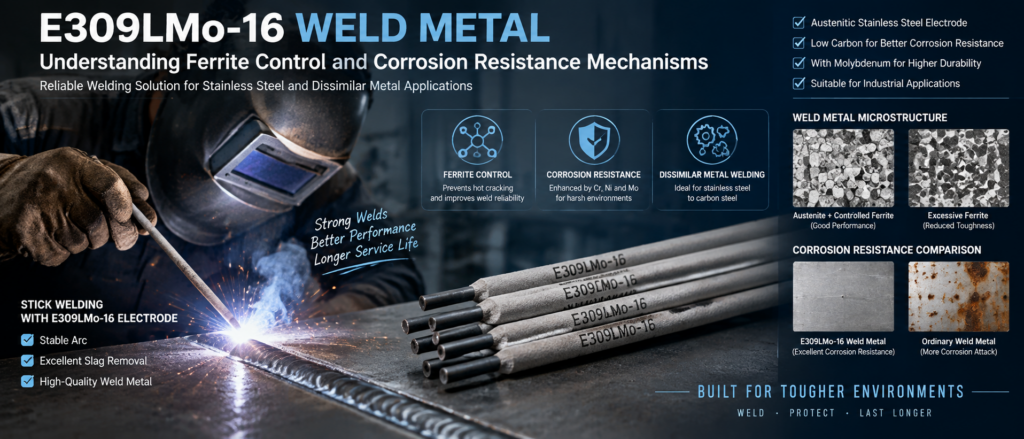
E309LMo-16 Weld Metal: Understanding Ferrite Control and Corrosion Resistance Mechanisms
Introduction
E309LMo-16 is a low-carbon austenitic stainless steel welding electrode designed for demanding welding applications where corrosion resistance, weld stability, and metallurgical reliability are critical. With a balanced alloy composition containing chromium, nickel, and molybdenum, E309LMo-16 provides excellent performance when joining stainless steels to carbon steels, low-alloy steels, or other dissimilar metal combinations.
The performance of E309LMo-16 weld metal is strongly influenced by two key metallurgical factors: ferrite control and corrosion resistance mechanisms. Understanding these characteristics helps engineers select appropriate welding materials and optimize weld quality in industrial environments.
1. Chemical Composition and Metallurgical Characteristics of E309LMo-16 Weld Metal
The weld metal produced by E309LMo-16 electrodes typically consists of an austenitic matrix with a controlled amount of delta ferrite. Its alloy design includes elevated chromium and nickel contents, along with molybdenum additions that enhance resistance against localized corrosion.
The major alloying elements contribute differently:
Chromium (Cr): Enhancing Passivation Ability
Chromium is responsible for forming a stable chromium oxide layer on the weld surface. This passive film protects the weld metal from oxidation and chemical attack, improving long-term corrosion resistance.
Higher chromium content also increases the ferritic tendency of the weld metal, requiring careful balance with austenite-forming elements.
Nickel (Ni): Stabilizing Austenitic Structure
Nickel promotes the formation of an austenitic microstructure and improves weld toughness and ductility. Proper nickel balance helps maintain weld metal stability during cooling and reduces the risk of cracking.
Molybdenum (Mo): Improving Localized Corrosion Resistance
The addition of molybdenum is one of the key advantages of E309LMo-16. Mo improves resistance to pitting and crevice corrosion, especially in chloride-containing environments.
This makes E309LMo-16 suitable for applications requiring enhanced corrosion performance.
2. The Role of Ferrite Control in E309LMo-16 Weld Metal
Ferrite control is a critical factor in stainless steel welding because the ferrite phase directly affects weld reliability.
During solidification, stainless steel weld metal may develop different phase structures depending on alloy composition and cooling conditions. A controlled amount of delta ferrite provides several benefits.
2.1 Preventing Hot Cracking During Welding
A fully austenitic weld structure has a higher tendency toward hot cracking because impurities such as sulfur and phosphorus can accumulate at grain boundaries during solidification.
The presence of controlled ferrite helps dissolve these harmful elements and improves resistance to solidification cracking.
For E309LMo-16 weld metal, maintaining an appropriate ferrite level improves welding reliability, especially during multi-pass welding or high heat input conditions.
2.2 Maintaining Mechanical Stability
Controlled ferrite contributes to improved weld strength and thermal stability. However, excessive ferrite can reduce toughness and corrosion performance in certain service environments.
Therefore, the goal is not to maximize ferrite content but to achieve an optimized balance between austenite and ferrite phases.
3. Ferrite Formation Mechanism in E309LMo-16 Weld Metal
The final ferrite content in E309LMo-16 weld metal depends on the balance between ferrite-forming and austenite-forming elements.
Ferrite-forming elements include:
Chromium
Molybdenum
Silicon
Niobium
Austenite-forming elements include:
Nickel
Carbon
Manganese
Nitrogen
The interaction between these elements determines the solidification mode and final microstructure.
A properly designed E309LMo-16 weld deposit solidifies with a controlled ferritic-austenitic structure, providing a combination of crack resistance, toughness, and corrosion protection.
4. Corrosion Resistance Mechanisms of E309LMo-16 Weld Metal
4.1 Formation of Protective Passive Film
The corrosion resistance of E309LMo-16 mainly comes from its chromium-rich passive layer.
When exposed to oxygen-containing environments, chromium reacts with oxygen to form a thin protective oxide film. This passive layer significantly reduces further corrosion reactions.
If the passive film is damaged, chromium enables rapid regeneration, maintaining surface protection.
4.2 Improved Resistance to Pitting and Crevice Corrosion
Chloride ions can destroy passive films and initiate localized corrosion. Molybdenum in E309LMo-16 improves resistance by strengthening the passive layer and reducing corrosion propagation.
This mechanism is particularly valuable in applications exposed to:
Marine environments
Chemical processing conditions
High-moisture industrial areas
Chloride-containing solutions
4.3 Low Carbon Content and Reduced Sensitization Risk
E309LMo-16 contains controlled carbon levels, which helps reduce chromium carbide precipitation during welding.
Excessive carbide formation can create chromium-depleted regions near grain boundaries, increasing susceptibility to intergranular corrosion.
The low-carbon design improves weld corrosion resistance after thermal exposure.
5. Applications of E309LMo-16 Weld Metal
Due to its balanced metallurgical properties, E309LMo-16 is widely used in applications requiring reliable dissimilar metal welding and corrosion resistance.
Typical applications include:
Joining stainless steel to carbon steel
Stainless steel overlay welding
Repair welding of corrosion-resistant components
Chemical processing equipment
Pressure vessel fabrication
Heat-resistant structural components
Industrial maintenance welding
Its ability to accommodate differences in thermal expansion and chemical composition makes it valuable for complex welding conditions.
6. Welding Considerations for Optimizing E309LMo-16 Performance
To achieve the best weld quality, several welding parameters should be carefully controlled:
Heat Input Control
Excessive heat input can influence ferrite formation, grain growth, and corrosion performance. Proper heat management helps maintain the desired weld microstructure.
E309LMo-16 Interpass Temperature Management
Maintaining suitable interpass temperatures reduces unfavorable phase transformations and supports consistent mechanical properties.
E309LMo-16 Surface Preparation
Removing contaminants such as oil, moisture, and oxides before welding helps prevent weld defects and improves corrosion resistance.
E309LMo-16 Welding Technique
Proper electrode handling, arc control, and deposition methods contribute to stable weld formation and uniform metallurgical properties.
E309LMo-16 Conclusion
E309LMo-16 weld metal achieves high welding reliability through carefully controlled ferrite content and enhanced corrosion resistance mechanisms. The combination of chromium, nickel, and molybdenum provides a balanced microstructure that supports crack resistance, mechanical stability, and protection against localized corrosion.
By understanding the relationship between alloy composition, ferrite control, and corrosion behavior, engineers can better optimize E309LMo-16 welding performance for stainless steel fabrication and dissimilar metal joining applications.