

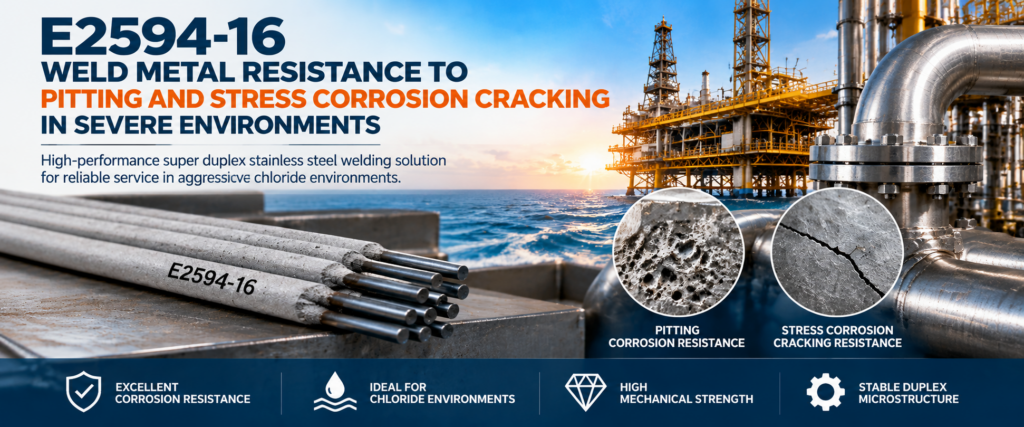
E2594-16 Weld Metal Resistance to Pitting and Stress Corrosion Cracking in Severe Environments
Introduction
In harsh industrial environments, welded components are often exposed to aggressive media containing chlorides, seawater, chemicals, and high temperatures. Under these conditions, conventional stainless steel weld metals may suffer from localized corrosion, including pitting corrosion and stress corrosion cracking (SCC).E2594-16
E2594-16 is a super duplex stainless steel electrode designed for high-performance welding applications where excellent corrosion resistance and mechanical reliability are required. Its advanced duplex weld metal structure, combining balanced austenitic and ferritic phases, provides outstanding resistance against localized corrosion and cracking in severe service environments.
Understanding the relationship between E2594-16 weld metal composition, microstructure, and corrosion performance is essential for selecting suitable welding materials for offshore, chemical processing, marine, and pressure equipment applications.
1. Why Pitting Corrosion Resistance Matters in Super Duplex Welds
Pitting corrosion is a localized corrosion phenomenon where small cavities form on the metal surface due to the breakdown of the passive oxide film. These pits can rapidly grow under chloride-containing conditions and may eventually lead to component failure.
For welded structures, the weld metal is often a critical area because thermal cycles during welding can change phase balance, chemical distribution, and corrosion behavior.
E2594-16 weld metal achieves high pitting resistance through several metallurgical advantages:
- High chromium content for stable passive film formation
- Molybdenum enhancement for chloride corrosion resistance
- Nitrogen addition for improved austenite stability and corrosion resistance
- Controlled duplex microstructure for optimized performance
These factors contribute to improved resistance against chloride-induced pitting corrosion, especially in seawater and chemical processing environments.
2. Role of Duplex Microstructure in Corrosion Performance
The corrosion resistance of E2594-16 weld metal is strongly influenced by the balance between ferrite and austenite phases.
A properly controlled duplex structure provides:
Ferrite Phase Benefits
- Higher resistance to chloride stress corrosion cracking
- Improved resistance to localized corrosion initiation
- Enhanced strength and structural stability
Austenite Phase Benefits
- Improved toughness
- Better ductility
- Increased resistance to hydrogen-related damage
An improper phase balance may reduce corrosion performance. Excessive ferrite can decrease toughness, while excessive austenite may reduce resistance to certain corrosive environments.
Therefore, controlling welding parameters, cooling rate, and heat input is critical for maintaining the ideal E2594-16 weld metal structure.
3. E2594-16 Resistance to Stress Corrosion Cracking
Stress corrosion cracking occurs when three factors combine:
- A susceptible material structure
- A corrosive environment
- Tensile stress
Chloride-containing environments are particularly challenging because they can accelerate crack initiation and propagation.
E2594-16 weld metal provides enhanced SCC resistance through:
High Alloying Stability
Chromium, molybdenum, and nitrogen improve the stability of the passive layer and reduce corrosion initiation sites.
Balanced Phase Distribution
The duplex structure helps prevent preferential crack paths by combining the advantages of ferritic and austenitic phases.
High Mechanical Strength
The duplex weld structure provides excellent resistance against deformation under mechanical loading, reducing the risk of stress-assisted corrosion damage.
These characteristics make E2594-16 suitable for applications where long-term corrosion reliability is required.
4. Influence of Welding Parameters on E2594-16 Corrosion Resistance
Although E2594-16 provides excellent corrosion performance, welding conditions significantly affect the final weld quality.
Heat Input Control
Excessive heat input may cause:
- Unbalanced ferrite and austenite distribution
- Intermetallic phase precipitation
- Reduced corrosion resistance
Low heat input may result in insufficient austenite formation and reduced toughness.
Optimized heat input allows the weld metal to achieve stable phase balance and improved corrosion resistance.
Cooling Rate
Cooling conditions directly influence phase transformation during solidification.
A suitable cooling rate helps:
- Promote austenite formation
- Avoid harmful secondary phases
- Maintain corrosion-resistant microstructure
Careful welding procedure control is therefore essential for maximizing E2594-16 performance.
5. Applications Requiring E2594-16 Corrosion Resistance
Due to its excellent resistance to pitting and stress corrosion cracking, E2594-16 weld metal is widely considered for demanding applications such as:
E2594-16 Offshore Equipment
Components exposed to seawater require strong resistance against chloride corrosion and mechanical stress.
E2594-16 Chemical Processing Systems
Equipment handling aggressive chemicals requires stable corrosion-resistant weld joints.
Pressure Vessels and Piping
Long service life and reliability are essential for welded pressure-containing components.
Marine Engineering
Super duplex welding materials provide enhanced durability in marine environments.
6. Advantages of Choosing E2594-16 Weld Metal
The main performance advantages include:
- Excellent pitting corrosion resistance
- Strong resistance to chloride stress corrosion cracking
- High mechanical strength
- Stable duplex microstructure
- Superior performance in aggressive environments
- Long-term weld reliability
Compared with conventional stainless steel welding materials, E2594-16 offers improved protection where corrosion resistance is the primary design requirement.
E2594-16 Conclusion
E2594-16 weld metal provides outstanding resistance to pitting corrosion and stress corrosion cracking through its optimized alloy composition and controlled duplex microstructure. The combination of chromium, molybdenum, nitrogen, ferrite-austenite balance, and proper welding control enables reliable performance in severe environments.
For applications involving seawater, chlorides, chemicals, and high mechanical stress, understanding the metallurgical behavior of E2594-16 is essential for achieving durable and corrosion-resistant welded structures.
By selecting appropriate welding procedures and maintaining proper heat input control, E2594-16 can deliver long-lasting performance in some of the most demanding industrial environments.